👩🏽🏭
The Emoji
Woman Factory Worker: Medium Skin Tone
U+1F469 U+1F3FD U+200D U+1F3ED · :woman_factory_worker_medium_skin_tone:
Trend 22
Meaning layers
- interpretation
- Used to represent hustle culture, grinding mentality, or working a tough job. Sometimes used ironically to describe doing repetitive or mind-numbing tasks.
- tiktok usage
- Appears in 'day in my life' content, work grind videos, or sarcastically when describing a boring or exhausting job situation.
- irony level
- 6 / 10
Platform meanings
- meaning
- Represents grinding, hard work, or blue-collar identity. Used in work-life content or ironically in burnout and hustle culture commentary.
- trend usage
- Featured in #WorkingClass, #HustleLife, and factory worker POV trends; also appears in anti-hustle culture critique videos.
- hashtags
- #WorkingClass#FactoryLife#Grind#BluCollarPride#HardWorker
- virality score
- 28 / 100
Cultural meanings
🇺🇸
Western / Gen-Z
Primarily used ironically to describe overwork or repetitive tasks; also embraced by working-class Gen Z proud of blue-collar roots as part of labor pride culture.
🇵🇰
Pakistan & India
Represents women working in textile factories or manufacturing plants, often carrying connotations of hard labor and economic necessity; also used in labor rights discussions.
🌍
Middle East
Less commonly used due to lower representation of women in factory roles in some countries, but appears in discussions about female workforce participation and industrial sectors.
🌐
Global Neutral
Universally understood as representing a female industrial worker; used across cultures to celebrate blue-collar labor and women in manufacturing.
🇧🇩
Bangladesh
Highly relevant given the country's large garment factory workforce; represents the millions of women working in the RMG (Ready-Made Garment) sector and their economic contribution.
🇱🇰
Sri Lanka
Used in the context of the country's significant export manufacturing sector; represents women workers in apparel and industrial zones.
🇨🇳
China
Strongly associated with the manufacturing sector; represents the millions of women working in China's vast industrial complex, often used with pride or in labor discourse.
🇯🇵
Japan
Used to represent women in manufacturing and industrial roles; in Japan, it may also signal the ongoing discussion about women breaking into traditionally male-dominated factory environments.
🇰🇷
South Korea
Appears in discussions about women in Korea's manufacturing and industrial sectors; also used in labor union contexts and working-class cultural content.
🇹🇼
Taiwan
Represents women in Taiwan's significant electronics and manufacturing industry; used in professional and labor rights contexts.
🇭🇰
Hong Kong
Less common due to the service-oriented economy, but used when referencing manufacturing history or in discussions about factory workers in the broader region.
🇵🇭
Philippines
Used to represent overseas Filipino workers (OFWs) in factory settings or women in local manufacturing; carries themes of sacrifice and hard work for family.
🇮🇩
Indonesia
Represents women in Indonesia's large textile and manufacturing sectors; associated with economic empowerment and labor struggles.
🇹🇭
Thailand
Associated with women in Thailand's export manufacturing sector, particularly electronics and garments; used in labor rights discussions.
🇻🇳
Vietnam
Highly relevant in Vietnam's fast-growing manufacturing sector; represents the many women working in electronics, textile, and export factories.
🇲🇾
Malaysia
Used to represent women in Malaysia's electronics and manufacturing industries; appears in content about industrial workforce and labor conditions.
🇸🇦
Saudi Arabia
Used in the context of Saudi Vision 2030 workforce diversification, representing growing female participation in non-traditional sectors including manufacturing.
🇦🇪
UAE
Appears in discussions about labor rights and women in industrial sectors in the UAE; also used in content about the diverse, multinational factory workforce.
🇪🇬
Egypt
Represents women in Egypt's textile and manufacturing industries; used in labor rights and economic empowerment discussions.
🇹🇷
Turkey
Associated with women in Turkey's large textile and manufacturing sectors; used in contexts celebrating working women and labor rights.
🇮🇷
Iran
Used to represent women in Iran's industrial workforce; may carry nuanced connotations given the socio-political context of women's roles in the economy.
🇳🇬
Nigeria
Represents women in Nigeria's growing manufacturing and industrial sectors; used in content about economic development and women's workforce participation.
🇿🇦
South Africa
Used in discussions about women in South Africa's mining, manufacturing, and industrial sectors; associated with labor rights and economic empowerment.
🇬🇧
UK & Ireland
Carries nostalgic connotations of Britain's industrial heritage and current manufacturing sector; used in working-class pride content and labor union discussions.
🇫🇷
France
Associated with France's industrial workforce and labor tradition; appears in content about worker's rights (droits des travailleurs) and blue-collar identity.
🇩🇪
Germany
Highly relevant given Germany's strong manufacturing sector (Mittelstand); represents women in the industry and is used with professional respect in labor and trade contexts.
🇪🇸
Spain & Italy
Used in the context of European manufacturing traditions; in Italy particularly associated with the country's fashion and industrial manufacturing workforce.
🇧🇷
Brazil
Represents women in Brazil's large industrial workforce; used in labor rights discussions and content celebrating working-class women (mulheres trabalhadoras).
🇲🇽
Mexico
Associated with maquiladora workers and women in manufacturing zones along the US-Mexico border; used in labor rights and economic discussions.
🌎
Latin America
Broadly represents working women in manufacturing across Latin America; used in content about female workforce participation and labor conditions.
🇦🇺
Australia & NZ
Used in discussions about women in Australia's mining, manufacturing, and industrial sectors; appears in blue-collar pride content and workforce diversity conversations.
How its meaning shifted
- 2010
The emoji did not yet exist; female worker representation in emoji was extremely limited, with gender-neutral worker figures being the only options.
- 2015
Still pre-introduction of this specific emoji; general worker emojis were used without gender or skin tone variation, limiting representation.
- 2020
Gaining usage as Unicode's expansion of occupation emojis with gender and skin tone diversity took hold; used in conversations about essential workers during the COVID-19 pandemic.
- 2026
Established part of the working-class and labor identity emoji vocabulary; used across labor rights movements, blue-collar pride content, and ironic overwork commentary in digital culture.
See it on every platform
Compare with
Adjacent emojis
- Often confused with
- woman cookwoman technologistwoman firefighter
- Can replace
- woman construction workerwoman mechanicgear
Share & embed
Frequently asked
01What does the 👩🏽🏭 Woman Factory Worker: Medium Skin Tone emoji mean?
A woman factory worker with medium skin tone, depicted wearing a hard hat and working in an industrial or manufacturing setting.
02What does 👩🏽🏭 mean on TikTok?
Represents grinding, hard work, or blue-collar identity. Used in work-life content or ironically in burnout and hustle culture commentary.
03What does 👩🏽🏭 mean on WhatsApp?
Signals someone is busy working or doing repetitive labor tasks; casually used to say 'I'm on the grind.'
04What does 👩🏽🏭 mean in Gen-Z slang?
Used to represent hustle culture, grinding mentality, or working a tough job. Sometimes used ironically to describe doing repetitive or mind-numbing tasks.
05Is the 👩🏽🏭 emoji safe to use?
Represents a woman working in a factory or industrial setting; used to celebrate blue-collar labor, workforce diversity, and working-class identity.
06What does 👩🏽🏭 mean in texting?
Evokes feelings of industriousness and resilience, often tied to working-class identity and pride. Can also signal exhaustion or the emotional weight of underappreciated labor.
07What is the shortcode for 👩🏽🏭?
The shortcode for Woman Factory Worker: Medium Skin Tone is :woman_factory_worker_medium_skin_tone:
08What does 👩🏽🏭 mean in dating?
Rarely used in flirting contexts; might appear when someone is showing off their hardworking nature or teasing a partner about working too much.
Safety & usage
- Safe meaning
- Represents a woman working in a factory or industrial setting; used to celebrate blue-collar labor, workforce diversity, and working-class identity.
- Caution
- In rare cases could be used condescendingly to demean someone's profession or imply someone only deserves low-wage labor; occasionally used in classist contexts.
Generally safe; however, context matters as it can be used in discussions about labor exploitation, unsafe working conditions, or sweatshop labor, which may be distressing to some.
How it looks across platforms
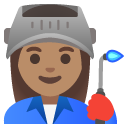


Appearance varies by platform and device. Google Noto, Twemoji, and OpenMoji are open-source.