🧚🏼♀️
The Emoji
Woman Fairy: Medium-light Skin Tone
U+1F9DA U+1F3FC U+200D U+2640 U+FE0F · :woman_fairy_mediumlight_skin_tone:
Trend 68
Meaning layers
- interpretation
- Used to express a carefree, ethereal, or 'main character' energy — often paired with manifestation culture, soft aesthetics, or ironic self-deprecation about being chaotic and whimsical.
- tiktok usage
- Appears in cottagecore, dark academia, and fairy-aesthetic content; also used sarcastically to say 'I did something unhinged and magical simultaneously.'
- irony level
- 5 / 10
Platform meanings
- meaning
- Represents whimsy, aesthetic living, manifestation, or chaotic girlhood energy; used heavily in soft girl, cottagecore, and fae aesthetic communities.
- trend usage
- Paired with trending sounds about magic, love, or nature; appears in 'POV you're a fairy' trends and 'main character era' content.
- hashtags
- #fairyaesthetic#cottagecore#maincharacter#fairycore#whimsical
- virality score
- 72 / 100
Cultural meanings
🇺🇸
Western / Gen-Z
Strongly associated with the fairycore and cottagecore aesthetic movements; used authentically and ironically by Gen Z girls to express whimsy, chaos, and magical self-identity.
🇵🇰
Pakistan & India
Used among younger, urban social media users to express admiration for something beautiful or to describe a girl as ethereal and delicate; less ironic than Western use.
🌍
Middle East
Used in aesthetic and beauty contexts, particularly by younger women on Instagram; associated with elegance and otherworldly beauty rather than mischief.
🌐
Global Neutral
Universally understood as representing magic, fantasy, and femininity; safe to use in most global contexts as a positive, whimsical signal.
🇧🇩
Bangladesh
Similar to South Asian use — connotes beauty and fantasy; used by younger users in aesthetic posts and to compliment someone's dreamy appearance.
🇱🇰
Sri Lanka
Used among younger social media users to express wonder or admiration; associated with fantasy films and fairy tale narratives from global media.
🇨🇳
China
Used on platforms like Weibo and Xiaohongshu (RED) in aesthetic posts; associated with 'fairy spirit' (仙气) aesthetics and the popular xianxia (fairy/immortal) cultural genre.
🇯🇵
Japan
Aligns with kawaii culture and the 'fairy kei' fashion subculture; used in cute, pastel aesthetic contexts and associated with magical girl (mahou shoujo) media.
🇰🇷
South Korea
Used in K-beauty and aesthetic content on Instagram and KakaoTalk; aligns with 'fairy-like visuals' often used to describe ethereally beautiful idols or soft aesthetics.
🇹🇼
Taiwan
Similar to broader East Asian use — connotes fantasy, softness, and beauty; used in aesthetic content and to describe someone with a gentle, magical presence.
🇭🇰
Hong Kong
Used in fashion and beauty contexts; the fairy aesthetic overlaps with local 'soft girl' trends and is common in Instagram and lifestyle content.
🇵🇭
Philippines
Popular among younger users on TikTok and Facebook for fairy-aesthetic content; also used to express admiration for someone who looks magical or enchantingly beautiful.
🇮🇩
Indonesia
Used in aesthetic and beauty content; associated with softness and fantasy, particularly in Islamic-adjacent aesthetic communities that frame it as pure and otherworldly.
🇹🇭
Thailand
Used in cute and aesthetic social media posts; aligns with Thai pop culture's love of fantasy and whimsy, often seen in gaming and cosplay communities.
🇻🇳
Vietnam
Appears in aesthetic content and beauty posts; associated with fantasy media and used to describe someone with an ethereal, delicate beauty.
🇲🇾
Malaysia
Used across beauty, lifestyle, and aesthetic content; the fairy concept resonates with local fantasy media and is seen as a positive, soft feminine symbol.
🇸🇦
Saudi Arabia
Used primarily in aesthetic and fashion contexts by younger women; the fairy image is seen as whimsical and beautiful rather than mythologically loaded.
🇦🇪
UAE
Common in beauty and luxury lifestyle content; used to convey elegance, dreaminess, and an aspirational ethereal aesthetic among young women.
🇪🇬
Egypt
Used in beauty and pop culture content; associated with fantasy and magic in a lighthearted sense, often appearing in celebrity admiration posts.
🇹🇷
Turkey
Used in aesthetic, fashion, and romantic contexts; the fairy ('peri') figure has roots in Turkish mythology, giving this emoji a culturally resonant layer.
🇮🇷
Iran
The fairy (peri) is a deeply rooted cultural figure in Persian mythology, making this emoji carry both mythological weight and modern aesthetic meaning simultaneously.
🇳🇬
Nigeria
Used among younger, urban users on Instagram and TikTok in aesthetic and beauty content; associated with fantasy, Afrofuturism-adjacent whimsy, and admiration for ethereal looks.
🇿🇦
South Africa
Used in aesthetic and youth culture content across platforms; signals dreamy or whimsical energy and is embraced by beauty and fashion communities.
🇬🇧
UK & Ireland
Used with British irony in meme culture ('just fairy things 🧚🏼♀️') alongside genuine use in cottagecore communities, which have strong UK cultural roots.
🇫🇷
France
Used in aesthetic and fashion contexts; French users tend toward understated irony with this emoji, sometimes using it to mock overly romantic behavior.
🇩🇪
Germany
Used in fantasy, cosplay, and aesthetic communities; Germans tend to use it more literally for fantasy-themed content rather than as a personality identity emoji.
🇪🇸
Spain & Italy
Used expressively in compliments and aesthetic posts; the fairy figure is associated with childhood magic and romance, making it a warm, positive signal.
🇧🇷
Brazil
Used enthusiastically in beauty, fashion, and affectionate messages; Brazilian users often pair it with other sparkle emojis to amplify compliments and express delight.
🇲🇽
Mexico
Used in aesthetic and romantic contexts; also appears in content about folklore and fantasy, occasionally bridging with local magical realism cultural sensibility.
🌎
Latin America
Broadly used across Latin America in beauty, aesthetic, and affectionate contexts; represents sweetness, magic, and ethereal femininity across the region.
🇦🇺
Australia & NZ
Used in cottagecore and fairycore aesthetic communities with both genuine enthusiasm and dry irony; Australians particularly enjoy using it in self-deprecating magical chaos contexts.
How its meaning shifted
- 2010
Did not exist as an emoji yet; fairy concepts were expressed with existing sparkle or star emojis, or in text art.
- 2015
Still pre-release; fantasy and magical aesthetics online were conveyed through ✨ and 🌟 combinations; the fairy emoji was anticipated by fantasy communities.
- 2020
Gained significant traction with the rise of cottagecore and fairycore aesthetics during pandemic-era escapism; became a staple of soft girl and whimsy aesthetics on TikTok and Instagram.
- 2026
Fully embedded in both genuine aesthetic identity (fairycore, cottagecore, ethereal) and ironic/sarcastic internet culture; used widely in manifestation content, chaotic girlhood memes, and soft fantasy branding.
See it on every platform
Adjacent emojis
- Can replace
- sparklesbutterflymagic wand
Share & embed
Frequently asked
01What does the 🧚🏼♀️ Woman Fairy: Medium-light Skin Tone emoji mean?
A fairy with feminine presentation and medium-light skin tone, depicted with wings, often holding a wand and wearing whimsical clothing.
02What does 🧚🏼♀️ mean on TikTok?
Represents whimsy, aesthetic living, manifestation, or chaotic girlhood energy; used heavily in soft girl, cottagecore, and fae aesthetic communities.
03What does 🧚🏼♀️ mean on WhatsApp?
Signals playfulness, excitement, or a dreamy mood; used by younger users to add a magical flair to messages.
04What does 🧚🏼♀️ mean in Gen-Z slang?
Used to express a carefree, ethereal, or 'main character' energy — often paired with manifestation culture, soft aesthetics, or ironic self-deprecation about being chaotic and whimsical.
05Is the 🧚🏼♀️ emoji safe to use?
Represents magic, whimsy, fantasy, and feminine ethereal beauty; broadly positive and safe across most contexts.
06What does 🧚🏼♀️ mean in texting?
Evokes childlike wonder and escapism; psychologically linked to a desire for enchantment or transcendence from mundane reality, often used by those who romanticize life.
07What is the shortcode for 🧚🏼♀️?
The shortcode for Woman Fairy: Medium-light Skin Tone is :woman_fairy_mediumlight_skin_tone:
08What does 🧚🏼♀️ mean in dating?
Used to signal a playful, flirty personality — 'I'm fun and a little mysterious.' Can be a soft flirt without being overly direct.
Safety & usage
- Safe meaning
- Represents magic, whimsy, fantasy, and feminine ethereal beauty; broadly positive and safe across most contexts.
- Caution
- Occasionally weaponized as sarcastic passive-aggression — used to infantilize or mock someone as delusional or naive ('must be nice to live in fairyland 🧚🏼♀️').
Skin tone modifier can occasionally be subject to colorism-related commentary online; otherwise very low risk. The passive-aggressive 'fairy comment' pattern can be used to subtly bully.
How it looks across platforms
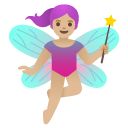
Appearance varies by platform and device. Google Noto, Twemoji, and OpenMoji are open-source.