🙍🏿♀️
The Emoji
Woman Frowning: Dark Skin Tone
U+1F64D U+1F3FF U+200D U+2640 U+FE0F · :woman_frowning_dark_skin_tone:
Trend 55
Meaning layers
- interpretation
- Used to express deep disappointment, being fed up, unbothered annoyance, or the 'I am not okay with this' energy. Often deployed when something is clearly wrong but the user is done explaining why.
- tiktok usage
- Appears in 'not me doing this again' content, reaction videos to cringe behavior, or as a mood signifier in comment sections expressing silent disapproval.
- irony level
- 6 / 10
Platform meanings
- meaning
- Represents a mood of fed-up frustration or quiet disapproval; often used in comment sections reacting to chaotic or disappointing content.
- trend usage
- Placed at the end of relatable struggle captions, duet reactions to bad takes, or in the 'POV: you've explained this 10 times' format.
- hashtags
- #FedUp#NotAgain#MoodCheck#DisappointedNotSurprised#JustStandingHere
- virality score
- 58 / 100
Cultural meanings
🇺🇸
Western / Gen-Z
Widely used by Gen Z as a shorthand for bottled-up frustration, especially in contexts discussing racial fatigue, emotional exhaustion, or the 'done explaining' sentiment.
🇵🇰
Pakistan & India
Used in urban youth social media to express general dissatisfaction or disappointment, though the skin tone modifier may be noted as a specific representation choice rather than a universal expression.
🌍
Middle East
Used to express upset or disapproval in private chats; the dark skin tone may not be specifically noted as identity-related but the expression itself is universally understood.
🌐
Global Neutral
Cross-culturally read as a frowning or upset woman; the emotional content is universally legible even where the skin tone modifier carries no specific significance.
🇧🇩
Bangladesh
Adopted primarily by younger social media users to signal frustration in casual digital conversations, often without awareness of the skin tone modifier's representational intent.
🇱🇰
Sri Lanka
Used in youth culture to represent a grumpy or upset mood, typically in WhatsApp and Instagram contexts, similar to general frowning face usage.
🇨🇳
China
Less commonly used given WeChat's own emoji ecosystem dominance; when used, it's interpreted straightforwardly as a woman expressing unhappiness.
🇯🇵
Japan
Used sparingly on platforms like Twitter/X; the combination of gender, expression, and skin tone may be read as a foreign or international expression rather than locally resonant.
🇰🇷
South Korea
Occasionally used on platforms like KakaoTalk or Instagram by younger users to express a pouty disappointment; the dark skin tone is noted but doesn't typically alter the emotional interpretation.
🇹🇼
Taiwan
Used in casual social media to express a mildly grumpy or upset mood; interpretation largely follows the literal meaning without additional cultural layering.
🇭🇰
Hong Kong
Used on Instagram and WhatsApp to convey frustration or discontent, often in commentary about social or political situations given the region's active expressive digital culture.
🇵🇭
Philippines
Commonly used in casual messaging to express disappointment or sulking, often with a humorous undertone; widely accepted across platforms.
🇮🇩
Indonesia
Popular on WhatsApp and Twitter among younger users to express being upset or fed up, often paired with venting text or self-deprecating humor.
🇹🇭
Thailand
Used on LINE and Twitter to express mild unhappiness or a pouty reaction; interpreted as a relatable expression of emotional discontent.
🇻🇳
Vietnam
Adopted by social media users to signal frustration or disappointment in posts; the expression is read straightforwardly without significant cultural overlay.
🇲🇾
Malaysia
Widely used on Twitter and Instagram to express being annoyed or unimpressed, often in commentary about daily life frustrations.
🇸🇦
Saudi Arabia
Used primarily in private messaging among women to express emotional states; the gendered representation aligns with spaces where women communicate personal feelings digitally.
🇦🇪
UAE
Used across diverse expat and local communities on Instagram and WhatsApp to express disappointment; the multicultural context means interpretations vary widely.
🇪🇬
Egypt
Used on Facebook and WhatsApp to express frustration or disapproval, especially in community discussions or personal venting posts.
🇹🇷
Turkey
Used on Twitter and Instagram to express being fed up or disappointed, particularly in political or social commentary threads among younger users.
🇮🇷
Iran
Used on Instagram (via VPN-accessible platforms) by younger generations to express emotional discontent or frustration with daily circumstances.
🇳🇬
Nigeria
Strongly resonant given the dark skin tone representation; used to express frustration, disappointment, or the 'not me dealing with this again' energy, especially by Nigerian women online.
🇿🇦
South Africa
Used across diverse communities to express frustration; the dark skin tone is seen as positive representation by many users who identify with it.
🇬🇧
UK & Ireland
Used with typical British understatement — often deployed for mild but real frustration, particularly in commentary on weather, politics, or football results.
🇫🇷
France
Used on social media to express a resigned or disappointed mood; French social media culture appreciates emotional nuance and this emoji fits the 'bof' (meh but frustrated) register.
🇩🇪
Germany
Used straightforwardly to communicate unhappiness or dissatisfaction; German digital culture tends toward literal emoji interpretation over layered irony.
🇪🇸
Spain & Italy
Used expressively in social media to dramatize disappointment or frustration, fitting the culturally expressive communication style of both regions.
🇧🇷
Brazil
Popular on Twitter and Instagram among younger users, especially in communities discussing race and representation; the dark skin tone is celebrated as inclusive and the expression resonates widely.
🇲🇽
Mexico
Used in casual digital conversations to signal being upset or annoyed, often with a dramatic or humorous flair consistent with Mexican meme culture.
🌎
Latin America
Broadly used across Latin America to express disappointment or frustration; increasingly appreciated for its representational diversity as conversations about Afro-Latinx identity grow.
🇦🇺
Australia & NZ
Used casually to express being unimpressed or mildly upset; fits the dry, underplayed frustration style common in Australian digital communication.
How its meaning shifted
- 2010
This specific emoji did not exist yet — gendered and skin tone emoji modifiers were introduced later, and expression emojis were limited to basic yellow faces.
- 2015
Skin tone modifiers were newly introduced (Unicode 8.0); early adopters began using this emoji to celebrate diverse representation, though usage was limited and exploratory.
- 2020
Usage expanded significantly alongside broader conversations about racial representation in tech and media; became part of the toolkit for expressing Black women's emotional experiences online.
- 2026
Firmly established in digital vocabulary as a nuanced expression of frustration, emotional exhaustion, and quiet disapproval; used widely across platforms with both literal and ironic registers.
See it on every platform
Compare with
Adjacent emojis
Share & embed
Frequently asked
01What does the 🙍🏿♀️ Woman Frowning: Dark Skin Tone emoji mean?
A woman with dark skin tone displaying a frowning or displeased expression, with slightly furrowed brow and downturned mouth, often with hands on hips or shoulders slumped.
02What does 🙍🏿♀️ mean on TikTok?
Represents a mood of fed-up frustration or quiet disapproval; often used in comment sections reacting to chaotic or disappointing content.
03What does 🙍🏿♀️ mean on WhatsApp?
Signals that the sender is unhappy or disappointed about something in the conversation, often used without additional words to let the expression speak for itself.
04What does 🙍🏿♀️ mean in Gen-Z slang?
Used to express deep disappointment, being fed up, unbothered annoyance, or the 'I am not okay with this' energy. Often deployed when something is clearly wrong but the user is done explaining why.
05Is the 🙍🏿♀️ emoji safe to use?
Expresses personal frustration, disappointment, or emotional discontent in a healthy, non-harmful way.
06What does 🙍🏿♀️ mean in texting?
This emoji channels internalized frustration — the kind that doesn't explode but simmers. Psychologically it reflects the suppression of anger into visible but controlled discontent, often used when the person feels unheard or repeatedly let down.
07What is the shortcode for 🙍🏿♀️?
The shortcode for Woman Frowning: Dark Skin Tone is :woman_frowning_dark_skin_tone:
08What does 🙍🏿♀️ mean in dating?
Rarely used flirtatiously; when it is, it's a playful 'you messed up and now I'm pouting' energy that invites the other person to apologize or fix things.
Safety & usage
- Safe meaning
- Expresses personal frustration, disappointment, or emotional discontent in a healthy, non-harmful way.
- Caution
- Can be used to stereotype or mock the 'angry Black woman' trope if deployed by others to caricature rather than represent; also used in passive-aggressive harassment.
Context matters significantly — when used by individuals to self-express, it is empowering and valid. When weaponized by others to invoke racial stereotypes, it can be harmful. The 'angry Black woman' trope is a known and damaging stereotype that this emoji can be used to either challenge or reinforce depending on who uses it and how.
How it looks across platforms
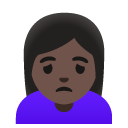
Appearance varies by platform and device. Google Noto, Twemoji, and OpenMoji are open-source.