🙆🏿♀️
The Emoji
Woman Gesturing OK: Dark Skin Tone
U+1F646 U+1F3FF U+200D U+2640 U+FE0F · :woman_gesturing_ok_dark_skin_tone:
Trend 74
Meaning layers
- interpretation
- Used to express unbothered confidence, sassy agreement, or 'yes, exactly that energy.' Often signals a bold, self-assured attitude — 'I'm that girl and I know it.' Also used ironically to say 'sure, whatever you say' with major attitude.
- tiktok usage
- Appears in POV videos and 'that girl' aesthetic content. Used in comment sections to agree enthusiastically or to signal unshakeable confidence. Paired with trending audios about self-love and Black girl magic.
- irony level
- 5 / 10
Platform meanings
- meaning
- Signals confidence, agreement, or unbothered energy. Frequently used in 'that girl' content, Black girl magic videos, and affirmation-heavy POVs.
- trend usage
- Appears in comment sections under viral Black women creators' videos. Used in duets and stitches to cosign a point. Paired with audio like 'I'm that girl' or motivational snippets.
- hashtags
- #ThatGirl#BlackGirlMagic#Unbothered#SelfLove#GirlsWhoKnow
- virality score
- 72 / 100
Cultural meanings
🇺🇸
Western / Gen-Z
Heavily associated with Black girl magic, unbothered culture, and affirmations of self-worth. A staple emoji in empowerment-forward Gen Z spaces.
🇵🇰
Pakistan & India
Used straightforwardly to mean 'okay' or 'all fine.' The dark skin tone may carry added resonance for South Asian users reclaiming darker skin positivity.
🌍
Middle East
Generally read as 'okay' or agreement. Among younger, social-media-savvy users, it may carry empowerment undertones influenced by global trends.
🌐
Global Neutral
Universally understood as an 'OK' or agreement gesture. The skin tone adds representation value recognized across global platforms.
🇧🇩
Bangladesh
Primarily used as a simple agreement or 'all is well' signal. Dark skin tone representation is increasingly appreciated by younger users.
🇱🇰
Sri Lanka
Used to mean 'okay' or 'no problem.' Younger users influenced by Instagram and TikTok may use it with the confidence/empowerment layer.
🇨🇳
China
The 'OK' gesture reads clearly. However, the female and dark skin modifier combination is less culturally specific — used mainly in global-context digital communication.
🇯🇵
Japan
Interesting cultural layer: the arms-raised OK gesture originates in Japanese customer service culture. The dark skin tone modifier is seen as a diversity-inclusive variation.
🇰🇷
South Korea
Read as agreement or 'everything is fine.' K-culture's growing awareness of diversity makes the skin tone variation more understood and appreciated than before.
🇹🇼
Taiwan
Used in casual digital communication to affirm or agree. Progressive online communities recognize the diversity representation aspect.
🇭🇰
Hong Kong
Understood as 'okay' or affirmation in bilingual digital contexts. Among younger, globally connected users, the empowerment connotation is recognized.
🇵🇭
Philippines
Widely used to mean 'okay' or 'all good.' Filipino users are highly social-media-savvy and often layer in the global Gen Z empowerment meaning.
🇮🇩
Indonesia
Used for agreement and affirmation. The dark skin tone resonates with Indonesian users who see diversity representation in emoji as meaningful.
🇹🇭
Thailand
Primarily means 'okay' or 'I agree.' Younger Thai users on TikTok and Instagram recognize the self-empowerment and 'that girl' cultural usage.
🇻🇳
Vietnam
Straightforward agreement or affirmation emoji in most contexts. Online-savvy users pick up on the global confidence/empowerment subtext.
🇲🇾
Malaysia
Used to mean 'okay' or 'sure.' The multicultural Malaysian digital space means users often pick up on diverse cultural nuances in emoji usage.
🇸🇦
Saudi Arabia
Generally read as agreement or approval. Among younger women especially, the female + confident gesture carries subtle resonance around personal expression.
🇦🇪
UAE
In the diverse, cosmopolitan UAE digital environment, this emoji is used both as simple agreement and as an empowerment signal by Black and South Asian women communities.
🇪🇬
Egypt
Used for 'okay' or agreeing to something. Younger Egyptian users influenced by global social media trends absorb the self-confidence undertones.
🇹🇷
Turkey
Primarily a casual 'okay' or 'all good.' Turkish Gen Z users familiar with global meme culture layer in the unbothered/confident meaning.
🇮🇷
Iran
Used as a neutral agreement signal in digital chats. The feminist resonance may carry subtle weight in contexts where women's expression is culturally loaded.
🇳🇬
Nigeria
This emoji is particularly resonant in Nigeria — the dark skin tone representation and confident gesture align powerfully with Afrocentric beauty standards and pride.
🇿🇦
South Africa
Widely embraced as a symbol of Black women's confidence and self-affirmation. Used enthusiastically in contexts celebrating South African women's strength.
🇬🇧
UK & Ireland
Used as a casual agreement or 'yeah, I'm fine' signal. Among Black British communities especially, it carries the full empowerment and cultural pride meaning.
🇫🇷
France
Primarily used as agreement. In Afro-French and diverse digital communities, the skin tone and gesture are recognized as symbols of inclusive representation.
🇩🇪
Germany
Used straightforwardly for agreement or confirmation. Among multicultural German social media communities, the diversity element is appreciated.
🇪🇸
Spain & Italy
Used casually for 'okay' or agreement. The cultural nuance of Black empowerment is less dominant but increasingly understood through global social media influence.
🇧🇷
Brazil
Very popular in Brazil where racial identity and Black pride are culturally significant. This emoji resonates deeply in Afro-Brazilian communities as a celebration of identity.
🇲🇽
Mexico
Used as agreement or affirmation. Among younger, social-media-connected users, the global 'that girl' and empowerment meaning is recognized and adopted.
🌎
Latin America
Across Latin America, used for agreement and positivity. In Afro-Latinx communities, the dark skin tone representation adds meaningful cultural resonance.
🇦🇺
Australia & NZ
Casual 'okay' or agreement in most contexts. In Aboriginal, Pacific Islander, and Black diaspora communities in Oceania, the representation aspect is valued.
How its meaning shifted
- 2010
Emoji did not yet exist with skin tone modifiers. The base gesture emoji was just emerging as a novelty in Japanese mobile culture, with limited global awareness.
- 2015
Skin tone modifiers were introduced in Unicode 8.0. The dark skin tone variant began appearing as users celebrated emoji diversity for the first time. Usage was exploratory and representation-focused.
- 2020
Deeply embedded in Black women's digital culture, especially on Black Twitter and Instagram. Used widely in self-empowerment content, Black Lives Matter-era solidarity posts, and affirmation culture.
- 2026
A mature, culturally layered emoji. Core to 'that girl' aesthetics, Black girl magic content, and Gen Z affirmation culture. Used both sincerely and ironically with high cultural literacy required to distinguish the two.
See it on every platform
Compare with
Adjacent emojis
Share & embed
Frequently asked
01What does the 🙆🏿♀️ Woman Gesturing OK: Dark Skin Tone emoji mean?
A woman with dark skin tone raising both arms above her head in a circular gesture, forming the shape of the letter 'O' to signal 'OK' or agreement.
02What does 🙆🏿♀️ mean on TikTok?
Signals confidence, agreement, or unbothered energy. Frequently used in 'that girl' content, Black girl magic videos, and affirmation-heavy POVs.
03What does 🙆🏿♀️ mean on WhatsApp?
Casual agreement or confirmation — 'yes, that works,' 'all good,' or 'I'm fine with that.' Used between friends to keep conversation light and affirming.
04What does 🙆🏿♀️ mean in Gen-Z slang?
Used to express unbothered confidence, sassy agreement, or 'yes, exactly that energy.' Often signals a bold, self-assured attitude — 'I'm that girl and I know it.' Also used ironically to say 'sure, whatever you say' with major attitude.
05Is the 🙆🏿♀️ emoji safe to use?
Positive affirmation, agreement, self-confidence, and empowerment. Safe for all audiences and contexts when used with genuine intent.
06What does 🙆🏿♀️ mean in texting?
The raised-arms gesture is psychologically linked to openness and triumph. Combined with the dark skin tone modifier, this emoji carries cultural weight around representation, self-empowerment, and visibility, making it emotionally resonant beyond simple agreement.
07What is the shortcode for 🙆🏿♀️?
The shortcode for Woman Gesturing OK: Dark Skin Tone is :woman_gesturing_ok_dark_skin_tone:
08What does 🙆🏿♀️ mean in dating?
Used to signal 'I'm okay with that' in a flirty, low-key confident way. Can imply 'I'm interested' without being too forward. Sometimes used to reply 'I'm fine' in a self-complimenting, playful tone.
Safety & usage
- Safe meaning
- Positive affirmation, agreement, self-confidence, and empowerment. Safe for all audiences and contexts when used with genuine intent.
- Caution
- Can be used mockingly against someone to imply their distress is being dismissed or that their concern is irrelevant — an 'okay, sure, totally fine' dismissive weapon.
Minimal risk. Be mindful of using skin-tone-specific emoji that don't match your own identity, as this can be seen as appropriative in some communities. Otherwise, broadly positive.
How it looks across platforms
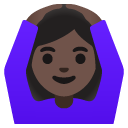
Appearance varies by platform and device. Google Noto, Twemoji, and OpenMoji are open-source.