💇🏽♀️
The Emoji
Woman Getting Haircut: Medium Skin Tone
U+1F487 U+1F3FD U+200D U+2640 U+FE0F · :woman_getting_haircut_medium_skin_tone:
Trend 61
Meaning layers
- interpretation
- Used to signal a glow-up, self-care day, or a major life change through a haircut — often symbolizing moving on from a breakup or toxic situation.
- tiktok usage
- Paired with transformation videos, breakup recovery content, or 'new me' energy posts, often captioned 'she said what she said' energy.
- irony level
- 3 / 10
Platform meanings
- meaning
- Represents self-care, glow-up moments, and post-breakup reinvention.
- trend usage
- Used in 'new era' TikToks, salon transformation videos, and 'she's not thinking about you' content.
- hashtags
- #GlowUp#SelfCareSunday#NewMe#SalonDay#HairTransformation
- virality score
- 62 / 100
Cultural meanings
🇺🇸
Western / Gen-Z
Strongly associated with the 'unbothered' and 'new era' meme culture — cutting your hair after a breakup is a widely recognized ritual.
🇵🇰
Pakistan & India
Represents a salon visit or beauty routine; hair oiling and trimming are culturally significant, so this emoji resonates with self-care traditions.
🌍
Middle East
Used to signal a salon day, which is a common social outing for women; beauty and grooming are highly valued and this emoji is used without subtext.
🌐
Global Neutral
Universally understood as a woman getting a haircut or hair treatment — carries no controversial meaning globally.
🇧🇩
Bangladesh
Understood as a salon visit; hair care is part of regular beauty routines and is used straightforwardly in messaging.
🇱🇰
Sri Lanka
Represents a visit to the beauty parlour, a common social activity; used naturally in everyday chat.
🇨🇳
China
Straightforwardly represents a haircut appointment; in younger WeChat and Weibo culture it may also signal a fresh start or style change.
🇯🇵
Japan
Used to represent salon visits; Japan's highly refined beauty culture gives this emoji a slightly elevated, aesthetic connotation.
🇰🇷
South Korea
Closely tied to K-beauty culture; signals a salon visit, beauty treatment, or a preparation for a special event — widely used by beauty influencers.
🇹🇼
Taiwan
Used similarly to South Korea — associated with beauty routines and self-care, common in Line and Instagram captions.
🇭🇰
Hong Kong
Represents a salon trip; given the fast-paced lifestyle, it may also imply a quick self-care break from a busy schedule.
🇵🇭
Philippines
Used to represent a trip to the parlor (beauty salon), which is a very common and social activity; carries positive, everyday connotations.
🇮🇩
Indonesia
Represents salon visits and self-care routines; popular in WhatsApp and Instagram among younger women.
🇹🇭
Thailand
Associated with beauty salon culture, which is deeply embedded in Thai daily life; used naturally and positively.
🇻🇳
Vietnam
Used to signal a haircut or beauty salon visit; grooming and hair care are important cultural practices reflected in this emoji's usage.
🇲🇾
Malaysia
Used across messaging apps to indicate a salon outing; fits naturally within the country's strong beauty and grooming culture.
🇸🇦
Saudi Arabia
Within women-only spaces and private chats, signals a salon trip — an important social activity; used positively and frequently.
🇦🇪
UAE
Represents a luxury salon experience in many contexts; UAE's strong beauty industry culture gives this emoji a slightly aspirational tone.
🇪🇬
Egypt
Used to represent a beauty salon visit; hair and beauty routines are an important part of feminine culture and social life.
🇹🇷
Turkey
Salon culture is strong; this emoji is used to communicate a haircut or beauty appointment, often with pride.
🇮🇷
Iran
Used in private messaging to signal a beauty visit; hair care and salon culture are significant for women despite public restrictions.
🇳🇬
Nigeria
Represents a visit to the salon, which is a major social hub in Nigerian culture; carries warm, community-oriented connotations.
🇿🇦
South Africa
Used to indicate a salon trip; given the diversity of hair textures and types in South Africa, this emoji resonates broadly across communities.
🇬🇧
UK & Ireland
Used similarly to other Western markets — a salon visit or glow-up signal; the 'unbothered' meme context is also well understood.
🇫🇷
France
Represents a coiffeur visit; French beauty culture is strong, and this emoji is used naturally in everyday contexts without heavy irony.
🇩🇪
Germany
Used straightforwardly to communicate a haircut appointment; less meme usage than English-speaking markets.
🇪🇸
Spain & Italy
Associated with beauty salon culture, which is socially significant; used warmly to signal self-care or a beauty appointment.
🇧🇷
Brazil
Brazilian beauty culture is world-renowned; this emoji carries strong positive energy tied to salon culture, hair treatments, and femininity.
🇲🇽
Mexico
Used to indicate a salon visit or beauty routine; beauty is a celebrated cultural value, giving this emoji a positive and common usage.
🌎
Latin America
Broadly used across Latin America to signal beauty appointments and self-care; salon culture is vibrant and socially important throughout the region.
🇦🇺
Australia & NZ
Used like other English-speaking Western markets — signals a salon day or glow-up; the 'unbothered' meme usage is well-recognized.
How its meaning shifted
- 2010
Emoji did not exist yet; haircut-related communication relied on text or basic scissors emoji.
- 2015
Recently introduced with Unicode skin tone support; used primarily in a literal sense to communicate salon appointments.
- 2020
Gained significant cultural traction with the 'post-breakup haircut' trend and the rise of self-care culture on social media.
- 2026
Deeply embedded in 'new era,' 'unbothered,' and 'main character' aesthetics; used both literally and as a cultural shorthand for reinvention and self-prioritization.
See it on every platform
Compare with
Adjacent emojis
- Often confused with
- woman getting massagebarber polehaircut
Share & embed
Frequently asked
01What does the 💇🏽♀️ Woman Getting Haircut: Medium Skin Tone emoji mean?
A woman with medium skin tone receiving a haircut or hair treatment at a salon, depicted with scissors near the head.
02What does 💇🏽♀️ mean on TikTok?
Represents self-care, glow-up moments, and post-breakup reinvention.
03What does 💇🏽♀️ mean on WhatsApp?
Letting someone know you're at the salon or about to get a haircut.
04What does 💇🏽♀️ mean in Gen-Z slang?
Used to signal a glow-up, self-care day, or a major life change through a haircut — often symbolizing moving on from a breakup or toxic situation.
05Is the 💇🏽♀️ emoji safe to use?
Represents a woman getting a haircut or hair treatment at a salon — a completely benign self-care activity.
06What does 💇🏽♀️ mean in texting?
Hair is deeply tied to identity; cutting it often represents shedding the past, reclaiming autonomy, or treating oneself — making this emoji carry subtle emotional weight beyond surface-level grooming.
07What is the shortcode for 💇🏽♀️?
The shortcode for Woman Getting Haircut: Medium Skin Tone is :woman_getting_haircut_medium_skin_tone:
08What does 💇🏽♀️ mean in dating?
Rarely used in a flirtatious context; sometimes sent to hint at getting dolled up before a date.
Safety & usage
- Safe meaning
- Represents a woman getting a haircut or hair treatment at a salon — a completely benign self-care activity.
- Caution
- Occasionally used passive-aggressively to imply 'cutting off' people, but this is mild and not truly harmful.
No significant safety concerns. In very rare contexts, could be used to mock someone's appearance, but this is uncommon and context-dependent.
How it looks across platforms
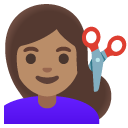
Appearance varies by platform and device. Google Noto, Twemoji, and OpenMoji are open-source.