💆🏽♀️
The Emoji
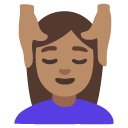
Woman Getting Massage: Medium Skin Tone
U+1F486 U+1F3FD U+200D U+2640 U+FE0F · :woman_getting_massage_medium_skin_tone:
Trend 54
Meaning layers
- interpretation
- Used to express needing a break, being stressed out, or treating yourself to self-care. Often used ironically to say 'I need therapy' or 'I deserve to be pampered right now.'
- tiktok usage
- Appears in self-care content, burnout commentary, and 'treat yourself' culture. Often paired with wellness routines or 'soft life' aesthetic videos.
- irony level
- 4 / 10
Platform meanings
- meaning
- Signals self-care content, relaxation vlogs, and 'I need a break from life' energy. Common in wellness and mental health tikTok communities.
- trend usage
- Used in 'soft life' trends, 'that girl' aesthetic content, and burnout recovery videos. Pairs with lo-fi music and spa aesthetic footage.
- hashtags
- #selfcare#softlife#spday#treatyourself#wellness
- virality score
- 52 / 100
Cultural meanings
🇺🇸
Western / Gen-Z
Heavily associated with 'soft life' and self-care culture; used frequently to express the need for rest and rejuvenation after stress, often with ironic or humorous undertones.
🇵🇰
Pakistan & India
Used to represent salon visits, which are popular social events for women; often shared when posting about parlour trips or pamper days with friends and family.
🌍
Middle East
Represents hammam (traditional bathhouse) culture and luxury spa experiences; commonly used by women to indicate personal indulgence or a wellness day.
🌐
Global Neutral
Universally understood as representing relaxation and massage; used across cultures to indicate rest, self-care, or a spa experience without strong cultural specificity.
🇧🇩
Bangladesh
Associated with beauty parlour culture, a popular social tradition for women; used to indicate personal grooming and self-pampering occasions.
🇱🇰
Sri Lanka
Resonates with Ayurvedic massage traditions; used to represent traditional wellness treatments as well as modern spa visits.
🇨🇳
China
Strongly associated with the popular massage culture (按摩) deeply embedded in Chinese daily wellness routines; commonly used to indicate visits to foot massage or full-body massage parlors.
🇯🇵
Japan
Connected to Japan's refined spa and onsen culture; used to represent the concept of 'me time' and the deeply valued practice of mental and physical restoration.
🇰🇷
South Korea
Tied to the thriving K-beauty and wellness culture; frequently used in skincare and self-care content, aligning with the cultural emphasis on appearance and holistic wellbeing.
🇹🇼
Taiwan
Associated with wellness routines and the popular spa/massage culture; used in lifestyle content emphasizing balanced living and self-nurturing.
🇭🇰
Hong Kong
Represents the busy urbanite's escape to wellness; used to signal taking a break from Hong Kong's notoriously high-pressure lifestyle.
🇵🇭
Philippines
Used to represent salon visits, which are a major social and self-care activity; often shared when treating oneself or spending a pamper day with friends.
🇮🇩
Indonesia
Connected to the rich tradition of Indonesian massage and jamu wellness culture; used both for traditional and modern spa content.
🇹🇭
Thailand
Deeply tied to Thailand's globally renowned traditional Thai massage culture; one of the most contextually resonant emojis for wellness in the Thai context.
🇻🇳
Vietnam
Associated with growing spa and wellness culture; used for beauty treatments and relaxation content in an increasingly wellness-aware society.
🇲🇾
Malaysia
Represents spa days and personal grooming; used in lifestyle content that reflects the growing wellness tourism and self-care industry in Malaysia.
🇸🇦
Saudi Arabia
Used primarily in private or women-only contexts to represent spa and salon experiences, which are popular social activities for Saudi women.
🇦🇪
UAE
Strongly associated with the luxurious spa and wellness culture of Dubai and Abu Dhabi; used by lifestyle influencers and wellness enthusiasts to signal high-end self-care.
🇪🇬
Egypt
Represents hammam and beauty salon culture; used to signal self-care rituals and relaxation, especially among women.
🇹🇷
Turkey
Intrinsically linked to the hammam (Turkish bath) tradition; one of the most culturally resonant uses of this emoji in Turkey, representing a deeply embedded wellness ritual.
🇮🇷
Iran
Used to represent beauty salon visits and private wellness rituals; associated with the important social role of women's beauty culture in Iran.
🇳🇬
Nigeria
Used to represent spa days and salon visits, which are growing in popularity; also used in aspirational content about the 'soft life' and self-indulgence.
🇿🇦
South Africa
Associated with wellness and spa culture across diverse communities; used in lifestyle content and as shorthand for deserving a rest after a hard day.
🇬🇧
UK & Ireland
Used humorously to indicate needing a spa day after British chaos — weather, politics, or social drama; common in self-deprecating and relatable content.
🇫🇷
France
Connected to the French concept of 'bien-être' (wellbeing); used elegantly in lifestyle content and less ironically than in English-speaking contexts.
🇩🇪
Germany
Used to represent the popular wellness and sauna culture (Wellness); Germans associate this with structured and intentional recovery, not just indulgence.
🇪🇸
Spain & Italy
Represents relaxation and the Mediterranean culture of slowing down; used to signal rest, dolce vita moments, and spa getaways.
🇧🇷
Brazil
Associated with the thriving beauty and wellness industry in Brazil; used frequently in content about massages, spa days, and the cultural emphasis on body care.
🇲🇽
Mexico
Used to indicate spa days and self-care routines; increasingly popular with the growth of wellness culture and 'date with yourself' content.
🌎
Latin America
Broadly associated with self-care and beauty culture across Latin America; used in aspirational content about treating oneself and embracing the 'soft life.'
🇦🇺
Australia & NZ
Used casually to indicate a massage, spa day, or the need to unwind after stress; common in lifestyle content with a laid-back, self-care framing.
How its meaning shifted
- 2010
Emoji did not yet exist in this form; general massage emojis were not yet part of Unicode and the concept of skin tone modifiers had not been introduced.
- 2015
Newly introduced with Unicode 8.0 skin tone modifiers; primarily used literally to indicate spa visits, massages, or relaxation without significant cultural layering.
- 2020
Gained traction with the explosion of self-care culture during the pandemic; widely used to represent mental health days, the need for rest, and wellness routines as people coped with lockdown stress.
- 2026
Firmly embedded in 'soft life' and anti-hustle culture discourse; used both sincerely for wellness content and ironically in meme culture to represent deserved rest after surviving modern life's chaos.
See it on every platform
Compare with
Adjacent emojis
Share & embed
Frequently asked
01What does the 💆🏽♀️ Woman Getting Massage: Medium Skin Tone emoji mean?
A woman receiving a head or neck massage, depicted with medium skin tone, typically shown with hands pressing on her head and a relaxed expression.
02What does 💆🏽♀️ mean on TikTok?
Signals self-care content, relaxation vlogs, and 'I need a break from life' energy. Common in wellness and mental health tikTok communities.
03What does 💆🏽♀️ mean on WhatsApp?
Tells friends you're relaxing, at a spa, or need to decompress. Common reply to stressful news.
04What does 💆🏽♀️ mean in Gen-Z slang?
Used to express needing a break, being stressed out, or treating yourself to self-care. Often used ironically to say 'I need therapy' or 'I deserve to be pampered right now.'
05Is the 💆🏽♀️ emoji safe to use?
Represents self-care, spa treatments, massage therapy, and relaxation. A positive and broadly safe emoji in almost all contexts.
06What does 💆🏽♀️ mean in texting?
Represents the psychological need for physical touch, stress relief, and permission to prioritize oneself — tied to the growing self-care movement and boundary-setting culture.
07What is the shortcode for 💆🏽♀️?
The shortcode for Woman Getting Massage: Medium Skin Tone is :woman_getting_massage_medium_skin_tone:
08What does 💆🏽♀️ mean in dating?
Can be used flirtatiously to hint at wanting pampering from a partner, or to suggest a spa date. Subtle but can carry sensual undertones depending on context.
Safety & usage
- Safe meaning
- Represents self-care, spa treatments, massage therapy, and relaxation. A positive and broadly safe emoji in almost all contexts.
- Caution
- In rare cases could be used in inappropriate contexts to reference physical contact in an unwanted or suggestive manner, though this is uncommon.
Generally safe for all audiences. The skin tone modifier adds a layer of personal identity expression. Very low risk for misuse or misinterpretation.
How it looks across platforms
Appearance varies by platform and device. Google Noto, Twemoji, and OpenMoji are open-source.