🧎🏿♀️➡️
The Emoji
Woman Kneeling Facing Right: Dark Skin Tone
U+1F9CE U+1F3FF U+200D U+2640 U+FE0F U+200D U+27A1 U+FE0F · :woman_kneeling_facing_right_dark_skin_tone:
Trend 42
Meaning layers
- interpretation
- Used to express submission, reverence, worship, or 'bowing down' to someone or something iconic. Also used sarcastically to mock excessive deference or to signal being humbled.
- tiktok usage
- Appears in POV videos where creators 'bow down' to a queen, trend, or moment. Used in comments under iconic performances or looks.
- irony level
- 6 / 10
Platform meanings
- meaning
- Symbolizes bowing down or paying homage to something iconic, often used in comment sections or overlaid on videos celebrating a queen or legend.
- trend usage
- Appears in 'POV: you witness greatness' trends and in comment chains under viral dance or fashion videos.
- hashtags
- #bowdown#queenvibes#iconic#stanculture#kneeling
- virality score
- 48 / 100
Cultural meanings
🇺🇸
Western / Gen-Z
Widely used as a hyperbolic gesture of admiration in stan culture and internet humor, often meaning 'I bow down to your greatness' without literal religious connotation.
🇵🇰
Pakistan & India
May be interpreted in the context of devotional or religious kneeling, resonating with cultural practices of prostration before elders or deities; less commonly used in casual digital communication.
🌍
Middle East
Could evoke connotations of submission or prayer posture, which carries spiritual weight; likely interpreted as reverence or humility rather than internet slang.
🌐
Global Neutral
Universally understood as a gesture of kneeling, broadly interpreted as submission, respect, or devotion depending on cultural and conversational context.
🇧🇩
Bangladesh
Similar to South Asian interpretation — kneeling is associated with religious devotion or respect for elders; internet slang meaning less prevalent.
🇱🇰
Sri Lanka
In Sri Lankan digital culture, this emoji may evoke Buddhist or Hindu connotations of prostration and reverence, used more sincerely than ironically.
🇨🇳
China
Kneeling carries deep Confucian and traditional cultural weight as a sign of deep respect or apology; internet users may use it in both sincere and meme contexts particularly in fandom culture.
🇯🇵
Japan
Kneeling (seiza or dogeza posture) is a recognized cultural gesture of deep apology or reverence; this emoji may be used in fan communities or to signal sincere admiration.
🇰🇷
South Korea
In K-pop fan culture, this emoji is popular in worshipping idols; also resonates with cultural practices of bowing deeply in respect, making it both sincere and fandom-driven.
🇹🇼
Taiwan
Commonly used in fan communities and LINE sticker culture; associated with admiring idol groups or expressing deep gratitude and respect.
🇭🇰
Hong Kong
Used in Cantonese internet culture to signal respect or mock submission in playful arguments; also appears in celebrity fan communities.
🇵🇭
Philippines
In Filipino digital culture, used to express admiration for celebrities or to show humility; resonates with cultural values of 'mano po' and respect-based gestures.
🇮🇩
Indonesia
Associated with showing deep respect, especially to elders or figures of authority; also used in fan culture among younger Indonesians for idol worship.
🇹🇭
Thailand
Resonates with the 'wai' culture of deep bowing and respect; may be used sincerely to honor someone greatly admired or humorously in fan contexts.
🇻🇳
Vietnam
Used to express deep respect or admiration, particularly for elders or admired figures; younger users may use it more playfully in stan culture.
🇲🇾
Malaysia
Used in fan communities and casual chat to signal extreme admiration; may also carry religious undertones in Muslim-majority contexts evoking prostration.
🇸🇦
Saudi Arabia
May evoke the concept of sujood or prostration in Islamic practice, making its casual use sensitive; more likely used in private chats among youth for humorous admiration.
🇦🇪
UAE
Similar to Saudi Arabia — spiritual connotations exist, but cosmopolitan digital culture in UAE means younger users also use it in secular admiration contexts.
🇪🇬
Egypt
In Egyptian digital culture, the emoji may be used humorously to mock over-compliance or sincerely in fan pages for celebrities; religious undertones are present but secondary in casual use.
🇹🇷
Turkey
Used in Turkish social media to express 'I bow to you' admiration; resonates both with traditional respect culture and modern internet humor.
🇮🇷
Iran
May be interpreted through a lens of religious prostration; younger Iranians in online spaces use it more ironically to worship a favorite artist or meme.
🇳🇬
Nigeria
Used energetically in Nigerian Twitter (Naija Twitter) to hype up queens and icons; often seen under powerful women's posts as a form of celebration and admiration.
🇿🇦
South Africa
Used in South African social media to show respect or admiration, particularly in fan communities; also appears in political commentary to mock sycophancy.
🇬🇧
UK & Ireland
Used with British dry humor to mock excessive deference; also genuinely used in stan communities for pop stars like Dua Lipa or Adele.
🇫🇷
France
Less emoji-heavy culture overall; when used, it signals theatrical admiration or sarcastic submission in online debates.
🇩🇪
Germany
Used sparingly and typically sincerely to indicate deep respect; also appears in gaming communities to bow before skilled players.
🇪🇸
Spain & Italy
Used expressively to show admiration for a diva or icon; resonates with Latin dramatic culture where gestures of devotion are celebrated.
🇧🇷
Brazil
Very popular in Brazilian stan Twitter (Stan Twitter Brasil) to worship pop queens; used energetically and frequently with exclamation-heavy text.
🇲🇽
Mexico
Used to express admiration for powerful female figures, celebrities, or mothers; aligns with cultural values of maternal reverence and female strength.
🌎
Latin America
Broadly used across Latin America in fan communities to signal devotion to artists, especially reggaeton, pop, and K-pop stars.
🇦🇺
Australia & NZ
Used casually to say 'I bow to you' in a playful, self-deprecating Australian humor context; also appears in Māori and Indigenous appreciation posts in NZ.
How its meaning shifted
- 2010
This specific emoji did not exist in 2010; kneeling emojis were not part of Unicode until much later, and directional variants were even further away.
- 2015
Still non-existent in emoji form; the concept of kneeling in digital communication was expressed through text-based emoticons or GIFs.
- 2020
The kneeling emoji gained major cultural resonance during the Black Lives Matter movement's 'take a knee' moment; dark skin tone variants became significant symbols of solidarity and protest.
- 2026
Evolved into a multi-layered symbol used for stan culture worship, sarcastic submission, genuine admiration, and directional action narratives in short-form video content.
See it on every platform
Adjacent emojis
- Often confused with
- person in lotus positionwoman bowingperson getting massage
- Can replace
- raised handsperson bowingfolded hands
Share & embed
Frequently asked
01What does the 🧎🏿♀️➡️ Woman Kneeling Facing Right: Dark Skin Tone emoji mean?
A woman kneeling and facing to the right, with dark skin tone applied via modifier. The emoji depicts a female figure in a kneeling posture oriented rightward.
02What does 🧎🏿♀️➡️ mean on TikTok?
Symbolizes bowing down or paying homage to something iconic, often used in comment sections or overlaid on videos celebrating a queen or legend.
03What does 🧎🏿♀️➡️ mean on WhatsApp?
Sent to a friend to say 'I bow to you' after they do something impressive or funny.
04What does 🧎🏿♀️➡️ mean in Gen-Z slang?
Used to express submission, reverence, worship, or 'bowing down' to someone or something iconic. Also used sarcastically to mock excessive deference or to signal being humbled.
05Is the 🧎🏿♀️➡️ emoji safe to use?
Represents a woman kneeling and facing right; used for admiration, reverence, protest solidarity, or storytelling.
06What does 🧎🏿♀️➡️ mean in texting?
Kneeling as a posture universally signals deference or vulnerability. The directional cue (facing right) adds a sense of intentionality or movement toward something, amplifying the feeling of purposeful devotion.
07What is the shortcode for 🧎🏿♀️➡️?
The shortcode for Woman Kneeling Facing Right: Dark Skin Tone is :woman_kneeling_facing_right_dark_skin_tone:
08What does 🧎🏿♀️➡️ mean in dating?
Rarely used in direct flirting; occasionally deployed to tell a partner 'I worship you' or 'you have me on my knees' in a romantic hyperbolic sense.
Safety & usage
- Safe meaning
- Represents a woman kneeling and facing right; used for admiration, reverence, protest solidarity, or storytelling.
- Caution
- Could theoretically be used in degrading power-dynamic conversations to imply forced submission, though this is rare.
Generally safe. In very specific NSFW contexts it could be misused to imply dominance/submission dynamics, but this is not a common or primary usage.
How it looks across platforms
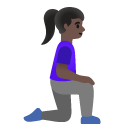
Appearance varies by platform and device. Google Noto, Twemoji, and OpenMoji are open-source.