🧎🏼♀️➡️
The Emoji
Woman Kneeling Facing Right: Medium-light Skin Tone
U+1F9CE U+1F3FC U+200D U+2640 U+FE0F U+200D U+27A1 U+FE0F · :woman_kneeling_facing_right_mediumlight_skin_tone:
Trend 38
Meaning layers
- interpretation
- Used to signal submission, reverence, worship, or being lowkey obsessed with someone or something. Also used humorously to indicate begging or desperation in a self-deprecating way.
- tiktok usage
- Appears in 'i would kneel for this person' contexts, usually under celebrity or crush videos. Sometimes used as a dramatic 'I'm not worthy' reaction.
- irony level
- 6 / 10
Platform meanings
- meaning
- Represents worship, obsession, or dramatic reverence toward a celebrity, trend, or moment. Used as hyperbolic admiration.
- trend usage
- Found in comment sections under viral videos, duets, and POV skits involving devotion or being 'on your knees' figuratively for something you love.
- hashtags
- #worship#notworthy#fangirl#simp#kneeling
- virality score
- 42 / 100
Cultural meanings
🇺🇸
Western / Gen-Z
Used liberally as a hyperbolic worship emoji, especially in fandom and admiration contexts. Carries a playful, ironic tone about being 'down bad' for someone.
🇵🇰
Pakistan & India
May carry religious connotations of prayer or prostration in devout communities, while younger users adopt the Western fandom usage similarly.
🌍
Middle East
Associated with prayer posture or humility before God in conservative contexts; younger, urban users may use it more casually like Western Gen Z.
🌐
Global Neutral
Universally understood as kneeling — interpreted as prayer, submission, or dramatic reverence depending on context.
🇧🇩
Bangladesh
Likely interpreted through a religious lens of humility or prayer, though urban youth may use it in fan culture contexts.
🇱🇰
Sri Lanka
In Buddhist cultural framing, kneeling carries spiritual reverence; in youth culture, mirrors South Asian fandom usage.
🇨🇳
China
Kneeling has historical connotations of submission or kowtowing; younger users on Weibo-equivalent platforms may use it humorously for idol worship culture (fan culture is massive).
🇯🇵
Japan
Resonates with seiza (formal kneeling posture) and respect culture; also used in otaku/fan culture to express deep devotion to an idol or character.
🇰🇷
South Korea
Deeply tied to idol worship culture (K-pop). Fans use it extensively to signal devotion to their favorite artists or groups.
🇹🇼
Taiwan
Similar to South Korean usage in fandom spaces; also carries cultural respect undertones in formal contexts.
🇭🇰
Hong Kong
Used in pop culture and fandom communities; less formal religious associations than mainland China usage.
🇵🇭
Philippines
Has Catholic prayer connotations but is also enthusiastically used in fan culture — Filipino fan communities are among the world's most active.
🇮🇩
Indonesia
May be associated with Islamic prayer postures in conservative contexts; increasingly used by youth in K-pop and celebrity fan communities.
🇹🇭
Thailand
Carries Buddhist reverence connotations; also used in entertainment fan communities, especially K-pop and Thai drama fandoms.
🇻🇳
Vietnam
Youth-driven usage mirrors global fandom culture; some older users may associate it with traditional bowing or respect.
🇲🇾
Malaysia
Multi-cultural context — may evoke Islamic prayer for some, general reverence for others, and fandom devotion for youth.
🇸🇦
Saudi Arabia
Strongly associated with Islamic prayer and submission to God; casual use in fandom contexts is less common but growing among younger users.
🇦🇪
UAE
Cosmopolitan user base means dual interpretation: religious reverence for some, ironic Gen Z worship for others in expat and youth communities.
🇪🇬
Egypt
Religious undertones dominate in conservative circles; younger Egyptians in fandom and social media spaces adopt playful Western usage.
🇹🇷
Turkey
Youth culture embraces fandom usage enthusiastically; older generations may associate it with religious or ceremonial kneeling.
🇮🇷
Iran
Used in youth-driven social media culture for fandom expression; religious associations exist but younger users are creative with emoji usage.
🇳🇬
Nigeria
Used in Afrobeats fan communities and celebrity culture to show admiration; also has some religious connotation in Christian worship contexts.
🇿🇦
South Africa
Appears in fan culture and sports contexts — particularly when celebrating extraordinary athletic or artistic achievements.
🇬🇧
UK & Ireland
Used ironically and sarcastically in online humor; also genuinely deployed in fandom contexts for celebrities and football players.
🇫🇷
France
Adopted mainly in fandom and ironic online discourse; French internet culture uses it with characteristic dry humor.
🇩🇪
Germany
Less emotionally expressive culture means more reserved usage; appears in fandom spaces and ironic online commentary.
🇪🇸
Spain & Italy
Expressive cultures embrace it enthusiastically in fandom and admiration contexts, often stacked with other emojis for dramatic effect.
🇧🇷
Brazil
Extremely popular in fan communities — Brazilian fans are globally known for intensity, and this emoji fits their expressive style perfectly.
🇲🇽
Mexico
Used in celebrity fan culture and humor; also appears in religious contexts around Catholic festivals and devotion.
🌎
Latin America
Broadly used across Latin American countries in fandom, sports celebration, and dramatic admiration; very high cultural resonance.
🇦🇺
Australia & NZ
Used with typical Antipodean irony and humor; appears in sports fan communities and celebrity culture commentary.
How its meaning shifted
- 2010
This specific emoji did not exist in 2010. Kneeling and directional emoji variants were not part of the Unicode standard yet.
- 2015
Still not yet introduced; the emoji landscape was gaining skin tone modifiers but directional kneeling figures were not yet available.
- 2020
Directional person emojis began rolling out; early adopters used this in fitness, prayer, and protest contexts (especially given global BLM movement associations with kneeling).
- 2026
Firmly embedded in fandom, worship, and ironic Gen Z vocabulary. Widely used across platforms to express devotion, pleading, and hyperbolic admiration.
See it on every platform
Compare with
Adjacent emojis
Share & embed
Frequently asked
01What does the 🧎🏼♀️➡️ Woman Kneeling Facing Right: Medium-light Skin Tone emoji mean?
A woman with medium-light skin tone kneeling and facing to the right, indicating movement or direction while in a kneeling position.
02What does 🧎🏼♀️➡️ mean on TikTok?
Represents worship, obsession, or dramatic reverence toward a celebrity, trend, or moment. Used as hyperbolic admiration.
03What does 🧎🏼♀️➡️ mean on WhatsApp?
Sent to show you're begging or dramatically pleading with someone in a lighthearted way.
04What does 🧎🏼♀️➡️ mean in Gen-Z slang?
Used to signal submission, reverence, worship, or being lowkey obsessed with someone or something. Also used humorously to indicate begging or desperation in a self-deprecating way.
05Is the 🧎🏼♀️➡️ emoji safe to use?
Represents a woman kneeling and facing right — used for prayer, reverence, admiration, devotion, or submission in a completely benign way.
06What does 🧎🏼♀️➡️ mean in texting?
Kneeling is universally associated with subordination, prayer, or surrender. The directional element adds a sense of active movement toward something, suggesting purposeful devotion or pursuit.
07What is the shortcode for 🧎🏼♀️➡️?
The shortcode for Woman Kneeling Facing Right: Medium-light Skin Tone is :woman_kneeling_facing_right_mediumlight_skin_tone:
08What does 🧎🏼♀️➡️ mean in dating?
Used flirtatiously to say 'I'd kneel for you' implying admiration or submission in a romantic/playful context. Can be slightly suggestive depending on platform tone.
Safety & usage
- Safe meaning
- Represents a woman kneeling and facing right — used for prayer, reverence, admiration, devotion, or submission in a completely benign way.
- Caution
- Could be used in degrading contexts to imply submission or subservience in a sexist or demeaning manner.
The kneeling posture can be weaponized in toxic online spaces to demean women or reinforce harmful power dynamics. Context matters greatly.
How it looks across platforms
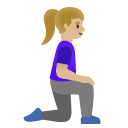
Appearance varies by platform and device. Google Noto, Twemoji, and OpenMoji are open-source.