👱🏾♀️
The Emoji
Woman: Medium-dark Skin Tone, Blond Hair
U+1F471 U+1F3FE U+200D U+2640 U+FE0F · :woman_mediumdark_skin_tone_blond_hair:
Trend 48
Meaning layers
- interpretation
- Used to represent oneself or a friend who is a brown-skinned blonde, often with connotations of being uniquely stylish, confident, or defying stereotypes. Also used playfully when discussing dyed blonde hair on darker skin tones.
- tiktok usage
- Appears in videos celebrating natural or dyed blonde hair on women of color, often paired with 'that girl' aesthetic content or empowerment narratives.
- irony level
- 2 / 10
Platform meanings
- meaning
- Represents a confident, stylish woman of medium-dark skin with blonde hair, often tied to aesthetic or identity-affirming content.
- trend usage
- Used in 'that girl' routines, hair transformation videos, and empowerment content by WOC (women of color) who have or want blonde hair.
- hashtags
- #BlondeWOC#MelaninAndBlonde#HairTransformation#ThatGirl#NaturallyMe
- virality score
- 55 / 100
Cultural meanings
🇺🇸
Western / Gen-Z
Celebrated as a symbol of breaking Eurocentric beauty norms; widely used by Gen Z to represent melanin beauty paired with bold hair choices like bleached or dyed blonde.
🇵🇰
Pakistan & India
Less commonly used due to rarity of natural blonde hair in the region; when used, it may represent a fictional character, a Bollywood look, or a bleached-hair aesthetic trend among younger generations.
🌍
Middle East
Occasionally used to represent women who dye their hair blonde, a common beauty practice in parts of the Arab world; seen as a fashion statement rather than an identity marker.
🌐
Global Neutral
Universally understood as a woman with medium-dark skin and blonde hair; used neutrally to represent or describe someone with these physical traits.
🇧🇩
Bangladesh
Rarely used organically; may appear in fashion or beauty contexts among urban youth familiar with global beauty trends.
🇱🇰
Sri Lanka
Infrequently used in everyday communication; may appear in beauty or lifestyle content influenced by Western social media trends.
🇨🇳
China
Used occasionally in beauty and fashion communities online; blonde hair on non-white women is associated with trendiness and Western fashion influence.
🇯🇵
Japan
Carries a 'gyaru' or fashion-forward connotation; blonde hair on darker-skinned women may be associated with specific subcultures or fashion identities in Japanese pop culture.
🇰🇷
South Korea
Associated with bold K-beauty style choices; used in contexts discussing hair color experimentation, especially among idol fan communities.
🇹🇼
Taiwan
Used in beauty and fashion communities to represent diverse style aesthetics; blonde hair is seen as a bold, trendy choice.
🇭🇰
Hong Kong
Appears in cosmopolitan beauty discussions; represents the intersection of diverse ethnic backgrounds and Western fashion influences common in Hong Kong culture.
🇵🇭
Philippines
Quite relatable given the diversity of Filipino skin tones; used to represent Filipinas or mixed-heritage individuals who dye their hair blonde.
🇮🇩
Indonesia
Used in beauty communities to represent the growing trend of hair dyeing among Indonesian women, especially lighter colors on darker skin.
🇹🇭
Thailand
Associated with bold fashion choices; in Thai beauty culture, lighter hair on darker skin is a notable aesthetic statement often seen in K-pop influenced circles.
🇻🇳
Vietnam
Used in hair and beauty contexts; Vietnamese beauty trends increasingly embrace dyed blonde hair, making this emoji relatable to younger generations.
🇲🇾
Malaysia
Resonates with the multiracial beauty landscape of Malaysia; used to represent diverse women who embrace blonde hair as a style choice.
🇸🇦
Saudi Arabia
In contexts where hair is discussed privately or in women-only spaces; blonde-dyed hair is a popular beauty trend, making this emoji recognizable in female chat groups.
🇦🇪
UAE
Used in the cosmopolitan UAE beauty scene to represent the diverse population of women who dye their hair blonde, a very common beauty practice in the region.
🇪🇬
Egypt
Relatable due to the widespread practice of hair bleaching and dyeing in Egypt; used to represent a fashionable, style-conscious woman.
🇹🇷
Turkey
Resonates in beauty conversations as blonde hair dyeing is extremely common in Turkey regardless of skin tone; used to represent a stylish, modern woman.
🇮🇷
Iran
Used among younger generations in private digital spaces; blonde hair is a popular dye choice in Iran, making this emoji reflect a common beauty aesthetic.
🇳🇬
Nigeria
Highly relatable in Nigerian beauty culture where hair dyeing and bleaching is trendy; often used to celebrate a bold look or new hair transformation.
🇿🇦
South Africa
Used to represent the diverse South African population; particularly resonant in communities celebrating Afro-blonde aesthetics.
🇬🇧
UK & Ireland
Used to represent the diverse population; in Black British communities especially, this emoji resonates as a celebration of Black women embracing blonde hair.
🇫🇷
France
Used in beauty and fashion contexts; France's diverse population makes this emoji relatable for many women of North African or Sub-Saharan African heritage who dye their hair.
🇩🇪
Germany
Used primarily in straightforward descriptive contexts; in multicultural urban communities, may carry positive connotations of style diversity.
🇪🇸
Spain & Italy
Used in beauty discussions; resonates with the Mediterranean population where diverse skin tones paired with lighter hair color is a fashion-forward choice.
🇧🇷
Brazil
Extremely relatable in Brazil given the country's vast racial diversity and widespread appreciation for hair color experimentation; associated with beauty, confidence, and fun.
🇲🇽
Mexico
Used in beauty and fashion contexts; resonates with mixed-heritage women who dye their hair and reflects the colorful beauty culture of Mexico.
🌎
Latin America
Broadly relatable across Latin America due to diverse skin tones and popular hair bleaching trends; represents a bold, confident woman embracing her style.
🇦🇺
Australia & NZ
Used to represent the diverse populations of Australia and New Zealand; resonates in communities celebrating multicultural beauty standards and inclusive representation.
How its meaning shifted
- 2010
This specific emoji did not exist in 2010; skin tone modifiers and blond hair variants were not yet part of Unicode, so generic yellow-toned human emojis were the only option.
- 2015
Skin tone modifiers were introduced in Unicode 8.0 (2015), but the specific combination of medium-dark skin with blonde hair was not yet individually selectable; diversity in emoji was just beginning to be prioritized.
- 2020
By 2020, this emoji was available and increasingly used as conversations about representation in beauty and media became mainstream, particularly in the context of Black Lives Matter and diversity movements.
- 2026
Widely used by 2026 to represent identity, beauty diversity, and self-expression; part of a broader cultural acceptance of blonde hair on darker-skinned women as both a personal choice and a statement.
See it on every platform
Compare with
Adjacent emojis
Share & embed
Frequently asked
01What does the 👱🏾♀️ Woman: Medium-dark Skin Tone, Blond Hair emoji mean?
A woman with medium-dark skin tone and blond hair, represented as a human figure emoji combining the woman base emoji with a medium-dark skin tone modifier and blond hair characteristic.
02What does 👱🏾♀️ mean on TikTok?
Represents a confident, stylish woman of medium-dark skin with blonde hair, often tied to aesthetic or identity-affirming content.
03What does 👱🏾♀️ mean on WhatsApp?
Used to represent the sender or a specific woman with darker skin and blonde hair in personal conversations.
04What does 👱🏾♀️ mean in Gen-Z slang?
Used to represent oneself or a friend who is a brown-skinned blonde, often with connotations of being uniquely stylish, confident, or defying stereotypes. Also used playfully when discussing dyed blonde hair on darker skin tones.
05Is the 👱🏾♀️ emoji safe to use?
A straightforward representation of a woman with medium-dark skin tone and blonde hair; used for identity expression, beauty representation, and inclusive communication.
06What does 👱🏾♀️ mean in texting?
This emoji carries a layer of identity affirmation, particularly for women of color who dye their hair blonde and navigate societal beauty standards. It can signal self-ownership and defiance of Eurocentric beauty norms.
07What is the shortcode for 👱🏾♀️?
The shortcode for Woman: Medium-dark Skin Tone, Blond Hair is :woman_mediumdark_skin_tone_blond_hair:
08What does 👱🏾♀️ mean in dating?
Sometimes used in flirtatious contexts to signal the sender's appearance or to describe an attractive woman with these characteristics. Can be used as a self-identifier in dating app bios.
Safety & usage
- Safe meaning
- A straightforward representation of a woman with medium-dark skin tone and blonde hair; used for identity expression, beauty representation, and inclusive communication.
- Caution
- Could potentially be used in negative stereotyping contexts (e.g., invoking 'dumb blonde' tropes in a racially charged way), though this is uncommon.
Generally safe; in rare cases may be used in racially insensitive joke contexts, but the emoji itself carries no inherent harmful meaning. Be attentive to surrounding text for context.
How it looks across platforms
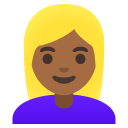
Appearance varies by platform and device. Google Noto, Twemoji, and OpenMoji are open-source.