🏃🏿♀️
The Emoji
Woman Running: Dark Skin Tone
U+1F3C3 U+1F3FF U+200D U+2640 U+FE0F · :woman_running_dark_skin_tone:
Trend 68
Meaning layers
- interpretation
- Used to signal escaping a situation, avoiding drama, ghosting someone, or literally being on the move. Also used as a celebration of Black women athletes and fitness culture. Often paired with empowerment messaging.
- tiktok usage
- Appears in 'running away from my problems' trend content, workout motivation videos, Black girl fitness content, and escape-from-cringe-situation storytelling.
- irony level
- 5 / 10
Platform meanings
- meaning
- Fitness motivation, Black girl running content, escaping situations, POV running-away humor, and athletic celebration.
- trend usage
- Featured in 'running era' trend videos, Black women marathon content, 'no more excuses' workout motivation, and escape-from-red-flags humor.
- hashtags
- #BlackGirlRuns#RunningEra#FitBlackGirls#RunningAwayFromProblems#BlackWomenAthletes
- virality score
- 72 / 100
Cultural meanings
🇺🇸
Western / Gen-Z
Widely used in fitness, empowerment, and 'escaping drama' contexts. The skin tone is intentionally chosen by or for Black Western Gen Z women as an act of representation and identity affirmation.
🇵🇰
Pakistan & India
Primarily understood as a literal fitness/running emoji. Skin tone significance may be interpreted differently given regional colorism dynamics, though urban progressive communities use it for representation.
🌍
Middle East
Interpreted mostly as a running/exercise symbol. Some regions may find the depiction of a woman running in public culturally notable; used in fitness communities and by younger diaspora generations.
🌐
Global Neutral
Universally understood as a woman running with dark skin tone. Represents physical activity, movement, and speed regardless of cultural context.
🇧🇩
Bangladesh
Understood as a fitness or exercise symbol. The specific skin tone representation resonates with Bangladeshi users who identify with the darker complexion, though emoji skin tone literacy varies widely.
🇱🇰
Sri Lanka
Interpreted as exercise or physical activity. Darker skin tones are common in Sri Lanka and the emoji may feel relatable to some users, used in fitness and motivational contexts.
🇨🇳
China
Primarily seen as a sports/running emoji. Skin tone diversity awareness is growing but still limited in mainstream usage; mostly used by international-facing or progressive communities.
🇯🇵
Japan
Interpreted literally as a running woman. Japan's emoji culture favors universal faces; the specific skin tone may be seen as representing a 'foreign' runner by some, though sports contexts normalize it.
🇰🇷
South Korea
Used in fitness and athletic contexts. K-fitness culture is booming and this emoji appears in workout content; skin tone specificity is noted but not always culturally significant in daily usage.
🇹🇼
Taiwan
Understood as sport/exercise emoji. Taiwan's progressive digital culture means skin tone diversity is respected; used in running events and fitness communities.
🇭🇰
Hong Kong
Used in fitness and exercise contexts. International exposure means Hong Kongers generally understand skin tone diversity in emoji; used in marathon and running club content.
🇵🇭
Philippines
Popular in fitness communities and OFW (overseas Filipino worker) content. Some Filipinos with darker skin tones (moreno/morena) relate to this emoji as a representation of their complexion.
🇮🇩
Indonesia
Fitness and sports usage is primary. Indonesia's diverse population includes many people with darker skin tones who may use this emoji for authentic representation in workout content.
🇹🇭
Thailand
Primarily a sports emoji. Given Thailand's colorism culture, some users may associate darker skin tones with specific social meanings, though fitness communities use it neutrally.
🇻🇳
Vietnam
Used mainly for literal running/exercise content. Skin tone nuance is less emphasized; appears in sports and fitness posts among younger, globally-connected Vietnamese users.
🇲🇾
Malaysia
Used across Malaysia's diverse ethnic communities in fitness contexts. Melanin-conscious younger users may specifically select this emoji for authentic representation.
🇸🇦
Saudi Arabia
Used in fitness and wellness contexts, particularly as women's public exercise becomes more normalized post-2017 reforms. The emoji represents active women in a culturally shifting landscape.
🇦🇪
UAE
Common in Dubai's international fitness community. The UAE's diverse Black African and South Asian populations use this emoji in running clubs, marathons, and wellness content.
🇪🇬
Egypt
Understood as an athletic/fitness emoji. Egypt has a growing running culture and this emoji appears in race event content; skin tone may resonate with darker-skinned Egyptian and Nubian communities.
🇹🇷
Turkey
Sports and fitness usage dominates. Turkey's young, digitally active population uses it in workout motivation content; skin tone representation is increasingly acknowledged by progressive users.
🇮🇷
Iran
Primarily interpreted as exercise/running. Used in fitness communities and by diaspora Iranians; the running woman also carries undertones of freedom and mobility given restrictions on women in public.
🇳🇬
Nigeria
Highly resonant in Nigeria's growing fitness culture. Nigerian users often deliberately choose this emoji to represent Black excellence, athletic achievement, and national pride in Black women's bodies.
🇿🇦
South Africa
Strong cultural resonance — used to celebrate Black South African women athletes, distance running culture (Comrades Marathon), and empowerment. The skin tone is a deliberate choice of representation.
🇬🇧
UK & Ireland
Used in fitness, Black British girl empowerment, and 'escape' humor contexts. The UK's Black British community uses it proudly; also widespread in general running/exercise posts.
🇫🇷
France
Used in sports and fitness content. France's large Afro-French community embraces this emoji for representation; also used in general athletic contexts without skin tone emphasis.
🇩🇪
Germany
Primarily fitness and exercise usage. Germany's growing awareness of representation means this emoji is used both by Black German users for identity and by allies for inclusive content.
🇪🇸
Spain & Italy
Sports and exercise contexts dominate. Mediterranean fitness culture embraces running emojis; the skin tone specificity is noted and respected in progressive communities.
🇧🇷
Brazil
Strong resonance in Brazil's Black community (Black Brazilian women = mulher negra). Used in fitness, empowerment, and 'correndo' (running) contexts; deeply tied to Black Brazilian pride movements.
🇲🇽
Mexico
Used in fitness and exercise contexts. Mexico's Afro-Mexican community uses it for representation; younger generations in major cities use it in workout motivation content.
🌎
Latin America
Resonates across Latin America's Afro-descendant communities for empowerment and representation. Generally understood as fitness/running with an important layer of racial identity affirmation.
🇦🇺
Australia & NZ
Used in fitness and running communities. Australia's Black African diaspora and Pacific Islander communities with darker skin tones use this for authentic representation in sports content.
How its meaning shifted
- 2010
This specific emoji did not exist in 2010. The base running emoji was minimal and gender/skin-tone variants had not yet been introduced to Unicode.
- 2015
Skin tone modifiers were introduced in Unicode 8.0 (2015). Early adoption was limited; used mainly by tech-savvy users conscious of representation. Gender variant was just emerging.
- 2020
Significant increase in usage during the COVID fitness boom and the Black Lives Matter movement's heightened awareness of Black representation. Black women fitness influencers drove adoption.
- 2026
Mainstream usage in Black women's fitness content, empowerment communities, and escape-humor memes. Intentional skin tone selection has become standard practice across platforms.
See it on every platform
Compare with
Adjacent emojis
Share & embed
Frequently asked
01What does the 🏃🏿♀️ Woman Running: Dark Skin Tone emoji mean?
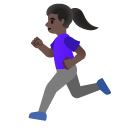
A woman with dark skin tone running, depicted in motion with one leg raised and arms pumping. Combines the woman running base emoji with the dark skin tone modifier (Fitzpatrick scale type 6).
02What does 🏃🏿♀️ mean on TikTok?
Fitness motivation, Black girl running content, escaping situations, POV running-away humor, and athletic celebration.
03What does 🏃🏿♀️ mean on WhatsApp?
Signaling that someone is leaving, rushing, or literally running somewhere. 'omw 🏃🏿♀️' is a common shorthand for 'on my way.'
04What does 🏃🏿♀️ mean in Gen-Z slang?
Used to signal escaping a situation, avoiding drama, ghosting someone, or literally being on the move. Also used as a celebration of Black women athletes and fitness culture. Often paired with empowerment messaging.
05Is the 🏃🏿♀️ emoji safe to use?
Represents a dark-skinned woman running, exercising, or moving forward. Used for fitness content, empowerment, and playful escape humor.
06What does 🏃🏿♀️ mean in texting?
The running figure evokes both forward momentum (goal-chasing, ambition) and flight (escape, avoidance). For Black women specifically, it carries additional cultural weight around reclaiming athletic spaces and celebrating physical excellence.
07What is the shortcode for 🏃🏿♀️?
The shortcode for Woman Running: Dark Skin Tone is :woman_running_dark_skin_tone:
08What does 🏃🏿♀️ mean in dating?
Rarely used as a direct flirt tool; may appear in a playful 'chasing you' context or as a response to someone being too intense — signaling 'running away' from the conversation.
Safety & usage
- Safe meaning
- Represents a dark-skinned woman running, exercising, or moving forward. Used for fitness content, empowerment, and playful escape humor.
- Caution
- Rarely weaponized, but could theoretically be used to mock someone 'running away' from responsibilities or used dismissively in arguments.
Generally safe. The skin tone modifier makes it a meaningful representation choice — misappropriation (non-Black users using it specifically to mock or stereotype) could be considered insensitive. No NSFW applications are common.
How it looks across platforms
Appearance varies by platform and device. Google Noto, Twemoji, and OpenMoji are open-source.