🏃🏾♀️
The Emoji
Woman Running: Medium-dark Skin Tone
U+1F3C3 U+1F3FE U+200D U+2640 U+FE0F · :woman_running_mediumdark_skin_tone:
Trend 68
Meaning layers
- interpretation
- Used to signal escaping awkward situations, fleeing drama, avoiding responsibilities, or hyping up someone's hustle and grind mentality. Also used literally for fitness content.
- tiktok usage
- Appears in 'running away from my problems' trend content, fitness motivation videos, and 'POV: you' running scenarios. Frequently paired with chaotic audio.
- irony level
- 7 / 10
Platform meanings
- meaning
- Used in fitness motivation, escape-from-drama scenarios, and hustle culture content. Represents both literal running and metaphorical fleeing.
- trend usage
- Appears in 'that girl' morning routine trends, 'running from my problems' duets, and workout montages. Medium-dark skin tone version is celebrated in BIPOC fitness creator spaces.
- hashtags
- #RunningGirl#ThatGirl#FitnessMotivation#RunningFromProblems#GirlsWhoRun
- virality score
- 72 / 100
Cultural meanings
🇺🇸
Western / Gen-Z
Primarily used to signal escaping awkward situations ironically, but also genuinely celebrated in BIPOC fitness and wellness content. Represents the 'that girl' era with added skin tone representation.
🇵🇰
Pakistan & India
Used literally to represent fitness activity, and increasingly among young urban women to signal independence and an active lifestyle, which can carry subtle progressive social connotations.
🌍
Middle East
Used in fitness contexts especially among women in urban areas; the specific skin tone makes it relatable to Arab women and represents modest athletic activity, though cultural sensitivity around women running publicly varies by country.
🌐
Global Neutral
Universally understood as a woman engaged in running or physical activity; the medium-dark skin tone adds a layer of representation without significantly altering the core athletic meaning.
🇧🇩
Bangladesh
Used among younger, urban Bangladeshi women to represent fitness goals and modern, active lifestyles; less common among older generations who may not relate to the emoji's cultural context.
🇱🇰
Sri Lanka
Seen in fitness communities and women's sports contexts; increasingly used by young Sri Lankan women on social media to represent athletic ambition and a healthy lifestyle.
🇨🇳
China
Used on platforms like WeChat and Weibo in fitness and health contexts; the skin tone may be seen as representing Southeast Asian or international identity rather than specifically Chinese identity.
🇯🇵
Japan
Used in jogging and running communities, women's fitness content, and occasionally in work-life balance discussions about staying active; skin tone is noted but doesn't significantly alter meaning in Japanese social media culture.
🇰🇷
South Korea
Common in fitness and K-health trend content; used by women who follow running routines as part of wellness culture, though lighter skin tone emojis are statistically more commonly selected in Korean contexts.
🇹🇼
Taiwan
Used in running communities, women's sports groups, and fitness content; appreciated for its diversity representation among younger, globally connected Taiwanese users.
🇭🇰
Hong Kong
Used in fitness and running contexts, particularly among younger users influenced by global wellness trends; the medium-dark skin tone is seen as a mark of diversity and global awareness.
🇵🇭
Philippines
Widely used in fitness motivation content; the medium-dark skin tone resonates naturally with many Filipino users and is used proudly in local fitness communities.
🇮🇩
Indonesia
Common in women's fitness communities and Islamic running groups; used to represent active Muslim women, especially when paired with modest sportswear imagery in content.
🇹🇭
Thailand
Used in fitness and wellness content, often in morning routine and healthy lifestyle posts; the skin tone is relatable to many Thai users and is used without significant cultural friction.
🇻🇳
Vietnam
Appears in fitness community content and young women's social media; used to represent an active, modern lifestyle, particularly among urban Vietnamese youth influenced by global wellness trends.
🇲🇾
Malaysia
Popular in fitness and running community contexts, especially among Malay and Indian Malaysian women; the medium-dark skin tone is inclusive and widely relatable across Malaysia's diverse demographics.
🇸🇦
Saudi Arabia
Used predominantly in digital fitness content, women's empowerment spaces post-2017 reforms, and running events for women; represents the growing women's sports culture in the Kingdom.
🇦🇪
UAE
Common in fitness and wellness content in Dubai and Abu Dhabi's cosmopolitan social media scene; resonates with the UAE's diverse population and growing women's sports culture.
🇪🇬
Egypt
Used in fitness motivation posts and women's sports content; increasingly popular among Egyptian women embracing active lifestyles and using social media to document their fitness journeys.
🇹🇷
Turkey
Used in fitness and running contexts, particularly among urban Turkish women; associated with modern, active lifestyles and is common in women's sports communities on Instagram and Twitter.
🇮🇷
Iran
Used in fitness and wellness content, especially among younger Iranian women online; represents athletic freedom and a modern lifestyle in digital spaces where such expression is more unrestricted.
🇳🇬
Nigeria
Strongly resonant in Nigerian fitness communities; the medium-dark skin tone is celebrated as representative and empowering, used widely in Lagos fitness culture and women's running clubs.
🇿🇦
South Africa
The medium-dark skin tone makes this emoji especially popular among Black South African women in fitness spaces; used in running groups, Parkrun communities, and women's wellness content.
🇬🇧
UK & Ireland
Used in fitness and running contexts by a diverse user base; the medium-dark skin tone is appreciated for its representation of the UK's multicultural communities, popular in running club social media.
🇫🇷
France
Used in fitness and sport contexts; appreciated in French social media for diversity representation, especially among Afro-French women in fitness and athletic communities.
🇩🇪
Germany
Used in fitness, marathon, and running club contexts; the skin tone representation is appreciated in multicultural urban German communities and seen as a positive symbol of diversity.
🇪🇸
Spain & Italy
Used in fitness and sports contexts, appearing in running communities and women's wellness content; the skin tone representation resonates with diverse Mediterranean and North African diaspora communities.
🇧🇷
Brazil
Widely used and highly relatable — the medium-dark skin tone resonates with Brazil's predominantly mixed-race population; used in fitness, running, and sports communities with pride and energy.
🇲🇽
Mexico
Used in fitness and running contexts, especially in urban areas; the medium-dark skin tone is relatable to many Mexican users and is used in women's fitness communities without significant cultural friction.
🌎
Latin America
Generally used for fitness and activity across Latin America; the medium-dark skin tone is relatable to Afro-Latino and mestizo communities and is used empoweringly in women's sports content.
🇦🇺
Australia & NZ
Used in running communities, Parkrun groups, and fitness content; the medium-dark skin tone represents Australia and New Zealand's multicultural communities, including Indigenous and Pacific Islander women.
How its meaning shifted
- 2010
Emoji with this level of specificity (gendered + skin tone) did not exist yet; basic running figure emojis were just emerging in Unicode.
- 2015
Gender-specific and skin tone variants were newly introduced; primarily used literally to mean 'I'm going for a run' or to represent athletic activity with excitement about diverse emoji options.
- 2020
Usage expanded significantly during COVID-19 as outdoor running surged in popularity; also adopted into 'running away from 2020' meme culture and Black Lives Matter fitness solidarity content.
- 2026
Firmly embedded in both literal fitness culture and ironic 'escape from chaos' meme usage; strongly associated with BIPOC wellness movements, 'that girl' era content, and women's empowerment in sports.
See it on every platform
Compare with
Adjacent emojis
Share & embed
Frequently asked
01What does the 🏃🏾♀️ Woman Running: Medium-dark Skin Tone emoji mean?
A woman running depicted with medium-dark skin tone, shown in motion with one leg raised and arms pumping, representing physical activity, running, jogging, or exercise.
02What does 🏃🏾♀️ mean on TikTok?
Used in fitness motivation, escape-from-drama scenarios, and hustle culture content. Represents both literal running and metaphorical fleeing.
03What does 🏃🏾♀️ mean on WhatsApp?
Telling someone you're literally on your way, rushing, or informally saying you're escaping a boring conversation or situation.
04What does 🏃🏾♀️ mean in Gen-Z slang?
Used to signal escaping awkward situations, fleeing drama, avoiding responsibilities, or hyping up someone's hustle and grind mentality. Also used literally for fitness content.
05Is the 🏃🏾♀️ emoji safe to use?
Represents athletic activity, fitness motivation, running, jogging, physical health, and by extension fleeing situations humorously.
06What does 🏃🏾♀️ mean in texting?
Running is psychologically associated with both pursuit and escape — this dual nature makes the emoji versatile for expressing either ambitious drive or the desire to flee stressful situations, tapping into the fight-or-flight instinct.
07What is the shortcode for 🏃🏾♀️?
The shortcode for Woman Running: Medium-dark Skin Tone is :woman_running_mediumdark_skin_tone:
08What does 🏃🏾♀️ mean in dating?
Used playfully to say 'I'm running to you' or 'I can't wait to see you,' or sarcastically when someone is trying to escape a situationship.
Safety & usage
- Safe meaning
- Represents athletic activity, fitness motivation, running, jogging, physical health, and by extension fleeing situations humorously.
- Caution
- Rarely used negatively; in extreme cases could be used to tell someone to 'run away' in a threatening context, but this is very uncommon.
Essentially a safe emoji with no significant toxic usage patterns. The skin tone specificity occasionally draws racial commentary but is overall celebrated for its representation.
How it looks across platforms
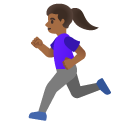
Appearance varies by platform and device. Google Noto, Twemoji, and OpenMoji are open-source.