🧍🏽♀️
The Emoji
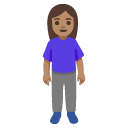
Woman Standing: Medium Skin Tone
U+1F9CD U+1F3FD U+200D U+2640 U+FE0F · :woman_standing_medium_skin_tone:
Trend 38
Meaning layers
- interpretation
- Used to convey awkward stillness, unbothered energy, or the feeling of just existing in a space without purpose — the digital equivalent of 'I'm just standing here'.
- tiktok usage
- Appears in relatable 'main character doing nothing' moments, posted when someone is just vibing or waiting awkwardly in real life.
- irony level
- 6 / 10
Platform meanings
- meaning
- Represents unbothered stillness, awkward waiting, or passive observation of absurd situations.
- trend usage
- Used in POV videos and 'standing there like' trends where the creator depicts themselves doing absolutely nothing in response to drama.
- hashtags
- #unbothered#juststanding#maincharacter#noreaction#imfine
- virality score
- 42 / 100
Cultural meanings
🇺🇸
Western / Gen-Z
Widely used as a deadpan reaction emoji representing unbothered stillness or awkward social situations — a staple of ironic Gen Z communication.
🇵🇰
Pakistan & India
Used straightforwardly to represent a woman or oneself in a waiting or neutral situation; also used humorously in relatable meme content about patience.
🌍
Middle East
Generally interpreted literally or used to represent a woman in a scene; some contexts use it to depict dignified composure in difficult situations.
🌐
Global Neutral
Universally understood as a standing woman; carries no strong cultural connotation and is widely used for straightforward human representation.
🇧🇩
Bangladesh
Used in everyday messaging to represent oneself or another woman; skin tone medium variant resonates more authentically with many Bangladeshi users.
🇱🇰
Sri Lanka
Often used casually in chats to represent standing, waiting, or idle presence; appreciated for its medium skin tone inclusion.
🇨🇳
China
Less commonly used than gesture-based emojis; when used, tends to represent waiting or neutral observation in group chats.
🇯🇵
Japan
Appreciated for its clean, simple design; used in contexts of polite waiting or neutral presence, aligning with cultural values of composure.
🇰🇷
South Korea
Used in casual KakaoTalk-style messaging to represent a calm or disinterested stance; occasionally appears in self-deprecating humor content.
🇹🇼
Taiwan
Used similarly to South Korea — casual, self-referential, often in ironic contexts about being present but emotionally checked out.
🇭🇰
Hong Kong
Seen in messaging to depict someone literally standing around or waiting; medium skin tone makes it more relatable to local users.
🇵🇭
Philippines
Commonly used in group chats to depict oneself in a boring or waiting scenario; Filipinos often pair it with humorous captions.
🇮🇩
Indonesia
Used to represent a woman in a neutral everyday situation; the medium skin tone variant is particularly embraced for cultural relatability.
🇹🇭
Thailand
Appears in casual chats to represent waiting or calm presence; sometimes used in contrast to more animated emoji to signal restraint.
🇻🇳
Vietnam
Used in relatable social media content about mundane daily life; appreciated as a simple, no-fuss self-representation emoji.
🇲🇾
Malaysia
Commonly used across ethnic groups in Malaysia to represent a woman waiting or observing; medium skin tone is widely resonant.
🇸🇦
Saudi Arabia
Used to represent a woman standing confidently; in the context of ongoing social changes, can carry a subtle note of independence and modern identity.
🇦🇪
UAE
Used in multicultural UAE contexts to represent a neutral standing woman; the medium skin tone is well-received across the diverse population.
🇪🇬
Egypt
Used in casual messaging to depict waiting, patience, or neutral presence; sometimes humorously used to represent 'just standing there while life happens'.
🇹🇷
Turkey
Used in everyday chat to represent a woman in a neutral or waiting state; appears in relatable content about patience and everyday mundanity.
🇮🇷
Iran
Used to represent a woman in everyday contexts; appreciated as a simple, non-provocative representation of female presence in casual digital communication.
🇳🇬
Nigeria
Used in relatable humor about waiting, being overlooked, or surviving chaos — fits well into Nigerian Twitter's ironic and self-aware humor culture.
🇿🇦
South Africa
Used across language groups to depict calm or idle presence; the medium skin tone resonates broadly with South Africa's diverse population.
🇬🇧
UK & Ireland
Used in dry, understated humor to represent doing absolutely nothing while the world falls apart — perfectly aligned with British ironic sensibility.
🇫🇷
France
Used to convey a certain je ne sais quoi indifference — the Gallic shrug translated into emoji form, standing unfazed.
🇩🇪
Germany
Interpreted practically as a neutral standing figure; used in casual messaging without heavy ironic layering, representing calm or waiting.
🇪🇸
Spain & Italy
Used expressively to indicate a person standing by while something dramatic unfolds; often paired with exasperated captions.
🇧🇷
Brazil
Frequently used in Brazilian Twitter and WhatsApp humor to represent witnessing absurd events with zero reaction — fits the 'tô aqui' (I'm just here) energy.
🇲🇽
Mexico
Used in meme culture and group chats to represent someone standing their ground or simply existing amid chaos with quiet dignity.
🌎
Latin America
Across Latin America, represents a woman who is present, patient, and perhaps slightly exasperated — used in relatable everyday humor.
🇦🇺
Australia & NZ
Used with classic Antipodean dry humor to represent being unbothered or standing around doing nothing — pairs well with sarcastic commentary.
How its meaning shifted
- 2010
Did not exist; skin tone modifiers and standing person emojis had not yet been introduced to the Unicode standard.
- 2015
Just introduced with Unicode 8.0 skin tone modifiers; used primarily for representation and diversity, celebrated as a step toward emoji inclusivity.
- 2020
Adopted into ironic and meme usage — the 'standing there watching everything collapse' format emerged and the emoji gained a secondary cultural life beyond literal representation.
- 2026
Fully integrated into Gen Z irony vocabulary; used as a deadpan reaction, self-representation in low-effort moments, and a staple of minimalist unbothered aesthetics across all major platforms.
See it on every platform
Compare with
Adjacent emojis
- Often confused with
- person standingwoman in lotus positionwoman walking
Share & embed
Frequently asked
01What does the 🧍🏽♀️ Woman Standing: Medium Skin Tone emoji mean?
A woman standing upright with medium skin tone, depicted in a neutral, relaxed pose with arms at sides.
02What does 🧍🏽♀️ mean on TikTok?
Represents unbothered stillness, awkward waiting, or passive observation of absurd situations.
03What does 🧍🏽♀️ mean on WhatsApp?
Signals that the sender is waiting, idle, or has nothing more to add to the conversation.
04What does 🧍🏽♀️ mean in Gen-Z slang?
Used to convey awkward stillness, unbothered energy, or the feeling of just existing in a space without purpose — the digital equivalent of 'I'm just standing here'.
05Is the 🧍🏽♀️ emoji safe to use?
A neutral representation of a standing woman with medium skin tone — safe for all audiences and contexts.
06What does 🧍🏽♀️ mean in texting?
The standing figure with no gesture conveys a psychological state of passive observation or emotional flatness — often used when someone lacks the energy or motivation to react expressively.
07What is the shortcode for 🧍🏽♀️?
The shortcode for Woman Standing: Medium Skin Tone is :woman_standing_medium_skin_tone:
08What does 🧍🏽♀️ mean in dating?
Rarely used in flirting; when used, it signals 'I'm here, come talk to me' in a low-effort, slightly aloof way.
Safety & usage
- Safe meaning
- A neutral representation of a standing woman with medium skin tone — safe for all audiences and contexts.
- Caution
- No inherently toxic usage; could theoretically be used in targeted harassment as a placeholder for a specific person, but this is extremely rare.
No significant safety concerns. In very rare edge cases it could be used to passively-aggressively represent someone being excluded or ignored, but this is context-dependent and not a widespread pattern.
How it looks across platforms
Appearance varies by platform and device. Google Noto, Twemoji, and OpenMoji are open-source.