🦹🏼♀️
The Emoji
Woman Supervillain: Medium-light Skin Tone
U+1F9B9 U+1F3FC U+200D U+2640 U+FE0F · :woman_supervillain_mediumlight_skin_tone:
Trend 72
Meaning layers
- interpretation
- Used to express a chaotic, unapologetic, 'bad girl' energy — someone owning their messy, petty, or devious behavior without shame. Also used ironically when someone does something slightly evil like finishing the last slice of pizza.
- tiktok usage
- Appears in 'villain era' content where creators celebrate cutting off toxic people, being selfish, or embracing their dark side unapologetically. Often paired with dramatic music transitions.
- irony level
- 7 / 10
Platform meanings
- meaning
- Represents entering your 'villain era' — a phase of putting yourself first and being unapologetically chaotic or selfish.
- trend usage
- Used in transformation videos, 'glow up after heartbreak' content, and 'things I did as the villain' trend series with dramatic audio overlays.
- hashtags
- #VillainEra#WomanSupervillain#UnapologeticEnergy#ChaoticGood#EvilGlowUp
- virality score
- 74 / 100
Cultural meanings
🇺🇸
Western / Gen-Z
Core to the 'villain era' trend — Western Gen Z users proudly deploy this to signal embracing selfishness, pettiness, or boundary-setting as empowerment rather than something to be ashamed of.
🇵🇰
Pakistan & India
Used among younger, digitally connected users primarily in English-language social media posts to signal a bold or rebellious female persona, though the 'villain era' cultural frame is less dominant here.
🌍
Middle East
Seen occasionally among younger Arabic-speaking social media users in English posts; may carry connotations of a strong-willed woman which can be read positively by some and negatively by more conservative audiences.
🌐
Global Neutral
Broadly understood as representing a mischievous or villainy-coded female figure, used internationally for playful 'bad girl' energy without requiring cultural-specific knowledge.
🇧🇩
Bangladesh
Primarily used by English-speaking younger demographics in urban areas on Instagram and TikTok; the villain-era frame is emerging but not yet dominant.
🇱🇰
Sri Lanka
Used in a similar fashion to neighboring South Asian countries — mostly by younger, digitally active users in English-language posts to express bold or cheeky behavior.
🇨🇳
China
Less commonly used due to platform differences (WeChat, Weibo favor local emoji sets); when used it signals a 'bad girl' or villain archetype similar to popular Chinese drama anti-heroines.
🇯🇵
Japan
The villain aesthetic resonates with Japanese pop culture's love of anti-heroes and 'akuma' (devil) characters; used in cosplay and fandom contexts more than in casual chat.
🇰🇷
South Korea
Resonates with the 'ssen unnie' (tough older sister) archetype popular in K-drama and K-pop culture; used to hype bold, no-nonsense female behavior online.
🇹🇼
Taiwan
Used in similar contexts to South Korea and Japan — fandom communities and younger social media users appreciate the anti-hero villain aesthetic it conveys.
🇭🇰
Hong Kong
Used in bilingual (Chinese-English) social media posts to convey a fierce, unapologetic female persona, especially in pop culture and entertainment commentary.
🇵🇭
Philippines
Very popular in Filipino social media, particularly on TikTok and Twitter, where the 'villain era' trend has been enthusiastically adopted by young women celebrating self-prioritization.
🇮🇩
Indonesia
Growing usage among Indonesian Gen Z on TikTok and Instagram; the villain-era narrative resonates with younger women asserting independence from family or relationship pressures.
🇹🇭
Thailand
Used in Thai social media to signal a bold or mischievous female personality; resonates with Thai pop culture's appreciation for morally complex female characters in dramas.
🇻🇳
Vietnam
Emerging usage among younger Vietnamese users, mostly in English-language or bilingual posts on Facebook and TikTok to express playful boldness or pettiness.
🇲🇾
Malaysia
Popular among young Malaysians especially on TikTok and Twitter; used both in English and Malay contexts to celebrate unapologetic female behavior.
🇸🇦
Saudi Arabia
Used cautiously by younger, internationally connected Saudi women online to signal independence and boldness; the villain framing can carry extra weight given social context around female behavior.
🇦🇪
UAE
More openly used in the cosmopolitan UAE social media scene, especially by younger women signaling fierce, independent energy in English-language posts.
🇪🇬
Egypt
Used by younger Egyptian social media users in English posts to hype bold female behavior; less understood in its full 'villain era' cultural context by older demographics.
🇹🇷
Turkey
Used among Turkish youth, especially on Twitter and Instagram, to celebrate assertive female behavior; the anti-hero frame connects well with popular Turkish drama culture.
🇮🇷
Iran
Usage is limited but found among internationally connected Iranian youth on Instagram, where it signals bold female self-expression in a context where such signals can carry added political weight.
🇳🇬
Nigeria
Popular among Nigerian Gen Z on Twitter/X and TikTok where 'bad girl' energy is celebrated; resonates with Afrobeats culture's celebration of confident, unapologetic women.
🇿🇦
South Africa
Used in South African social media to signal fierce female energy; the villain-era frame has been adopted by younger users celebrating women who refuse to be walked on.
🇬🇧
UK & Ireland
Widely used in British and Irish social media in classic villain-era contexts; British sarcasm culture amplifies the ironic 'I'm being evil' framing with extra dry wit.
🇫🇷
France
Used by younger French users on Instagram and TikTok, often with a glamorous 'femme fatale' connotation that maps onto French cultural archetypes of the mysterious, dangerous woman.
🇩🇪
Germany
Used among German Gen Z mostly in English-language posts; the direct German communication style means it's deployed less ironically and more to signal genuine boundary-setting energy.
🇪🇸
Spain & Italy
Very popular in Spanish and Italian social media — the passionate, dramatic cultural register makes the villain aesthetic feel glamorous and aspirational rather than just ironic.
🇧🇷
Brazil
Hugely popular in Brazilian social media, especially on Twitter/X and TikTok; Brazilian internet culture's love of drama and boldness makes this emoji a natural fit for 'rainha do caos' (chaos queen) vibes.
🇲🇽
Mexico
Used widely by Mexican social media users to celebrate mujeres who are unapologetically bold; ties into cultural appreciation for fierce, no-nonsense women who stand their ground.
🌎
Latin America
Across Latin America the emoji signals fierce, independent female energy — the 'chica mala' (bad girl) archetype that is both feared and celebrated in pop culture.
🇦🇺
Australia & NZ
Used in Australian and New Zealand social media in the classic villain-era context with the added cultural flavor of dry, self-deprecating humor — 'yeah I did that, absolute villain behavior mate'.
How its meaning shifted
- 2010
This emoji did not exist in 2010; the supervillain emoji set was introduced with Unicode 11.0 in 2018, so no usage occurred during this period.
- 2015
Still did not exist; pre-release period. The concept of villain-coded female empowerment existed in pop culture but lacked this specific emoji shorthand.
- 2020
After the emoji's introduction in 2018, by 2020 it was gaining traction in early 'villain era' content on TikTok, fueled by lockdown-era self-reflection and boundary-setting narratives.
- 2026
Fully integrated into Gen Z digital vocabulary as shorthand for the villain-era mindset; used across platforms in personal branding, empowerment content, and ironic self-awareness about chaotic behavior.
See it on every platform
Compare with
Adjacent emojis
Share & embed
Frequently asked
01What does the 🦹🏼♀️ Woman Supervillain: Medium-light Skin Tone emoji mean?
A woman with medium-light skin tone depicted as a supervillain, typically shown with a dramatic costume, cape, or mask suggesting villainy and mischief.
02What does 🦹🏼♀️ mean on TikTok?
Represents entering your 'villain era' — a phase of putting yourself first and being unapologetically chaotic or selfish.
03What does 🦹🏼♀️ mean on WhatsApp?
Sent after confessing to doing something sneaky or petty to a friend, like 'I may have told him she was busy 🦹🏼♀️'.
04What does 🦹🏼♀️ mean in Gen-Z slang?
Used to express a chaotic, unapologetic, 'bad girl' energy — someone owning their messy, petty, or devious behavior without shame. Also used ironically when someone does something slightly evil like finishing the last slice of pizza.
05Is the 🦹🏼♀️ emoji safe to use?
Playful expression of mischief, self-empowerment, pettiness, or villain-era identity — overwhelmingly used in lighthearted, ironic, or empowering contexts.
06What does 🦹🏼♀️ mean in texting?
Tapping into shadow archetype psychology, this emoji lets users express repressed rebellious or 'dark' desires in a safe, humorous way. It signals self-awareness about one's own chaotic tendencies.
07What is the shortcode for 🦹🏼♀️?
The shortcode for Woman Supervillain: Medium-light Skin Tone is :woman_supervillain_mediumlight_skin_tone:
08What does 🦹🏼♀️ mean in dating?
Used flirtatiously to signal 'I'm trouble but the fun kind' — a teasing, mysterious persona meant to intrigue a crush or match.
Safety & usage
- Safe meaning
- Playful expression of mischief, self-empowerment, pettiness, or villain-era identity — overwhelmingly used in lighthearted, ironic, or empowering contexts.
- Caution
- Could theoretically be used to celebrate genuinely harmful behavior or to normalize manipulative/abusive actions under the guise of 'villain era' aesthetics.
Generally safe; context-dependent. In rare cases could be used to celebrate actual harmful actions framed as 'villain behavior'. Not inherently toxic but monitor context.
How it looks across platforms
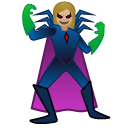
Appearance varies by platform and device. Google Noto, Twemoji, and OpenMoji are open-source.