🚶🏼♀️➡️
The Emoji
Woman Walking Facing Right: Medium-light Skin Tone
U+1F6B6 U+1F3FC U+200D U+2640 U+FE0F U+200D U+27A1 U+FE0F · :woman_walking_facing_right_mediumlight_skin_tone:
Trend 55
Meaning layers
- interpretation
- Used to signal leaving a situation, moving on, or literally walking away from drama, toxic people, or bad vibes. Often used in sequences to show a character exiting a scene.
- tiktok usage
- Appears in 'walking away' trend videos, POV skits where someone leaves a situation without looking back, or as a visual metaphor for unbothered energy.
- irony level
- 4 / 10
Platform meanings
- meaning
- Represents walking away unbothered, moving on, or the 'main character leaving the scene' energy.
- trend usage
- Used in POV videos, 'walk away' challenge content, and text-overlay videos about personal growth or cutting off people.
- hashtags
- #walkingaway#maincharacter#unbothered#movingon#girlswhowalk
- virality score
- 62 / 100
Cultural meanings
🇺🇸
Western / Gen-Z
A quintessential 'unbothered queen walking away' emoji used to signal independence, clean exits, and moving forward with zero regrets.
🇵🇰
Pakistan & India
Used literally to represent women walking, outdoor activity, or travel; also increasingly used by younger users to signal leaving a bad situation or moving on emotionally.
🌍
Middle East
Generally interpreted literally as a woman walking; in progressive youth spaces it may represent independence or modern feminine mobility.
🌐
Global Neutral
Universally understood as a woman in motion heading to the right, representing movement, progress, or walking as activity.
🇧🇩
Bangladesh
Primarily used to indicate physical movement or going for a walk; among urban youth it may carry the 'moving on' connotation.
🇱🇰
Sri Lanka
Used in casual contexts to indicate someone is heading out or going for a walk; fitness and wellness communities use it for step challenges.
🇨🇳
China
Used in fitness and wellness WeChat moments or social posts to represent walking exercise; directional emoji are popular in step-count sharing culture.
🇯🇵
Japan
Associated with peaceful solo walks, daily commutes, and mindful movement; fits well into the Japanese aesthetic of calm purposeful living.
🇰🇷
South Korea
Used in health and fitness content on KakaoTalk and Instagram; also resonates with the 'girl walking' aesthetic trend popular among Korean youth.
🇹🇼
Taiwan
Used in fitness content and lifestyle posts; the rightward direction is seen as forward progress, aligning with Taiwanese motivational culture.
🇭🇰
Hong Kong
Used in busy city contexts to represent commuting or walking through urban spaces; also used by youth to mean leaving a stressful situation.
🇵🇭
Philippines
Popularly used in OFW (Overseas Filipino Worker) community posts about moving forward, as well as in fitness and lifestyle content.
🇮🇩
Indonesia
Used among younger Indonesian users to represent morning walks or leaving negative situations; fits into self-improvement content culture.
🇹🇭
Thailand
Seen in wellness and fitness content; also used metaphorically by Thai youth online to mean disengaging from drama or conflict.
🇻🇳
Vietnam
Used in health-conscious communities and morning routine content; younger Vietnamese users also use it in 'moving on' emotional contexts.
🇲🇾
Malaysia
Appears in fitness tracking posts and casual chats to indicate going for a walk; also used metaphorically in advice about leaving bad situations.
🇸🇦
Saudi Arabia
Used primarily in fitness and health contexts, representing women's increasing participation in public walking and exercise culture.
🇦🇪
UAE
Used widely in wellness and lifestyle content; in a multicultural digital space, it carries both literal and metaphorical 'moving forward' meanings.
🇪🇬
Egypt
Used in fitness communities and casual conversation to mean going out or heading somewhere; among youth it may carry the 'walking away' metaphor.
🇹🇷
Turkey
Common in daily conversation to mean heading out or going for a walk; also used in motivational content about moving on from hardship.
🇮🇷
Iran
Used in Persian social media to represent going out, walking in nature, or quiet independence, especially among younger women expressing autonomy.
🇳🇬
Nigeria
Used in lifestyle and fitness content; also resonates in Afrobeat and youth culture as a symbol of a woman walking confidently toward her goals.
🇿🇦
South Africa
Used in fitness, outdoor, and wellness communities; also embraced in youth culture to represent leaving toxic situations behind.
🇬🇧
UK & Ireland
Used with dry humor — often the emoji equivalent of a passive-aggressive exit from a conversation; also used genuinely in walking and hiking content.
🇫🇷
France
Used in lifestyle and promenade contexts; French social media users may use it to represent elegant purposeful movement or a philosophical 'moving on.'
🇩🇪
Germany
Interpreted practically — used for walking, commuting, and health content; also adopted in motivational posts about efficiency and forward thinking.
🇪🇸
Spain & Italy
Used in travel and lifestyle content; Mediterranean cultures embrace walking culture and this emoji fits naturally into paseo (evening walk) references.
🇧🇷
Brazil
Used in fitness, empowerment, and lifestyle content; also appears in feminist-adjacent posts about women walking their own path with confidence.
🇲🇽
Mexico
Used in casual walking references and fitness content; among youth, it carries the 'walking away unbothered' attitude in response to drama.
🌎
Latin America
Broadly used across Latin America to represent movement, progress, or the cultural value of a woman who walks her own path with dignity.
🇦🇺
Australia & NZ
Used in outdoor, hiking, and fitness content; also used with laid-back humor to signal 'I'm done with this conversation' energy.
How its meaning shifted
- 2010
This specific directional variant did not exist in 2010; basic walking person emojis were just being introduced without skin tone or directional options.
- 2015
Walking emojis existed but were gender-neutral or male-defaulting; the concept of directional variants was not yet in Unicode. Women's walking emojis were emerging with the 2015 gender diversity push.
- 2020
Directional variants were added around this era; used primarily literally for walking activity, fitness tracking, and going somewhere. The 'walking away' metaphor began gaining cultural traction.
- 2026
Firmly established as both a literal fitness/movement emoji and a cultural symbol of feminine independence, unbothered energy, and clean exits from toxic situations. Widely used in wellness, self-help, and empowerment content.
See it on every platform
Adjacent emojis
- Opposite
- woman sittingsleeping faceanchor
- Often confused with
- man walking facing rightwoman walkingperson running
- Can replace
- woman runningperson walkingleg
Share & embed
Frequently asked
01What does the 🚶🏼♀️➡️ Woman Walking Facing Right: Medium-light Skin Tone emoji mean?
A woman walking and facing to the right, displayed with a medium-light skin tone. The rightward direction indicates forward movement or progression.
02What does 🚶🏼♀️➡️ mean on TikTok?
Represents walking away unbothered, moving on, or the 'main character leaving the scene' energy.
03What does 🚶🏼♀️➡️ mean on WhatsApp?
Signals leaving a conversation, going for a walk, or metaphorically moving on from a topic.
04What does 🚶🏼♀️➡️ mean in Gen-Z slang?
Used to signal leaving a situation, moving on, or literally walking away from drama, toxic people, or bad vibes. Often used in sequences to show a character exiting a scene.
05Is the 🚶🏼♀️➡️ emoji safe to use?
A woman walking to the right; used to represent movement, exercise, progress, independence, and metaphorical departure from situations.
06What does 🚶🏼♀️➡️ mean in texting?
The forward-facing direction psychologically implies agency and purpose. It can represent healthy boundaries, self-preservation, or quiet confidence in disengaging from negativity.
07What is the shortcode for 🚶🏼♀️➡️?
The shortcode for Woman Walking Facing Right: Medium-light Skin Tone is :woman_walking_facing_right_mediumlight_skin_tone:
08What does 🚶🏼♀️➡️ mean in dating?
Rarely used flirtatiously; may be used to playfully threaten to leave if someone doesn't respond or step up.
Safety & usage
- Safe meaning
- A woman walking to the right; used to represent movement, exercise, progress, independence, and metaphorical departure from situations.
- Caution
- Rarely used in toxic contexts; could be used dismissively to tell someone to 'walk away' or in harassment threads to mock someone leaving.
Generally a very safe emoji with no widely recognized harmful usage. Low risk across all platforms and demographics.
How it looks across platforms
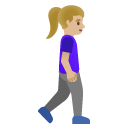
Appearance varies by platform and device. Google Noto, Twemoji, and OpenMoji are open-source.