🚶🏽♀️➡️
The Emoji
Woman Walking Facing Right: Medium Skin Tone
U+1F6B6 U+1F3FD U+200D U+2640 U+FE0F U+200D U+27A1 U+FE0F · :woman_walking_facing_right_medium_skin_tone:
Trend 58
Meaning layers
- interpretation
- Used to signal 'I'm out,' 'moving on,' or 'walking away from this situation.' Often dropped in conversations or posts to signal unbothered exit energy or self-directed momentum.
- tiktok usage
- Appears in 'walking away from my problems' trends, 'main character walking into the scene' edits, and POV transition videos where the creator is literally or metaphorically on the move.
- irony level
- 4 / 10
Platform meanings
- meaning
- Signals forward movement, walking away from drama, or the 'main character walking into her era' energy. Used in voiceover and transition trends.
- trend usage
- Frequently used in 'girl walking' aesthetic trends, 'walking away from my past self' transformation videos, and as a caption emoji in fitness/morning routine content.
- hashtags
- #girlwalking#maincharacter#walkingaway#shesonthemove#walkingintomyera
- virality score
- 62 / 100
Cultural meanings
🇺🇸
Western / Gen-Z
Primarily used as an empowerment and 'I'm out' emoji, central to the 'walking away unbothered' aesthetic popular in American and European Gen Z digital culture.
🇵🇰
Pakistan & India
Used to indicate physically going somewhere or being on the move; also adopted by younger urban women to signal independence and self-directed life choices online.
🌍
Middle East
Generally interpreted as walking/movement in everyday contexts; among younger generations, increasingly used to signal personal freedom and forward movement, especially in women's empowerment spaces.
🌐
Global Neutral
Universally understood as a woman in motion, facing right. Used across cultures to indicate walking, movement, travel, or forward progress without strong cultural charge.
🇧🇩
Bangladesh
Used in practical contexts to indicate walking or being on the way somewhere; occasionally adopted by young women online to express independence.
🇱🇰
Sri Lanka
Understood as a movement/travel emoji in general conversation; younger users adopt it for empowerment or 'on my way' messaging.
🇨🇳
China
Used by young women on platforms like Douyin and Xiaohongshu to signal solo travel aesthetics, self-improvement journeys, and the '她经济' (her economy) independent woman narrative.
🇯🇵
Japan
Interpreted cleanly as a person walking; used in travel and commute contexts. Among younger women, occasionally used for the 'solo activity' or 'independent woman' aesthetic.
🇰🇷
South Korea
Associated with the '혼행' (solo travel) trend and 'independent woman' imagery on platforms like Instagram and KakaoTalk. Used in fitness and wellness content.
🇹🇼
Taiwan
Used in travel diaries, solo adventure content, and among young women sharing their independent lifestyle on Instagram and PTT.
🇭🇰
Hong Kong
Common in messages about commuting, walking, or being en route. Younger users use it with similar 'main character walking' energy seen in Western Gen Z culture.
🇵🇭
Philippines
Broadly understood as walking or being on the move; frequently used in casual chat to say 'I'm heading out' and in empowerment content among young Filipinas.
🇮🇩
Indonesia
Used in everyday mobile communication to indicate physical movement; among Gen Z women, increasingly used in empowerment and self-care content on TikTok Indonesia.
🇹🇭
Thailand
Interpreted as movement or going somewhere in everyday chat; used in travel content and by young women expressing independence and self-sufficiency.
🇻🇳
Vietnam
Used casually to indicate being on the move; among younger women on TikTok Vietnam, adopted for 'walking into my era' type empowerment content.
🇲🇾
Malaysia
Practical use for indicating movement; among younger Malaysians on Instagram and TikTok, used to signal independence and forward-moving personal narratives.
🇸🇦
Saudi Arabia
Interpreted conservatively as movement; among younger Saudi women especially post-Vision 2030, increasingly used to signal personal freedom and social mobility.
🇦🇪
UAE
Used broadly for travel and movement; in the cosmopolitan Dubai/Abu Dhabi context, fits the expat and young women's empowerment aesthetic across platforms.
🇪🇬
Egypt
Used for literal walking or travel indication; among younger Egyptian women online, occasionally adopted to signal independence and leaving behind difficult situations.
🇹🇷
Turkey
Widely used for movement and going somewhere; young Turkish women use it in empowerment contexts, especially on Instagram and Twitter to signal personal agency.
🇮🇷
Iran
In everyday use signals walking or movement; among Iranian women on international platforms, can carry a politically charged undertone of freedom and self-directed movement.
🇳🇬
Nigeria
Used in casual chat for indicating movement; in Nigerian Gen Z culture on Twitter and TikTok, signals the confident 'I'm not entertaining this' exit energy.
🇿🇦
South Africa
Understood as movement or travel; among South African Gen Z women, used similarly to Western Gen Z for empowerment and walking-away-from-drama content.
🇬🇧
UK & Ireland
Used with similar Gen Z connotations as in the US — walking away unbothered, main character energy; also used practically for commuting and outdoor walk content.
🇫🇷
France
Used for movement and travel; younger French women use it in the context of 'promenade' aesthetics and independence-forward personal branding on Instagram.
🇩🇪
Germany
Practical interpretation as walking/movement predominates; younger Germans use it in fitness, hiking, and personal development content with some 'walking away' irony.
🇪🇸
Spain & Italy
Used for travel, outdoor life, and movement; among younger users, also carries the 'moving forward' empowerment connotation aligned with Mediterranean lifestyle aesthetics.
🇧🇷
Brazil
Widely used in casual chat for being on the move; Brazilian Gen Z women adopt it for empowerment content on TikTok and Instagram, often paired with upbeat captions.
🇲🇽
Mexico
Used to signal being on the move or heading somewhere; younger Mexican women use it in empowerment and 'walking away' contexts consistent with broader Latin American Gen Z trends.
🌎
Latin America
Broadly used across Latin America for movement and travel; among young women, increasingly tied to empowerment, solo travel, and 'nueva yo' (new me) content.
🇦🇺
Australia & NZ
Used practically for outdoor walking, hiking, and fitness content; also carries the Western Gen Z 'walking away unbothered' irony in casual digital communication.
How its meaning shifted
- 2010
This specific directional variant did not exist in 2010. General walking emojis were not yet part of Unicode, and skin tone modifiers were not yet available.
- 2015
Basic walking emojis existed but directional variants and this specific combination were not available. Skin tone modifiers were introduced in 2015 but directional walking was not yet added.
- 2020
Directional variants began rolling out; the emoji was gaining traction as a symbol of movement and independence, though its ironic 'walking away' usage was still nascent.
- 2026
Fully established in the cultural lexicon as both a literal movement indicator and a symbolic 'walking away unbothered' emoji, central to Gen Z empowerment aesthetics and main character energy trends across all major platforms.
See it on every platform
Compare with
Adjacent emojis
- Often confused with
- woman walking facing right light skin toneperson walking facing rightwoman running
- Can replace
- woman walkingrunning shoefootprints
Share & embed
Frequently asked
01What does the 🚶🏽♀️➡️ Woman Walking Facing Right: Medium Skin Tone emoji mean?
A woman walking and facing to the right, depicted with a medium skin tone. The rightward direction indicates forward movement or progression.
02What does 🚶🏽♀️➡️ mean on TikTok?
Signals forward movement, walking away from drama, or the 'main character walking into her era' energy. Used in voiceover and transition trends.
03What does 🚶🏽♀️➡️ mean on WhatsApp?
Sent to indicate leaving a situation, going for a walk, or physically being on the move. Also used to non-verbally end a conversation one is done with.
04What does 🚶🏽♀️➡️ mean in Gen-Z slang?
Used to signal 'I'm out,' 'moving on,' or 'walking away from this situation.' Often dropped in conversations or posts to signal unbothered exit energy or self-directed momentum.
05Is the 🚶🏽♀️➡️ emoji safe to use?
Represents a woman walking forward, used for movement, independence, travel, fitness, and empowerment. Entirely safe and positive in standard use.
06What does 🚶🏽♀️➡️ mean in texting?
Walking forward as a symbol of autonomy and self-directed progress. The rightward direction psychologically reads as 'future-oriented' in left-to-right reading cultures, evoking a sense of purposeful momentum without urgency.
07What is the shortcode for 🚶🏽♀️➡️?
The shortcode for Woman Walking Facing Right: Medium Skin Tone is :woman_walking_facing_right_medium_skin_tone:
08What does 🚶🏽♀️➡️ mean in dating?
Rarely used for flirting directly; can be sent after a bad date exchange to signal 'I'm walking away from this.' Sometimes used humorously as 'guess I'll just keep walking alone 🚶🏽♀️➡️' hinting at loneliness.
Safety & usage
- Safe meaning
- Represents a woman walking forward, used for movement, independence, travel, fitness, and empowerment. Entirely safe and positive in standard use.
- Caution
- In rare hostile contexts, could be used dismissively to tell a woman to 'just walk away' or be patronizingly deployed in arguments. Context-dependent.
No significant safety concerns. Occasionally used in 'walking away' meme contexts that can be dismissive in arguments, but generally benign.
How it looks across platforms
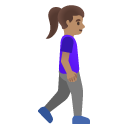
Appearance varies by platform and device. Google Noto, Twemoji, and OpenMoji are open-source.