🚶🏻♀️➡️
The Emoji
Woman Walking Facing Right: Light Skin Tone
U+1F6B6 U+1F3FB U+200D U+2640 U+FE0F U+200D U+27A1 U+FE0F · :woman_walking_facing_right_light_skin_tone:
Trend 52
Meaning layers
- interpretation
- Used to signal moving on, leaving a situation behind, or confidently walking away from drama, toxic people, or bad vibes. The rightward direction implies forward momentum and progress.
- tiktok usage
- Appears in 'walking away' trend videos, POV clips where someone is leaving a bad relationship or job, and transition content showing personal growth.
- irony level
- 4 / 10
Platform meanings
- meaning
- Symbolizes walking away from negativity, leaving a situation with dignity, or transitioning to a new life chapter.
- trend usage
- Used in transition videos, 'walking away from my old self' transformation content, and POV storytelling where a character exits a bad scenario.
- hashtags
- #walkingaway#newchapter#movingon#girlswalking#selfrespect
- virality score
- 58 / 100
Cultural meanings
🇺🇸
Western / Gen-Z
Widely used to symbolize unbothered confidence, leaving drama behind, and forward momentum — a staple in 'that girl' and self-improvement aesthetics.
🇵🇰
Pakistan & India
Used literally to indicate someone is going for a walk, or colloquially to say 'I'm leaving this conversation' — particularly common among younger, urban social media users.
🌍
Middle East
Interpreted mostly literally as walking or being on the move; younger users adopt the Western 'walking away' metaphor in English-language posts.
🌐
Global Neutral
Universally understood as a woman in motion heading to the right; the skin tone modifier may or may not be noted depending on cultural context.
🇧🇩
Bangladesh
Primarily used literally to convey going for a walk or commuting; younger users increasingly adopt its metaphorical 'moving on' usage from global social media trends.
🇱🇰
Sri Lanka
Used in casual conversation to indicate movement or departure; the directional element is sometimes used humorously in group chats.
🇨🇳
China
On platforms like WeChat and Weibo, interpreted as someone going out or taking a walk; the 'walking away' metaphor resonates with younger users influenced by global trends.
🇯🇵
Japan
Associated with the concept of 'moving forward' (前へ進む); used in motivational contexts and occasionally in kawaii-style content about daily life routines.
🇰🇷
South Korea
Popular in Kakao and Instagram culture to depict the 'healing walk' trend (힐링 산책) or signify confidently moving on after heartbreak.
🇹🇼
Taiwan
Used frequently in lifestyle and wellness content; the rightward direction aligns with positive forward-movement symbolism in Mandarin cultural contexts.
🇭🇰
Hong Kong
Blends Cantonese internet culture with global emoji trends; used to indicate 'I'm out' in both literal and metaphorical senses.
🇵🇭
Philippines
Casually used in chats to mean 'I'm heading out' or humorously in group chats when someone leaves mid-conversation; also appears in relatable meme content.
🇮🇩
Indonesia
Used on LINE, WhatsApp, and Instagram to signal departure or moving on; the light skin tone is sometimes noted in skin-tone-aware communities.
🇹🇭
Thailand
Associated with casual walking activities and sometimes used in 'moving on' content popular among Thai youth on TikTok and Instagram.
🇻🇳
Vietnam
Used to indicate physical walking or traveling; younger Vietnamese social media users adopt the metaphorical usage from international platforms.
🇲🇾
Malaysia
In Malaysian chat culture, it signals 'I'm leaving' either literally or as a conversation exit — used playfully among friend groups.
🇸🇦
Saudi Arabia
Interpreted conservatively as a walking figure; younger Saudi users on Snapchat and Twitter/X use it to signal departure or moving on.
🇦🇪
UAE
In the multicultural UAE digital space, used across both literal and metaphorical contexts; popular among expat communities for travel and movement-related posts.
🇪🇬
Egypt
Used in Egyptian WhatsApp culture to indicate someone is heading out; younger users on TikTok use it with the international 'walking away' meaning.
🇹🇷
Turkey
Popular in Turkish Twitter and Instagram culture to signal exiting a conversation or moving on from a situation; resonates with themes of independence.
🇮🇷
Iran
Used on Instagram (one of the most popular platforms despite restrictions) to indicate movement or personal journeys; metaphorical 'moving forward' usage is popular.
🇳🇬
Nigeria
Nigerian Twitter (X) users use it humorously to signal walking away from bad takes, toxic behavior, or 'leaving on sight' scenarios.
🇿🇦
South Africa
Used across English and Afrikaans-speaking social media communities to indicate departure, movement, or confidently moving on from negativity.
🇬🇧
UK & Ireland
Used with dry humor in British internet culture — 'just going to walk away from that one 🚶🏻♀️➡️' — often in response to absurd statements or chaotic comment sections.
🇫🇷
France
Used in French social media to indicate departure or moving forward; occasionally adopted in 'je m'en vais' (I'm leaving) contexts on Twitter and Instagram.
🇩🇪
Germany
Interpreted practically — often denotes actual walking activity or fitness; younger Germans also use it for the 'moving on' metaphor in casual digital communication.
🇪🇸
Spain & Italy
In Spanish and Italian social media, used expressively to signal confidently leaving a bad situation or simply indicating a walk; popular in lifestyle content.
🇧🇷
Brazil
Brazilian social media users on Instagram and Twitter use it to convey independence, movement, and the popular 'fui' (I'm gone) dismissal culture.
🇲🇽
Mexico
Used in Mexican meme culture and casual chats to indicate walking away from drama or literally heading somewhere; often paired with humor.
🌎
Latin America
Broadly used across Latin American platforms to signal movement, confidence, or departure; resonates with regional themes of resilience and forward movement.
🇦🇺
Australia & NZ
Used casually in Australian and New Zealand social media to indicate going for a walk — especially beach or bush walks — or to humorously exit conversations.
How its meaning shifted
- 2010
This specific emoji variant did not exist in 2010; basic walking emojis were not yet widely available and directional variants were far in the future.
- 2015
Walking emojis existed but directional and skin tone variants were just being introduced; skin tone modifiers launched in 2015 but directional combinations came later.
- 2020
By 2020, woman walking emojis with skin tones were common but the facing-right directional variant was not yet standardized; users improvised with existing walking emojis.
- 2026
The directional variant has become part of the expanded emoji vocabulary; used heavily in TikTok walking-away trends, self-improvement content, and the growing 'unbothered woman' meme archetype.
See it on every platform
Compare with
Adjacent emojis
Share & embed
Frequently asked
01What does the 🚶🏻♀️➡️ Woman Walking Facing Right: Light Skin Tone emoji mean?
A woman walking and facing to the right, depicted with light skin tone. The figure is shown in profile moving rightward, combining the woman walking emoji with a directional indicator and light skin tone modifier.
02What does 🚶🏻♀️➡️ mean on TikTok?
Symbolizes walking away from negativity, leaving a situation with dignity, or transitioning to a new life chapter.
03What does 🚶🏻♀️➡️ mean on WhatsApp?
Signals physically walking somewhere or metaphorically moving on from a topic or person.
04What does 🚶🏻♀️➡️ mean in Gen-Z slang?
Used to signal moving on, leaving a situation behind, or confidently walking away from drama, toxic people, or bad vibes. The rightward direction implies forward momentum and progress.
05Is the 🚶🏻♀️➡️ emoji safe to use?
A woman walking toward the right — used for movement, travel, fitness, motivation, and moving on from situations.
06What does 🚶🏻♀️➡️ mean in texting?
Directional walking emojis tap into the psychological concept of forward momentum — the sense of agency and control over one's path. The rightward direction in left-to-right reading cultures subconsciously signals progress and future orientation.
07What is the shortcode for 🚶🏻♀️➡️?
The shortcode for Woman Walking Facing Right: Light Skin Tone is :woman_walking_facing_right_light_skin_tone:
08What does 🚶🏻♀️➡️ mean in dating?
Rarely used as a flirt tool; more often sent after a disagreement to signal walking away or giving the cold shoulder — a subtle power move.
Safety & usage
- Safe meaning
- A woman walking toward the right — used for movement, travel, fitness, motivation, and moving on from situations.
- Caution
- Occasionally used passive-aggressively to signal abandonment or dismissal in relationship conflicts; rarely weaponized but can sting in the right context.
Generally very safe. In some contexts it can be sent as a dismissive gesture in arguments, but it carries no inherently harmful or NSFW connotations.
How it looks across platforms
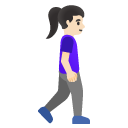
Appearance varies by platform and device. Google Noto, Twemoji, and OpenMoji are open-source.