🧕🏾
The Emoji
Woman With Headscarf: Medium-dark Skin Tone
U+1F9D5 U+1F3FE · :woman_with_headscarf_mediumdark_skin_tone:
Trend 58
Meaning layers
- interpretation
- Used by Gen Z to represent Muslim identity, cultural pride, and representation. Also used as a symbol of solidarity and allyship toward Muslim women and marginalized communities.
- tiktok usage
- Appears in Muslim lifestyle content, Ramadan videos, modest fashion content, and 'day in my life' vlogs. Frequently used in comments to show support for Muslim creators.
- irony level
- 1 / 10
Platform meanings
- meaning
- Represents Muslim identity and modest lifestyle content; used extensively during Ramadan, Eid, and in hijab tutorial or modest fashion niches.
- trend usage
- Used in #MuslimTikTok and hijab-related trends, often paired with outfit-of-the-day posts, Quran recitation videos, and Islamic reminder content.
- hashtags
- #MuslimTikTok#HijabFashion#ModestFashion#Ramadan#IslamicLifestyle
- virality score
- 62 / 100
Cultural meanings
🇺🇸
Western / Gen-Z
Seen as a powerful symbol of identity and self-expression; Gen Z in Western countries frequently uses it in allyship contexts and to celebrate Muslim friends and creators.
🇵🇰
Pakistan & India
Widely used with pride to represent Muslim women; in India it also reflects the complex sociopolitical discourse around religious identity and the hijab controversy.
🌍
Middle East
Used as a natural, everyday representation of Muslim womanhood; carries deep cultural normality and religious significance without the political edge seen in Western contexts.
🌐
Global Neutral
Universally recognized as representing a woman wearing a hijab; interpreted as a symbol of Muslim identity and religious diversity across most global contexts.
🇧🇩
Bangladesh
Used with strong cultural and religious pride; represents the majority Muslim identity and is common in family and community digital communication.
🇱🇰
Sri Lanka
Used primarily by Sri Lanka's Muslim minority to represent their identity; gained additional significance following the 2019 Easter attacks and subsequent discussions around Muslim identity.
🇨🇳
China
Associated with the Uyghur Muslim minority; use of this emoji can carry political sensitivity given government policies, though diaspora communities use it with pride.
🇯🇵
Japan
Relatively niche usage; primarily understood in educational contexts about global religious diversity, used by Japan's small Muslim community and those interested in Islamic culture.
🇰🇷
South Korea
Used by the growing Muslim community in Korea and in K-content that increasingly features diverse characters; also appears in halal tourism and cultural exchange discussions.
🇹🇼
Taiwan
Used in multicultural education contexts and by Taiwan's small Muslim population; generally interpreted as representing religious diversity.
🇭🇰
Hong Kong
Used by the South Asian and Muslim communities in Hong Kong to represent cultural identity; appears in interfaith and multicultural community communications.
🇵🇭
Philippines
Used by Filipino Muslims, particularly from Mindanao, to represent their identity; carries cultural pride as a marker of the significant Muslim minority population.
🇮🇩
Indonesia
Extremely common and culturally resonant; Indonesia as the world's largest Muslim-majority nation uses this emoji naturally and frequently across all social platforms.
🇹🇭
Thailand
Used by Thailand's Muslim minority in the southern provinces; represents cultural identity and is used in Muslim community communications.
🇻🇳
Vietnam
Used by Vietnam's small Muslim Cham community; generally interpreted by the broader population as a symbol of Islamic religion and diversity.
🇲🇾
Malaysia
Highly common and culturally significant in Malaysia's Muslim-majority society; used naturally in everyday communication and carries strong national-cultural resonance.
🇸🇦
Saudi Arabia
Represents everyday reality; used widely and naturally in digital communication, often alongside Islamic phrases and in religious and cultural contexts.
🇦🇪
UAE
Used frequently in the UAE's diverse, multicultural digital space; represents both Emirati cultural identity and the identity of the large Muslim expatriate population.
🇪🇬
Egypt
Used with strong cultural and religious familiarity; represents Egyptian Muslim women's identity and is common across all social platforms.
🇹🇷
Turkey
Carries significant political weight due to Turkey's history with debates over hijab in public spaces; used both as a statement of religious identity and sometimes in political contexts.
🇮🇷
Iran
Highly politically charged; can represent both state-enforced hijab and personal faith choice, and in the context of the Woman Life Freedom movement, its meaning is deeply contested.
🇳🇬
Nigeria
Used by Nigerian Muslim women, particularly in the north, to represent faith identity; also appears in interfaith discussions given Nigeria's significant Muslim-Christian population dynamic.
🇿🇦
South Africa
Used by South Africa's Cape Malay and broader Muslim community to represent cultural and religious identity; associated with vibrant Muslim heritage in the Western Cape.
🇬🇧
UK & Ireland
Used in UK Muslim communities to represent identity; also appears in broader multicultural conversations and diversity discussions, especially in cities with large Muslim populations.
🇫🇷
France
Carries intense political significance due to France's debates over laïcité and hijab bans; used as a symbol of resistance and identity by French Muslim women.
🇩🇪
Germany
Used in Germany's large Turkish-origin and broader Muslim community; appears in integration debates and identity discussions, carrying both cultural pride and political dimensions.
🇪🇸
Spain & Italy
Used by Muslim communities in both countries to represent identity; in Italy it appears in discussions around immigration and integration, in Spain often tied to Moorish cultural heritage discussions.
🇧🇷
Brazil
Used by Brazil's small but growing Muslim community; generally interpreted by broader Brazilian society as representing religious diversity and international cultural exchange.
🇲🇽
Mexico
Relatively niche in Mexico; used by the small Muslim community concentrated in states like Chiapas and in urban areas, and in multicultural education contexts.
🌎
Latin America
Used by small Muslim communities across Latin America; generally interpreted as representing Islamic identity and recognized as a symbol of global religious diversity.
🇦🇺
Australia & NZ
Used in multicultural contexts by Muslim communities in both countries; appears in interfaith dialogue, diversity celebrations, and by Muslim women asserting representation in public discourse.
How its meaning shifted
- 2010
The emoji did not yet exist; Muslim women's digital representation was largely absent from standard emoji sets, leading to community advocacy for inclusive emoji design.
- 2015
Still pre-release; advocacy for a hijab emoji was building, with petitions and social media campaigns calling for Unicode to add representation for Muslim women.
- 2020
Established as a meaningful representation emoji; widely adopted by Muslim communities globally, increasingly used in diversity discussions, and normalized in mainstream social media during COVID-19 when representation conversations intensified.
- 2026
Deeply embedded in Muslim digital culture and mainstream diversity communication; used naturally across generations of Muslim users and in global conversations about religious freedom, representation, and inclusion.
See it on every platform
Adjacent emojis
- Opposite
- woman blond haircrownbikini
- Can replace
- crescent moonmosquefolded hands
Share & embed
Frequently asked
01What does the 🧕🏾 Woman With Headscarf: Medium-dark Skin Tone emoji mean?
A woman wearing a hijab or headscarf, depicted with medium-dark skin tone. Represents Muslim women and women who wear headscarves for religious, cultural, or personal reasons.
02What does 🧕🏾 mean on TikTok?
Represents Muslim identity and modest lifestyle content; used extensively during Ramadan, Eid, and in hijab tutorial or modest fashion niches.
03What does 🧕🏾 mean on WhatsApp?
Used by Muslim women to represent themselves in group chats, family conversations, and community discussions; a shorthand for 'Muslim woman speaking' or Muslim identity.
04What does 🧕🏾 mean in Gen-Z slang?
Used by Gen Z to represent Muslim identity, cultural pride, and representation. Also used as a symbol of solidarity and allyship toward Muslim women and marginalized communities.
05Is the 🧕🏾 emoji safe to use?
Represents Muslim women and hijab-wearing women with pride, used for cultural and religious identity expression, solidarity, and representation advocacy.
06What does 🧕🏾 mean in texting?
This emoji carries significant psychological weight as a symbol of religious and cultural identity. For Muslim women, it can evoke feelings of being seen and represented; for others, it may trigger reflections on diversity, inclusion, and religious expression.
07What is the shortcode for 🧕🏾?
The shortcode for Woman With Headscarf: Medium-dark Skin Tone is :woman_with_headscarf_mediumdark_skin_tone:
08What does 🧕🏾 mean in dating?
Rarely used in flirtatious contexts; when used in dating apps, it typically signals religious identity and invites partners who respect Islamic values and modest dating practices.
Safety & usage
- Safe meaning
- Represents Muslim women and hijab-wearing women with pride, used for cultural and religious identity expression, solidarity, and representation advocacy.
- Caution
- Has been weaponized in anti-Islamic discourse to mock or demean Muslim women; used in hate speech contexts or to dehumanize Muslim communities on certain platforms.
This emoji can attract Islamophobic responses in politically charged discussions. Platform moderators should monitor its use in hate speech contexts. It is also sometimes misused to stereotype or essentialize Muslim women's identity.
How it looks across platforms
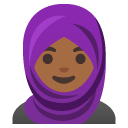


Appearance varies by platform and device. Google Noto, Twemoji, and OpenMoji are open-source.