🤼♀️
The Emoji
Women Wrestling
U+1F93C U+200D U+2640 U+FE0F · :women_wrestling:
Trend 58
Meaning layers
- interpretation
- Used to represent drama, petty conflicts, girl fights, competitive female friendships, or chaotic energy between two women. Often deployed ironically to describe arguments, beef, or intense competition.
- tiktok usage
- Appears in comment sections when two people are clearly fighting or competing, or when creators are calling out drama between public figures.
- irony level
- 7 / 10
Platform meanings
- meaning
- Drama indicator, used in comments to highlight conflict between public figures or creators, or to signal chaotic girl energy.
- trend usage
- Deployed in comment sections of drama videos, duets where two creators are beefing, or any content involving competitive female dynamics.
- hashtags
- #girlsdrama#womenbeef#girlsfight#dramaAlert#womenvsworld
- virality score
- 62 / 100
Cultural meanings
🇺🇸
Western / Gen-Z
Primarily used ironically to describe drama, petty conflicts, or competitive dynamics between women in social media contexts.
🇵🇰
Pakistan & India
Largely unfamiliar in casual use; may be interpreted literally as a sports emoji or viewed as representing physical conflict between women, which carries social stigma.
🌍
Middle East
Rarely used in everyday communication; in conservative contexts it may be seen as inappropriate due to depictions of women in physical combat.
🌐
Global Neutral
Understood as a representation of women's wrestling as a sport, used internationally in sports discussion contexts.
🇧🇩
Bangladesh
Uncommon in everyday use; interpreted literally as a sports reference with little ironic or meme-based connotation.
🇱🇰
Sri Lanka
Used primarily in sports contexts; limited awareness of its ironic or drama-related usage in Western digital culture.
🇨🇳
China
Occasionally used in sports discussions; the drama/conflict connotation is less prominent compared to Western usage.
🇯🇵
Japan
Associated with women's wrestling (joshi puroresu), a respected sport in Japan; used authentically by fans of the genre.
🇰🇷
South Korea
Used in sports contexts and occasionally in idol fan communities when female idols or groups are perceived to be in competition.
🇹🇼
Taiwan
Similar to South Korea; used in sports and entertainment contexts with limited ironic connotation.
🇭🇰
Hong Kong
Used in sports discussions and occasionally to describe interpersonal conflict in a humorous way.
🇵🇭
Philippines
Used to express drama or conflict between women, often in entertainment or celebrity gossip contexts.
🇮🇩
Indonesia
Primarily interpreted as a sports reference; the conflict/drama usage is growing among younger social media users.
🇹🇭
Thailand
Used in sports contexts and in reference to competitive dynamics; Thailand's strong martial arts culture gives it added relevance.
🇻🇳
Vietnam
Mostly literal sports usage; ironic drama connotation is emerging among youth influenced by Western social media.
🇲🇾
Malaysia
Used in sports and drama contexts; younger users familiar with Western meme culture may use it ironically.
🇸🇦
Saudi Arabia
Sensitive usage; women in physical combat may conflict with cultural norms, so it is rarely used and mostly interpreted literally in sports contexts.
🇦🇪
UAE
More cosmopolitan usage; found in sports discussions and increasingly in drama/conflict commentary among youth.
🇪🇬
Egypt
Limited usage; primarily interpreted as a sports emoji with some adoption of the drama connotation among young social media users.
🇹🇷
Turkey
Used in both sports and drama contexts; Turkey's active social media culture means the ironic connotation is gaining traction.
🇮🇷
Iran
Rarely used in public social media; in private contexts among youth it may be used ironically to describe conflicts.
🇳🇬
Nigeria
Used in Nollywood drama commentary and celebrity gossip; the conflict connotation resonates strongly in entertainment discussions.
🇿🇦
South Africa
Used in sports contexts given strong wrestling and combat sports culture, as well as in drama commentary on social media.
🇬🇧
UK & Ireland
Used similarly to US Gen Z — for drama, conflict commentary, and sports discussions, with high irony in meme culture.
🇫🇷
France
Used in sports contexts and increasingly for ironic commentary on interpersonal conflicts, following Anglo-American meme trends.
🇩🇪
Germany
Primarily literal sports usage; ironic connotation is less common but present among younger, online-savvy users.
🇪🇸
Spain & Italy
Used in sports and drama contexts; passion for conflict-driven content makes the drama connotation relatively popular.
🇧🇷
Brazil
Heavily used in celebrity drama and entertainment gossip, especially in Twitter/X and Instagram communities.
🇲🇽
Mexico
Used in entertainment drama contexts and sports discussions; lucha libre culture gives wrestling emojis added cultural resonance.
🌎
Latin America
Broadly used for drama and sports across Latin America; wrestling culture makes the literal interpretation strong alongside the drama connotation.
🇦🇺
Australia & NZ
Used similarly to the UK and US — both for literal sports and for ironic drama commentary in casual digital communication.
How its meaning shifted
- 2010
Emoji did not exist yet; women's wrestling in digital culture was discussed with text or basic emoticons.
- 2015
Introduced around this era as part of Unicode's gender-inclusive emoji expansion; used almost exclusively in literal sports contexts.
- 2020
Drama and conflict connotation began to emerge strongly, especially on TikTok and Twitter, driven by meme culture surrounding celebrity feuds.
- 2026
Firmly established as both a sports emoji and a shorthand for female conflict/drama, with high irony usage among Gen Z and Gen Alpha across all major platforms.
See it on every platform
Adjacent emojis
- Often confused with
- people wrestlingmartial arts uniformperson fencing
- Can replace
- people wrestlingcollisionanger symbol
Share & embed
Frequently asked
01What does the 🤼♀️ Women Wrestling emoji mean?
Two women engaged in a wrestling match, depicted as a competitive sport or physical grappling activity between female participants.
02What does 🤼♀️ mean on TikTok?
Drama indicator, used in comments to highlight conflict between public figures or creators, or to signal chaotic girl energy.
03What does 🤼♀️ mean on WhatsApp?
Signals that two people are having a fight or that drama is happening, often sent to a group chat with context.
04What does 🤼♀️ mean in Gen-Z slang?
Used to represent drama, petty conflicts, girl fights, competitive female friendships, or chaotic energy between two women. Often deployed ironically to describe arguments, beef, or intense competition.
05Is the 🤼♀️ emoji safe to use?
Represents women's wrestling as a sport, competitive spirit, physical strength, and female athleticism.
06What does 🤼♀️ mean in texting?
Taps into primal competitive instincts and social conflict dynamics; often used to externalize interpersonal tension in a non-threatening, humorous way.
07What is the shortcode for 🤼♀️?
The shortcode for Women Wrestling is :women_wrestling:
08What does 🤼♀️ mean in dating?
Rarely used flirtatiously; occasionally used between women in playful banter to suggest a competitive or dominant dynamic.
Safety & usage
- Safe meaning
- Represents women's wrestling as a sport, competitive spirit, physical strength, and female athleticism.
- Caution
- Can be used to demean or mock women in conflict, trivialize female disputes, or sarcastically undermine women's arguments.
Generally safe; however, context matters — when paired with targeted harassment of specific women or used to mock female public figures in degrading ways, it can contribute to toxic pile-ons.
How it looks across platforms
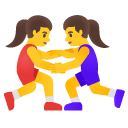
Appearance varies by platform and device. Google Noto, Twemoji, and OpenMoji are open-source.