🧟
The Emoji
Zombie
U+1F9DF · :zombie:
Trend 74
Meaning layers
- interpretation
- Used to describe feeling completely dead inside, exhausted beyond recovery, braindead from boredom or overwork, or going through the motions of life without any real engagement.
- tiktok usage
- Appears in videos about sleep deprivation, Monday morning struggles, doomscrolling all night, or dissociation — 'me at 8am after 3 hours of sleep 🧟'
- irony level
- 7 / 10
Platform meanings
- meaning
- Represents complete exhaustion, dead-inside energy, or horror/Halloween content.
- trend usage
- Used in POV videos, 'day in my life' fatigue content, Halloween transitions, and zombie makeup tutorials. Common in 'me surviving [x]' trend formats.
- hashtags
- #zombie#exhausted#deadinside#mondaymood#zombiemode
- virality score
- 78 / 100
Cultural meanings
🇺🇸
Western / Gen-Z
Universally understood as the quintessential 'dead inside, still functioning' emoji — a cornerstone of burnout and exhaustion humor in Western Gen Z digital communication.
🇵🇰
Pakistan & India
Used in urban youth circles to express extreme fatigue from exams, work pressure, or family obligations — 'board exams 🧟' is a common usage pattern.
🌍
Middle East
Popular among young Arabic-speaking social media users to express exhaustion, late-night studying, or survival during Ramadan fasting days.
🌐
Global Neutral
Broadly understood as representing extreme tiredness, horror themes, or Halloween across most global digital communities regardless of specific cultural context.
🇧🇩
Bangladesh
Used among Dhaka-based youth and university students on Facebook and WhatsApp to signal exam burnout or oppressive heat exhaustion.
🇱🇰
Sri Lanka
Appears in youth social media to humorously describe surviving power cuts, economic hardship humor, or exam season fatigue.
🇨🇳
China
Less commonly used than local equivalents on WeChat/Weibo; when used on bilingual platforms, understood in the horror or exhaustion context by younger users familiar with Western pop culture.
🇯🇵
Japan
Used on Twitter/X (popular in Japan) for relatable overwork humor, connecting to Japan's culture of karoshi (death from overwork) — darkly resonant and frequently ironic.
🇰🇷
South Korea
Popular among Korean youth on Instagram and Twitter to humorously reference study grind culture, idol fan exhaustion, or post-exam collapse.
🇹🇼
Taiwan
Used similarly to Korean context — relatable exhaustion emoji in student and young professional communities, also tied to gaming culture references.
🇭🇰
Hong Kong
Used on Instagram and Telegram to express fatigue from intense work culture and long hours — resonates with the local 'work until you drop' social critique.
🇵🇭
Philippines
Widely used among Filipino social media users to signal late-night studying, work from home exhaustion, or surviving typhoon season stress.
🇮🇩
Indonesia
Popular on TikTok and WhatsApp among Indonesian youth to express Monday dread, exam burnout, and the humor of barely surviving daily life.
🇹🇭
Thailand
Used on Facebook and TikTok to represent exhaustion or to engage with horror/undead content popular in Thai ghost and horror media culture.
🇻🇳
Vietnam
Appears in youth social media to express exhaustion from academic pressure or late-night online activity — also used in gaming contexts.
🇲🇾
Malaysia
Common in WhatsApp and Instagram among Malaysian youth for burnout humor, also tied to gaming communities and Halloween events in shopping malls.
🇸🇦
Saudi Arabia
Used by younger Saudi social media users (particularly on Snapchat and TikTok) to express fatigue during school periods or summer heat — Halloween context less prominent due to cultural restrictions.
🇦🇪
UAE
More widely used than in other Gulf states due to UAE's multicultural population — appears in both exhaustion humor and Halloween event content in Dubai/Abu Dhabi.
🇪🇬
Egypt
Used on TikTok and Facebook by Egyptian youth to express exhaustion from heat, economic pressure, or studying — often paired with relatable humor.
🇹🇷
Turkey
Popular on Twitter/X (heavily used in Turkey) for dark humor about daily struggles, economic anxiety, and collective exhaustion — fits Turkish internet's sardonic humor style well.
🇮🇷
Iran
Used on Instagram (popular despite restrictions) among Iranian youth to signal burnout, emotional numbness, and relatable fatigue — carries a subtle undertone of existential resilience.
🇳🇬
Nigeria
Used on Twitter and WhatsApp in Nigerian internet culture as part of relatable hustle culture humor — 'after NEPA takes light again 🧟' type usage.
🇿🇦
South Africa
Common in South African youth social media for load-shedding exhaustion humor, post-braai tiredness, and general 'we're all just surviving' humor.
🇬🇧
UK & Ireland
Heavily used in British and Irish internet culture to describe the Monday feeling, work exhaustion, and dark British humor about barely functioning — pairs well with self-deprecating UK humor.
🇫🇷
France
Used by French youth online for burnout humor, often in the context of critiquing work culture or surviving school — fits French internet's flair for existential complaint.
🇩🇪
Germany
Used straightforwardly for exhaustion and horror themes — German internet culture appreciates its literal clarity while younger users adopt the ironic exhaustion meaning.
🇪🇸
Spain & Italy
Used humorously for late-night social exhaustion, post-fiesta recovery, or deadpan commentary on bureaucracy and daily life frustration.
🇧🇷
Brazil
Hugely popular in Brazilian internet culture — used for relatable burnout humor, 'segunda-feira 🧟' (Monday zombie) is a very common trope on Brazilian Twitter and TikTok.
🇲🇽
Mexico
Resonates strongly given Mexico's rich tradition of Day of the Dead and undead iconography — used for both humor about exhaustion and in contexts celebrating or referencing death/undead culture.
🌎
Latin America
Broadly used across Latin America for Monday exhaustion humor, student burnout, and work survival memes — universally relatable across the region's youth culture.
🇦🇺
Australia & NZ
Common in Australian and New Zealand social media for self-deprecating humor about heat exhaustion, work grind, and Monday dread — fits the laid-back dark humor of Antipodean internet culture.
How its meaning shifted
- 2010
Pre-emoji era — zombie imagery was popular in The Walking Dead's debut year and zombie walk events, but digital use was limited to text emoticons and image macros.
- 2015
Used mainly literally for Halloween, zombie runs, horror discussions, and The Walking Dead fandom — metaphorical exhaustion usage was just beginning to emerge.
- 2020
Exploded in metaphorical use during COVID-19 — used to describe lockdown brain fog, pandemic exhaustion, quarantine monotony, and the collective dead-inside feeling of 2020.
- 2026
Firmly established as a dual-purpose emoji: horror/Halloween icon and the definitive symbol of burnout culture, Gen Z emotional numbness, and anti-hustle exhaustion humor across all major platforms.
See it on every platform
Compare with
Emoji combinations
Adjacent emojis
- Opposite
- flexed bicepssparklessun
- Often confused with
- person gesturing noperson walkingconstruction worker
- Can replace
- skullsleeping facedizzy face
Share & embed
Frequently asked
01What does the 🧟 Zombie emoji mean?
A zombie — an undead creature from folklore and pop culture, depicted with greenish skin, blank or glazed eyes, torn clothing, and outstretched arms in a shuffling pose.
02What does 🧟 mean on TikTok?
Represents complete exhaustion, dead-inside energy, or horror/Halloween content.
03What does 🧟 mean on WhatsApp?
Signals extreme tiredness or that the sender is barely functioning — casual shorthand for 'I'm dead'.
04What does 🧟 mean in Gen-Z slang?
Used to describe feeling completely dead inside, exhausted beyond recovery, braindead from boredom or overwork, or going through the motions of life without any real engagement.
05Is the 🧟 emoji safe to use?
Halloween decoration, horror fandom, exhaustion humor, gaming references, zombie pop culture discussions.
06What does 🧟 mean in texting?
Psychologically maps to depersonalization and emotional burnout — using the zombie metaphor allows people to humorously acknowledge states of deep fatigue or emotional shutdown without fully confronting them seriously.
07What is the shortcode for 🧟?
The shortcode for Zombie is :zombie:
08What does 🧟 mean in dating?
Rarely used flirtatiously; occasionally used as self-deprecating humor — 'I look like 🧟 rn but still showed up for you' to signal effort despite exhaustion.
Safety & usage
- Safe meaning
- Halloween decoration, horror fandom, exhaustion humor, gaming references, zombie pop culture discussions.
- Caution
- Could theoretically be used dehumanizingly to describe groups of people as mindless or sub-human — context-dependent risk.
Generally safe and widely understood. Rare misuse potential when applied to groups of people in a dehumanizing context. Not inherently harmful but monitor mass-use in political rhetoric.
How it looks across platforms
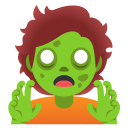


Appearance varies by platform and device. Google Noto, Twemoji, and OpenMoji are open-source.