🧏🏿
The Emoji
Deaf Person: Dark Skin Tone
U+1F9CF U+1F3FF · :deaf_person_dark_skin_tone:
Trend 48
Meaning layers
- interpretation
- Used to signal 'I'm not listening to this,' tuning out noise, or expressing selective hearing. Also used genuinely in disability representation and deaf community pride content.
- tiktok usage
- Appears in videos about ignoring drama, deaf culture education, ASL tutorials, and 'not listening to haters' content.
- irony level
- 4 / 10
Platform meanings
- meaning
- Represents deaf identity, ASL culture, disability pride, or the casual 'not hearing this' reaction to drama or bad takes.
- trend usage
- Featured in #DeafTok, ASL tutorial videos, disability awareness content, and sassy 'ignoring haters' TikToks.
- hashtags
- #DeafTok#DeafCulture#ASL#DisabilityPride#NotListening
- virality score
- 52 / 100
Cultural meanings
🇺🇸
Western / Gen-Z
Widely used in both genuine deaf pride and ironic 'not listening' contexts; deeply tied to DeafTok and disability representation movements. Gen Z tends to code-switch between sincere and humorous uses fluidly.
🇵🇰
Pakistan & India
Primarily understood as a disability representation emoji; less common in casual ironic use. Appears in accessibility advocacy content and sign language awareness campaigns in urban digital spaces.
🌍
Middle East
Used mainly in literal disability context; growing presence in accessibility advocacy content. Skin tone specificity is noted as a step forward in representation for darker-skinned populations in the region.
🌐
Global Neutral
Universally recognized as representing a deaf or hard-of-hearing person; the dark skin tone modifier adds a layer of racial inclusion that is acknowledged across diverse global communities.
🇧🇩
Bangladesh
Primarily used in disability awareness contexts; seen in social media campaigns about sign language education and deaf school initiatives. Less ironic use compared to Western contexts.
🇱🇰
Sri Lanka
Used in disability representation posts and sign language awareness content. Relatively niche usage in mainstream social media, more common in advocacy and NGO communication.
🇨🇳
China
Used mainly in disability awareness contexts; skin tone diversity emoji are less culturally emphasized in mainstream Chinese social media but appear in international-facing content.
🇯🇵
Japan
Understood primarily as a disability symbol; Japan's deaf community uses it for identity expression online. Cultural sensitivity around disability representation means it is used carefully and respectfully.
🇰🇷
South Korea
Used in deaf awareness and K-sign language educational content. The dark skin tone variant is noted in discussions of global representation, though locally lighter skin tone versions dominate usage.
🇹🇼
Taiwan
Seen in disability rights content and Taiwanese Sign Language (TSL) educational material. Progressive representation discourse in Taiwan makes the dark skin tone modifier positively received.
🇭🇰
Hong Kong
Used in disability and accessibility advocacy content; also appears in discussions of HKSL (Hong Kong Sign Language) education. The ironic 'not listening' use is less prevalent than in Western markets.
🇵🇭
Philippines
Common in disability awareness campaigns and Filipino Sign Language (FSL) educational content. Increasingly used by younger Filipinos in casual 'not listening' contexts inspired by Western social media.
🇮🇩
Indonesia
Used in disability advocacy and BISINDO (Indonesian Sign Language) promotion content. Mainstream casual use remains low but is growing among younger, globally connected Indonesians.
🇹🇭
Thailand
Appears in deaf awareness and TSL (Thai Sign Language) content. Casual ironic use is emerging among Thai Gen Z influenced by TikTok trends from Western markets.
🇻🇳
Vietnam
Used primarily in disability representation and VSL (Vietnamese Sign Language) awareness posts. Less ironic use; more genuine advocacy and community-building context.
🇲🇾
Malaysia
Used in BIM (Bahasa Isyarat Malaysia) educational content and disability advocacy. Bilingual online communities use it alongside both Malay and English captioned content.
🇸🇦
Saudi Arabia
Seen in disability awareness posts and LGArSA (Lughat al-Ishara al-Saudiya) sign language promotion. Cultural context emphasizes charitable and supportive framing around disability representation.
🇦🇪
UAE
Used in inclusive design and accessibility campaigns common in the UAE's progressive digital communication landscape. Appears in multilingual disability advocacy content across Arabic and English platforms.
🇪🇬
Egypt
Primarily used in disability awareness and Egyptian Sign Language content. Social media use is growing in advocacy spaces, with limited ironic mainstream use.
🇹🇷
Turkey
Used in TİD (Türk İşaret Dili) awareness and disability inclusion content. Turkish Gen Z occasionally adopts the 'not listening' ironic usage influenced by global social media trends.
🇮🇷
Iran
Used carefully in disability awareness contexts; open cultural discussion about deafness and accessibility is growing on platforms like Instagram and Telegram among Iranian youth.
🇳🇬
Nigeria
Used in disability representation and advocacy content; the dark skin tone variant resonates strongly as a representation of African identity in globally dominant emoji sets.
🇿🇦
South Africa
The dark skin tone modifier is particularly meaningful in South Africa's context of racial representation; used in disability advocacy and SASL (South African Sign Language) promotion.
🇬🇧
UK & Ireland
Used in both genuine deaf community content and ironic 'not hearing this' commentary. British Sign Language (BSL) communities actively use it as a digital identity marker.
🇫🇷
France
Used in LSF (Langue des Signes Française) advocacy and disability representation. French digital culture adopts it both seriously and with dry irony in dismissive comment contexts.
🇩🇪
Germany
Used in DGS (Deutsche Gebärdensprache) awareness and disability inclusion content. German online culture tends toward literal and advocacy-oriented use over ironic dismissal.
🇪🇸
Spain & Italy
Used in LSE/LIS awareness campaigns and disability advocacy. Southern European social media culture uses it both genuinely and humorously in 'not listening' contexts.
🇧🇷
Brazil
Used in LIBRAS (Língua Brasileira de Sinais) educational content and deaf pride movements. Brazilian social media culture freely mixes genuine and humorous uses with characteristic warmth.
🇲🇽
Mexico
Used in LSM (Lengua de Señas Mexicana) awareness and disability representation. Mexican Gen Z uses it both for advocacy and in 'not listening to drama' casual contexts.
🌎
Latin America
Broadly used across Latin America for deaf pride and sign language awareness; casual 'tuning out' usage is rising among younger demographics influenced by TikTok culture.
🇦🇺
Australia & NZ
Used in Auslan and NZSL awareness content and disability inclusion advocacy. Also popularly used in casual 'not listening' ironic contexts, with strong community use among deaf Australians and New Zealanders.
How its meaning shifted
- 2010
Emoji as a concept was in early adoption; this specific emoji and skin tone modifiers did not yet exist. Disability representation in emoji was essentially nonexistent.
- 2015
Skin tone modifier emojis began rolling out (Unicode 8.0, 2015); early disability-focused emojis started appearing. The deaf person emoji was not yet available, so representation was absent.
- 2020
The deaf person emoji with skin tone variants became more established (added around Unicode 12.0, 2019). Usage spiked in disability advocacy circles, ASL TikTok communities, and #DeafTok's rise during pandemic-era social media expansion.
- 2026
Firmly established in both genuine deaf community identity expression and mainstream ironic 'not listening' usage. DeafTok culture has made it recognizable globally; used frequently in accessibility tech, DEIB corporate content, and Gen Z dismissive humor.
See it on every platform
Adjacent emojis
- Often confused with
- person facepalmingperson shruggingwaving hand
Share & embed
Frequently asked
01What does the 🧏🏿 Deaf Person: Dark Skin Tone emoji mean?
A person with dark skin tone touching their ear or making a gesture associated with deafness or hearing impairment, representing a deaf or hard-of-hearing individual.
02What does 🧏🏿 mean on TikTok?
Represents deaf identity, ASL culture, disability pride, or the casual 'not hearing this' reaction to drama or bad takes.
03What does 🧏🏿 mean on WhatsApp?
Sent to express 'I'm ignoring this,' 'I didn't hear that,' or genuine representation in disability-related conversations.
04What does 🧏🏿 mean in Gen-Z slang?
Used to signal 'I'm not listening to this,' tuning out noise, or expressing selective hearing. Also used genuinely in disability representation and deaf community pride content.
05Is the 🧏🏿 emoji safe to use?
Represents deaf and hard-of-hearing identity with dark skin tone inclusion; used for disability pride, ASL/sign language awareness, and accessibility advocacy.
06What does 🧏🏿 mean in texting?
Carries dual emotional weight — genuine pride and community belonging for deaf/HoH individuals, while also being co-opted as a lighthearted 'not listening' signal. Reflects both empowerment and playful emotional boundary-setting.
07What is the shortcode for 🧏🏿?
The shortcode for Deaf Person: Dark Skin Tone is :deaf_person_dark_skin_tone:
08What does 🧏🏿 mean in dating?
Rarely used in flirting contexts; might be used humorously to say 'I can't hear your excuses' when someone is dodging a question.
Safety & usage
- Safe meaning
- Represents deaf and hard-of-hearing identity with dark skin tone inclusion; used for disability pride, ASL/sign language awareness, and accessibility advocacy.
- Caution
- Could be used mockingly toward deaf individuals or in ableist contexts to belittle communication differences; ironic overuse can sometimes trivialize deaf identity.
Using this emoji sarcastically in ways that mock deafness or use disability as a punchline can be considered ableist. Best used with awareness of the deaf community's reclamation of this symbol.
How it looks across platforms
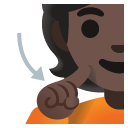


Appearance varies by platform and device. Google Noto, Twemoji, and OpenMoji are open-source.