🧏🏻
The Emoji
Deaf Person: Light Skin Tone
U+1F9CF U+1F3FB · :deaf_person_light_skin_tone:
Trend 55
Meaning layers
- interpretation
- Used to signal 'I'm not listening,' 'blocking out the noise,' or 'not hearing this drama.' Also used genuinely to represent Deaf identity or solidarity with Deaf culture.
- tiktok usage
- Appears in videos about Deaf culture, ASL tutorials, or as a metaphor for tuning out toxic people or unwanted opinions.
- irony level
- 4 / 10
Platform meanings
- meaning
- Represents Deaf identity, ASL content, or the act of tuning out noise — both literal and figurative.
- trend usage
- Common in ASL tutorial videos, Deaf creator content, and 'not listening to negativity' trend videos.
- hashtags
- #DeafTikTok#ASL#DeafCulture#HardOfHearing#DeafCommunity
- virality score
- 62 / 100
Cultural meanings
🇺🇸
Western / Gen-Z
Used both authentically by Deaf Gen Z for identity pride and ironically to mean 'I am choosing to not hear your opinion.' Strongly associated with DeafTok and ASL content.
🇵🇰
Pakistan & India
Primarily used literally to indicate deafness or hearing impairment; awareness of ASL/Deaf cultural significance is limited but growing among urban youth.
🌍
Middle East
Used mainly in literal disability or medical contexts; Deaf community representation is growing but the emoji's cultural depth is less widely recognized.
🌐
Global Neutral
Universally understood as representing a deaf or hard-of-hearing person; interpreted as an inclusion or accessibility symbol across cultures.
🇧🇩
Bangladesh
Used in disability awareness and social inclusion discussions; limited ironic or Gen Z usage; seen more as a representation of hearing impairment.
🇱🇰
Sri Lanka
Primarily literal in meaning, used by disability advocates or families of Deaf individuals; ironic usage is uncommon.
🇨🇳
China
Used in disability inclusion contexts and online discussions about accessibility; ironic usage is emerging among younger users mimicking Western meme culture.
🇯🇵
Japan
Associated with disability awareness and sign language (JSL) content; used respectfully in educational contexts and by Deaf community members.
🇰🇷
South Korea
Growing presence in disability representation content and Deaf K-content communities; younger Koreans may adopt the 'not listening' ironic usage from global trends.
🇹🇼
Taiwan
Used in Deaf community spaces and accessibility discussions; urban youth may use it ironically in line with global meme trends.
🇭🇰
Hong Kong
Seen in disability advocacy and bilingual (spoken/sign language) community content; some ironic crossover usage among youth.
🇵🇭
Philippines
Used in Deaf community organizations and awareness campaigns; also adopted humorously by Gen Z to indicate ignoring drama or noise.
🇮🇩
Indonesia
Primarily disability and accessibility context; used in Deaf community posts and sign language education content.
🇹🇭
Thailand
Mainly used in disability representation and sign language content; ironic usage exists but is secondary to literal identity usage.
🇻🇳
Vietnam
Used in disability inclusion contexts and awareness campaigns; limited ironic or meme usage among younger demographics.
🇲🇾
Malaysia
Used by Deaf community members for identity and in disability awareness content; urban youth may use it informally to indicate selective inattention.
🇸🇦
Saudi Arabia
Used in disability awareness and accessibility contexts; limited to literal interpretation in most social circles.
🇦🇪
UAE
Appears in multicultural inclusion and accessibility discussions; expat youth may use the ironic 'not listening' interpretation.
🇪🇬
Egypt
Primarily used in disability awareness and Deaf community representation; ironic usage is uncommon.
🇹🇷
Turkey
Used in Deaf community and TİD (Turkish Sign Language) content; younger users may adopt global ironic usage patterns.
🇮🇷
Iran
Used cautiously in disability representation contexts; the Deaf community uses it for identity but broader meme usage is limited.
🇳🇬
Nigeria
Used in disability inclusion advocacy; also adopted by youth online to mean 'not hearing' drama or nonsense, aligning with global meme culture.
🇿🇦
South Africa
Used in Deaf community and SASL (South African Sign Language) advocacy; youth also use it in the global ironic sense.
🇬🇧
UK & Ireland
Used both for genuine Deaf identity representation and sarcastically in 'not listening to this' contexts; BSL awareness campaigns often feature it.
🇫🇷
France
Used in Deaf community (LSF - langue des signes française) content and disability rights discussions; younger French users adopt the sarcastic usage.
🇩🇪
Germany
Primarily used in disability inclusion and DGS (Deutsche Gebärdensprache) contexts; ironic usage is present but secondary.
🇪🇸
Spain & Italy
Used in disability awareness and sign language community content; youth in both countries have adopted the ironic 'not listening' usage.
🇧🇷
Brazil
Common in Deaf community (LIBRAS) content and disability inclusion campaigns; also widely used ironically among Brazilian youth online.
🇲🇽
Mexico
Used in Deaf community and LSM (Lengua de Señas Mexicana) content; youth also use it in meme contexts to indicate selective deafness to drama.
🌎
Latin America
Across Latin America, used in Deaf community identification and disability advocacy; ironic usage is growing with Gen Z social media culture.
🇦🇺
Australia & NZ
Used for Deaf identity (Auslan/NZSL community) and disability inclusion; also adopted humorously in the ironic 'tuning out' sense by younger users.
How its meaning shifted
- 2010
This specific emoji did not exist; deafness was represented clumsily with generic disability symbols or text descriptions.
- 2015
Still not in Unicode; Deaf representation online relied on 🤟, text-based ASL descriptions, or advocacy hashtags.
- 2020
Newly introduced in Unicode 12.0 (2019); adopted enthusiastically by the Deaf community and ASL educators; beginning to appear in accessibility advocacy.
- 2026
Firmly established in Deaf community identity usage; widely recognized globally; also embedded in meme culture for the 'not listening' trope; increased use in accessibility campaigns and corporate inclusion messaging.
See it on every platform
Adjacent emojis
- Often confused with
- person gesturing okraised handperson facepalming
- Can replace
- ear with hearing aidsign of the hornsmute
Share & embed
Frequently asked
01What does the 🧏🏻 Deaf Person: Light Skin Tone emoji mean?
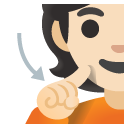
A person with light skin tone making the ASL sign for 'deaf' — hand moving from ear to mouth — representing a deaf or hard-of-hearing individual.
02What does 🧏🏻 mean on TikTok?
Represents Deaf identity, ASL content, or the act of tuning out noise — both literal and figurative.
03What does 🧏🏻 mean on WhatsApp?
Used by Deaf/HoH users for self-identification or by anyone joking that they're ignoring a conversation.
04What does 🧏🏻 mean in Gen-Z slang?
Used to signal 'I'm not listening,' 'blocking out the noise,' or 'not hearing this drama.' Also used genuinely to represent Deaf identity or solidarity with Deaf culture.
05Is the 🧏🏻 emoji safe to use?
Representation and identity for Deaf and hard-of-hearing individuals; advocacy for accessibility and inclusion; ASL/sign language cultural pride.
06What does 🧏🏻 mean in texting?
Carries dual emotional weight: genuine pride and representation for Deaf individuals, and a figurative 'tuning out' coping mechanism for others experiencing emotional overwhelm or boundary-setting.
07What is the shortcode for 🧏🏻?
The shortcode for Deaf Person: Light Skin Tone is :deaf_person_light_skin_tone:
08What does 🧏🏻 mean in dating?
Rarely used flirtatiously; may appear when someone is playfully ignoring texts or pretending not to see a message.
Safety & usage
- Safe meaning
- Representation and identity for Deaf and hard-of-hearing individuals; advocacy for accessibility and inclusion; ASL/sign language cultural pride.
- Caution
- Can be used mockingly toward Deaf individuals in ableist contexts; rarely weaponized but possible in trolling scenarios.
Should not be used sarcastically in contexts where it could mock or minimize Deaf identity. Misuse as a 'I'm ignoring you' taunt directed at Deaf individuals is ableist. Generally safe and positive in use.
How it looks across platforms


Appearance varies by platform and device. Google Noto, Twemoji, and OpenMoji are open-source.