🧏🏽
The Emoji
Deaf Person: Medium Skin Tone
U+1F9CF U+1F3FD · :deaf_person_medium_skin_tone:
Trend 52
Meaning layers
- interpretation
- Used to signal 'I'm not listening to that,' 'I can't hear the negativity,' or to express willful ignorance of drama or bad takes. Also genuinely used by Deaf Gen Z creators for identity and community pride.
- tiktok usage
- Appears in videos about ignoring toxic people, tuning out drama, or Deaf creators showcasing sign language culture. Common in 'deaf awareness' and 'I can't hear the haters' content.
- irony level
- 4 / 10
Platform meanings
- meaning
- Represents Deaf identity in creator content, or metaphorically used to signal tuning out negativity or drama.
- trend usage
- Featured in Deaf TikTok (#DeafTok), sign language tutorials, accessibility awareness trends, and 'I can't hear the hate' aesthetic videos.
- hashtags
- #DeafTok#DeafCommunity#SignLanguage#HardOfHearing#DeafAwareness
- virality score
- 58 / 100
Cultural meanings
🇺🇸
Western / Gen-Z
Widely understood both as Deaf representation and as a meme tool for 'ignoring negativity.' Gen Z Deaf creators have reclaimed it powerfully on TikTok as a badge of cultural pride.
🇵🇰
Pakistan & India
Primarily understood as a literal disability symbol; used in social awareness campaigns about hearing impairment. Less common as ironic or meme usage compared to Western contexts.
🌍
Middle East
Used mainly in disability awareness and accessibility advocacy contexts; Deaf communities in the region use it for identity representation on social media.
🌐
Global Neutral
Universally recognized as representing deaf or hard of hearing individuals; serves as a symbol for hearing accessibility globally.
🇧🇩
Bangladesh
Mostly used in disability rights advocacy and NGO communications; awareness about Deaf culture is growing and this emoji appears in related digital campaigns.
🇱🇰
Sri Lanka
Used in disability inclusion posts and occasionally by Deaf individuals as a personal identity marker on social platforms.
🇨🇳
China
Used in posts about disability services and inclusion; the Deaf community in China uses it on platforms like Weibo to signal identity.
🇯🇵
Japan
Associated with disability awareness and accessibility services; used respectfully by Deaf Japanese users and organizations supporting hearing-impaired individuals.
🇰🇷
South Korea
Used in disability advocacy and K-content accessibility discussions; Deaf Korean creators on platforms like TikTok and YouTube use it as an identity flag.
🇹🇼
Taiwan
Appears in Deaf community spaces and accessibility policy discussions; also used in supportive comments toward Hard of Hearing creators.
🇭🇰
Hong Kong
Used in disability rights content and by Deaf community organizations; occasionally appears in discussions about sign language recognition.
🇵🇭
Philippines
Common in disability awareness campaigns and social media posts by Deaf Filipino creators; used both literally and as a community solidarity symbol.
🇮🇩
Indonesia
Used in posts about hearing impairment, Deaf schools, and accessibility; Deaf Indonesian users on Instagram and TikTok use it as an identity marker.
🇹🇭
Thailand
Associated with disability inclusivity campaigns; Deaf Thai creators use it alongside Thai Sign Language content to mark their community.
🇻🇳
Vietnam
Appears in content about Deaf Vietnamese communities and accessibility education; used as an identifier by Deaf creators and NGOs.
🇲🇾
Malaysia
Used in disability awareness posts and Deaf community social media; also appears in sign language promotion campaigns run by Malaysian NGOs.
🇸🇦
Saudi Arabia
Used in disability and accessibility awareness content; Islamic context frames disability with dignity and this emoji aligns with respectful representation.
🇦🇪
UAE
Appears in inclusive workplace campaigns and Deaf community content; the UAE's push for inclusive digital spaces has increased its usage in official communications.
🇪🇬
Egypt
Used in Deaf community advocacy and NGO posts; Egyptian Sign Language creators use it as an identity marker on social media platforms.
🇹🇷
Turkey
Used in disability rights posts and Deaf community content; Turkish Deaf creators on Instagram and TikTok use it for community identification.
🇮🇷
Iran
Primarily used in disability awareness and educational content; Deaf Iranian community members use it to signal identity on accessible platforms.
🇳🇬
Nigeria
Used in disability advocacy campaigns and by Deaf Nigerian creators; growing Deaf TikTok presence in Nigeria has boosted its visibility.
🇿🇦
South Africa
Used in Deaf community content and disability rights advocacy; South Africa's 11 official languages context makes sign language representation particularly meaningful.
🇬🇧
UK & Ireland
Used by Deaf British/Irish users as identity representation; also used ironically in the 'ignoring nonsense' meme context, similar to US Gen Z usage.
🇫🇷
France
Used in French Deaf community (LSF - Langue des Signes Française) content and disability awareness posts; meme usage is less prevalent than in English-speaking regions.
🇩🇪
Germany
Used in DGS (Deutsche Gebärdensprache) community content and German disability advocacy; the practical German digital culture means it's used mostly literally.
🇪🇸
Spain & Italy
Used in Deaf community posts and disability inclusion campaigns; LSE and LIS communities use it for identity marking on Spanish and Italian social platforms.
🇧🇷
Brazil
Active in Brazilian Deaf community (LIBRAS) content and accessibility posts; Deaf Brazilian creators on Instagram and TikTok use it frequently as an identity symbol.
🇲🇽
Mexico
Used in Mexican Deaf community and LSM (Lengua de Señas Mexicana) content; appears in disability inclusion campaigns by Mexican NGOs and government bodies.
🌎
Latin America
Broadly used across Latin American Deaf communities as a unifying identity symbol; also appears in accessibility advocacy across the region's growing social media Deaf spaces.
🇦🇺
Australia & NZ
Used by Deaf Australian and New Zealand creators as identity representation; also adopted in the ironic 'not listening' meme context common in English-speaking youth culture.
How its meaning shifted
- 2010
This emoji did not exist yet; deaf representation online was limited to text descriptions or unrelated symbols. The concept was not part of the emoji lexicon.
- 2015
Still predates this emoji's introduction; disability representation discussions were growing online but this specific symbol was not yet available.
- 2020
Newly introduced in Unicode 12.0 (2019) and gaining traction; primarily used by Deaf communities and disability advocates as a literal representation tool, with meme usage beginning to emerge.
- 2026
Established dual usage: serious Deaf pride and community identity marker among Deaf/HoH individuals, alongside mainstream ironic use as a 'can't hear the negativity' symbol in Gen Z digital culture.
See it on every platform
Compare with
Adjacent emojis
- Opposite
- loudly crying facemegaphoneear
- Often confused with
- person gesturing noperson shruggingperson facepalming
- Can replace
- ear with hearing aidno entrymuted speaker
Share & embed
Frequently asked
01What does the 🧏🏽 Deaf Person: Medium Skin Tone emoji mean?
A person touching their ear or hand near their face to indicate deafness or hearing impairment, shown with medium skin tone.
02What does 🧏🏽 mean on TikTok?
Represents Deaf identity in creator content, or metaphorically used to signal tuning out negativity or drama.
03What does 🧏🏽 mean on WhatsApp?
Literally used to indicate someone is deaf or hard of hearing, or casually to say 'I'm not listening to this.'
04What does 🧏🏽 mean in Gen-Z slang?
Used to signal 'I'm not listening to that,' 'I can't hear the negativity,' or to express willful ignorance of drama or bad takes. Also genuinely used by Deaf Gen Z creators for identity and community pride.
05Is the 🧏🏽 emoji safe to use?
Representation of Deaf and Hard of Hearing individuals; disability pride and accessibility advocacy symbol.
06What does 🧏🏽 mean in texting?
Carries dual emotional weight — genuine pride and representation for the Deaf community, while also serving as a light emotional boundary-setting tool for hearing users who use it metaphorically to signal disengagement.
07What is the shortcode for 🧏🏽?
The shortcode for Deaf Person: Medium Skin Tone is :deaf_person_medium_skin_tone:
08What does 🧏🏽 mean in dating?
Rarely used in flirting; occasionally used humorously like 'sorry I can't hear your excuses 🧏🏽' to playfully dismiss someone's bad explanation.
Safety & usage
- Safe meaning
- Representation of Deaf and Hard of Hearing individuals; disability pride and accessibility advocacy symbol.
- Caution
- Can be used mockingly to dismiss someone's valid points, which may be disrespectful, particularly if used to silence marginalized voices.
Using this emoji sarcastically to dismiss serious discussions or marginalized voices can be perceived as ableist or tone-deaf. Context matters significantly.
How it looks across platforms
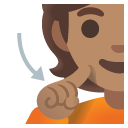


Appearance varies by platform and device. Google Noto, Twemoji, and OpenMoji are open-source.