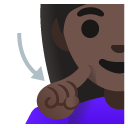
🧏🏿♀️
The Emoji
Deaf Woman: Dark Skin Tone
U+1F9CF U+1F3FF U+200D U+2640 U+FE0F · :deaf_woman_dark_skin_tone:
Trend 38
Meaning layers
- interpretation
- Used to signal 'not listening,' ignoring someone deliberately, or expressing unbothered energy. Also genuinely used in Deaf pride and disability advocacy content.
- tiktok usage
- Appears in 'I can't hear the haters' trend content, Deaf creator spaces, and subtly as a 'blocked out the noise' metaphor in self-care videos.
- irony level
- 4 / 10
Platform meanings
- meaning
- Symbol of Deaf culture pride, also repurposed as 'unbothered' or 'not listening to negativity' aesthetic.
- trend usage
- Featured in Deaf TikTok creator videos, ASL tutorial content, and 'blocking out the noise' motivation trends.
- hashtags
- #DeafTikTok#DeafPride#HardOfHearing#DeafCulture#NotListening
- virality score
- 52 / 100
Cultural meanings
🇺🇸
Western / Gen-Z
Widely used in Deaf TikTok and Instagram spaces for authentic identity representation; casually appropriated by hearing users to mean 'not listening to negativity.'
🇵🇰
Pakistan & India
Primarily used in disability awareness campaigns and social media posts; limited casual use, most appearances are in NGO or healthcare-related content.
🌍
Middle East
Appears in disability advocacy content and government accessibility initiative posts; cultural sensitivity around disability representation varies by country.
🌐
Global Neutral
Universally recognized as representing a deaf or hearing-impaired woman; safe to use in accessibility and inclusion contexts worldwide.
🇧🇩
Bangladesh
Used mainly in disability rights NGO communications and social welfare posts; not yet common in casual digital conversation.
🇱🇰
Sri Lanka
Seen in disability inclusion campaigns and special education content; growing use in social media Deaf community groups.
🇨🇳
China
Used in disability awareness content on WeChat and Weibo; the dark skin tone modifier may attract attention in a largely homogeneous digital culture.
🇯🇵
Japan
Appears in sign language learning content and disability advocacy; Japan's strong manga/kawaii emoji culture means this specific emoji sees moderate use.
🇰🇷
South Korea
Used in disability representation posts and K-culture inclusion discussions; South Korea's growing disability rights movement increases its relevance.
🇹🇼
Taiwan
Found in disability advocacy content and sign language education materials; Taiwan's progressive social policies support its positive reception.
🇭🇰
Hong Kong
Used in accessibility and social inclusion posts; also appears in protest-adjacent content about 'not being heard' metaphorically.
🇵🇭
Philippines
Seen in disability community Facebook groups and OFW community posts about health challenges; genuine use dominates over ironic use.
🇮🇩
Indonesia
Used in disability awareness content and Islamic social welfare posts about caring for differently-abled community members.
🇹🇭
Thailand
Appears in Thai Deaf community social media and school of the deaf promotional content; positive cultural reception.
🇻🇳
Vietnam
Found in disability support community posts and government accessibility initiative campaigns; limited casual digital use.
🇲🇾
Malaysia
Used in multicultural Malaysian disability advocacy content; appears in both Malay and English language posts about hearing impairment.
🇸🇦
Saudi Arabia
Primarily used in official government accessibility program content and disability charity posts; conservative context means literal interpretation dominates.
🇦🇪
UAE
Appears in Dubai and Abu Dhabi accessibility initiative campaigns; UAE's multicultural digital space means it's used by diverse communities.
🇪🇬
Egypt
Used in disability support organization posts and awareness campaigns; Egyptian digital culture skews toward literal interpretation.
🇹🇷
Turkey
Found in disability rights advocacy and social inclusion posts; growing youth engagement with Deaf culture online increases its visibility.
🇮🇷
Iran
Limited to disability awareness and social welfare content on platforms accessible within Iran; genuine representation use dominates.
🇳🇬
Nigeria
Used in disability rights posts and Nollywood accessibility discussions; Nigerian social media users occasionally repurpose it for 'not hearing bad energy' humor.
🇿🇦
South Africa
Appears in Deaf community posts and South African Sign Language (SASL) advocacy content; disability inclusion is a constitutional right there, giving this emoji political weight.
🇬🇧
UK & Ireland
Used in Deaf community content and accessibility advocacy; the dark skin tone is positively received in the UK's diverse digital culture.
🇫🇷
France
Found in disability rights posts and French Sign Language (LSF) promotion content; French digital culture is relatively literal in interpreting this emoji.
🇩🇪
Germany
Used in German Deaf community social media and accessibility technology discussions; precise and literal cultural interpretation dominates.
🇪🇸
Spain & Italy
Appears in disability awareness campaigns and sign language education posts; expressive Southern European digital culture occasionally uses it for dramatic 'not listening' humor.
🇧🇷
Brazil
Used in Brazilian Deaf community (LIBRAS) content and disability rights posts; also casually repurposed in 'não to nem aí' (couldn't care less) meme culture.
🇲🇽
Mexico
Found in Mexican disability advocacy posts and Lengua de Señas Mexicana (LSM) community content; occasional humorous use in 'ignoring drama' contexts.
🌎
Latin America
Broadly used across Latin America in disability inclusion content; the dark skin tone resonates with Afro-Latino communities for dual representation.
🇦🇺
Australia & NZ
Used in Auslan (Australian Sign Language) community posts and disability representation content; positively received in both nations' inclusive digital cultures.
How its meaning shifted
- 2010
This specific emoji did not exist yet; hearing impairment was rarely represented in emoji form and dark skin tone modifiers had not been introduced.
- 2015
Skin tone modifiers were being introduced to Unicode; disability-specific emojis were limited and Deaf representation was virtually absent from mainstream emoji sets.
- 2020
Emoji was newly introduced as part of Unicode's accessibility expansion; primarily used by Deaf communities and disability advocates, limited mainstream awareness.
- 2026
Established in Deaf TikTok and disability pride digital culture; dual-use as both genuine Deaf identity symbol and metaphorical 'unbothered' expression; recognized in DEI and accessibility professional contexts.
See it on every platform
Adjacent emojis
- Opposite
- earloudspeakerspeaking head
- Often confused with
- person shruggingnail polishperson gesturing ok
Share & embed
Frequently asked
01What does the 🧏🏿♀️ Deaf Woman: Dark Skin Tone emoji mean?
Represents a deaf or hard-of-hearing woman with dark skin tone, depicted touching her ear or the side of her head to indicate deafness or hearing impairment.
02What does 🧏🏿♀️ mean on TikTok?
Symbol of Deaf culture pride, also repurposed as 'unbothered' or 'not listening to negativity' aesthetic.
03What does 🧏🏿♀️ mean on WhatsApp?
Playfully signals ignoring a message or not wanting to hear something; also used genuinely among Deaf communities.
04What does 🧏🏿♀️ mean in Gen-Z slang?
Used to signal 'not listening,' ignoring someone deliberately, or expressing unbothered energy. Also genuinely used in Deaf pride and disability advocacy content.
05Is the 🧏🏿♀️ emoji safe to use?
Representation of Deaf or hard-of-hearing women; used in disability advocacy, Deaf culture celebration, and accessibility awareness content.
06What does 🧏🏿♀️ mean in texting?
Carries dual emotional weight — genuine pride and identity affirmation for Deaf communities, while also functioning as a boundary-setting symbol for those metaphorically tuning out stressors or negativity.
07What is the shortcode for 🧏🏿♀️?
The shortcode for Deaf Woman: Dark Skin Tone is :deaf_woman_dark_skin_tone:
08What does 🧏🏿♀️ mean in dating?
Rarely used flirtatiously; may appear when someone is playfully ignoring a text to seem uninterested or playing hard to get.
Safety & usage
- Safe meaning
- Representation of Deaf or hard-of-hearing women; used in disability advocacy, Deaf culture celebration, and accessibility awareness content.
- Caution
- Could be used mockingly to dismiss or demean someone's communication, or to dehumanize Deaf individuals if weaponized in harassment contexts.
Non-deaf users should be mindful of using this emoji as a casual 'ignoring' symbol as it can trivialize Deaf identity; the dark skin tone modifier means this emoji carries additional intersectional identity weight.
How it looks across platforms
Appearance varies by platform and device. Google Noto, Twemoji, and OpenMoji are open-source.