🧏🏾♀️
The Emoji
Deaf Woman: Medium-dark Skin Tone
U+1F9CF U+1F3FE U+200D U+2640 U+FE0F · :deaf_woman_mediumdark_skin_tone:
Trend 55
Meaning layers
- interpretation
- Used both literally to represent Deaf identity and culture, and figuratively to mean 'I'm not listening,' 'I can't hear you,' or 'that's irrelevant to me.' Also used as a sass indicator.
- tiktok usage
- Appears in TikTok comments to signal selective hearing or ignoring criticism. Deaf creators use it as a proud identity marker in their bios and videos.
- irony level
- 4 / 10
Platform meanings
- meaning
- Identity marker for Deaf/HoH creators; also used sarcastically to mean 'not listening' or 'blocking out the noise'
- trend usage
- Deaf TikTok creators use it in hashtags and bios. Hearing users use it in comment sections to signal they're ignoring drama or hate.
- hashtags
- #DeafTikTok#DeafCulture#NotListening#HardOfHearing#DeafIdentity
- virality score
- 62 / 100
Cultural meanings
🇺🇸
Western / Gen-Z
Widely used both literally by Deaf Gen Z creators building community on social media and figuratively to mean 'not listening to negativity.' Strong association with disability pride movements.
🇵🇰
Pakistan & India
Primarily understood literally as representing a deaf or hearing-impaired woman. Disability awareness campaigns increasingly use it; figurative use is limited but growing in urban digital spaces.
🌍
Middle East
Understood mostly in its literal context of disability representation. Gaining traction in disability advocacy circles, though cultural stigma around disability can complicate open use.
🌐
Global Neutral
Universally recognized as a symbol of Deaf or hard-of-hearing identity. The dismissive figurative use is understood across digital platforms regardless of language.
🇧🇩
Bangladesh
Primarily literal in meaning, associated with disability awareness. NGO and health communication accounts in Bangladesh use it when discussing hearing-related disabilities.
🇱🇰
Sri Lanka
Understood in its literal disability representation context. Disability rights organizations use it in campaigns; figurative internet usage is minimal.
🇨🇳
China
Used in disability awareness contexts on platforms like Weibo. The figurative 'not listening' interpretation is understood among younger, globally connected Chinese internet users.
🇯🇵
Japan
Associated with Deaf culture representation and disability inclusion. Japan's strong emoji culture means it appears in disability advocacy content with respectful and literal intent.
🇰🇷
South Korea
Used in Deaf community content and disability representation posts. Korean internet culture occasionally adopts the figurative use of ignoring something unwanted.
🇹🇼
Taiwan
Used in disability awareness and Deaf community content. Taiwanese social media users familiar with global meme culture also use it in the figurative 'not listening' sense.
🇭🇰
Hong Kong
Appears in disability representation content and occasionally in sarcastic digital communication among younger users who are fluent in Western internet culture.
🇵🇭
Philippines
Used primarily for disability representation; Filipino content creators in the Deaf community use it proudly. The humorous 'not listening' usage is growing among younger Filipinos online.
🇮🇩
Indonesia
Understood as a disability representation emoji. Indonesian disability advocacy groups use it in awareness campaigns; figurative internet use is emerging on Twitter/X.
🇹🇭
Thailand
Used in disability inclusion campaigns and Deaf community content. Thai social media users also pick up the dismissive figurative meaning from global meme culture.
🇻🇳
Vietnam
Primarily literal, representing deaf or hearing-impaired individuals. Disability advocacy in Vietnam increasingly uses it, and urban youth adopt it in figurative dismissal contexts.
🇲🇾
Malaysia
Used in disability representation and awareness content. The multilingual Malaysian internet community also uses it figuratively in the 'not listening' meme sense.
🇸🇦
Saudi Arabia
Understood in its literal disability representation context. Disability awareness campaigns backed by Vision 2030 initiatives increasingly incorporate such emojis for inclusion messaging.
🇦🇪
UAE
Used in disability inclusion and Deaf community content within the UAE's diverse, digitally active population. Figurative use is adopted by younger, globally connected residents.
🇪🇬
Egypt
Primarily understood as a disability representation symbol. Egyptian disability rights organizations use it; the figurative meaning is less common but present among younger urban users.
🇹🇷
Turkey
Used in disability awareness content and Deaf community representation on Turkish social media. Young Turkish users also use it humorously to mean they're ignoring something.
🇮🇷
Iran
Understood in its literal disability representation context within Iranian digital spaces. Disability advocacy groups use it cautiously given platform restrictions.
🇳🇬
Nigeria
Used in disability awareness posts and Deaf community content. Nigerian Gen Z and millennial users also adopt the figurative 'not listening to negativity' usage in social media.
🇿🇦
South Africa
Used both for Deaf community representation and figuratively to dismiss negativity. South African disability organizations actively use it in awareness and inclusion campaigns.
🇬🇧
UK & Ireland
Used literally by the Deaf community and figuratively in British internet humor to dismiss annoying people or situations with dry wit.
🇫🇷
France
Recognized as disability representation; French Deaf community organizations use it. Figurative use in dismissal contexts is growing among younger French social media users.
🇩🇪
Germany
Used in disability inclusion content and Deaf culture communities. German internet users adopt it straightforwardly, with limited sarcastic or ironic overlay.
🇪🇸
Spain & Italy
Used in Deaf community and disability representation content. Spanish and Italian social media users also use it expressively to signal they're choosing not to engage with something.
🇧🇷
Brazil
Brazilian Deaf community uses it as a proud identity marker on social media. Figurative usage for ignoring drama is very common in Brazilian internet culture, especially on Twitter/X.
🇲🇽
Mexico
Used in disability representation and Deaf community content. Mexican social media users freely adopt the 'not listening' figurative meaning in humorous and sarcastic contexts.
🌎
Latin America
Across Latin America, it serves dual purpose as Deaf identity representation and a widely understood figurative symbol for tuning out negativity or drama.
🇦🇺
Australia & NZ
Used by the Deaf community for proud identity representation and by general users to humorously signal selective hearing or dismissal of unwanted input.
How its meaning shifted
- 2010
This specific emoji did not exist in 2010. General disability-related communication relied on text descriptions or basic hand gesture emojis that were often misappropriated.
- 2015
Emoji for disability representation were beginning to be discussed but this specific emoji had not yet been introduced. Deaf community members used approximate hand gesture emojis.
- 2020
Introduced as part of expanded disability and skin tone representation. Immediately adopted by the Deaf community on social media as a long-awaited identity symbol.
- 2026
Established dual identity: a proud Deaf community symbol used globally in advocacy and representation, and a widely understood figurative emoji for choosing not to engage with negativity or drama.
See it on every platform
Compare with
Adjacent emojis
Share & embed
Frequently asked
01What does the 🧏🏾♀️ Deaf Woman: Medium-dark Skin Tone emoji mean?
A woman with medium-dark skin tone placing her hand near her ear or pointing to it, representing deafness or hard-of-hearing identity. Part of the disability representation emoji set.
02What does 🧏🏾♀️ mean on TikTok?
Identity marker for Deaf/HoH creators; also used sarcastically to mean 'not listening' or 'blocking out the noise'
03What does 🧏🏾♀️ mean on WhatsApp?
Literal representation of being Deaf or hard-of-hearing, or metaphorically saying 'I'm tuning you out'
04What does 🧏🏾♀️ mean in Gen-Z slang?
Used both literally to represent Deaf identity and culture, and figuratively to mean 'I'm not listening,' 'I can't hear you,' or 'that's irrelevant to me.' Also used as a sass indicator.
05Is the 🧏🏾♀️ emoji safe to use?
Representation of Deaf or hard-of-hearing identity; metaphorical expression of choosing not to engage with negativity or unwanted communication.
06What does 🧏🏾♀️ mean in texting?
For Deaf and hard-of-hearing individuals, this emoji carries strong identity pride and community belonging. For hearing users, it often signals emotional self-protection through metaphorical 'not listening.'
07What is the shortcode for 🧏🏾♀️?
The shortcode for Deaf Woman: Medium-dark Skin Tone is :deaf_woman_mediumdark_skin_tone:
08What does 🧏🏾♀️ mean in dating?
Rarely used in flirting contexts; occasionally used humorously when someone is ignoring their crush's mixed signals or pretending not to hear a rejection.
Safety & usage
- Safe meaning
- Representation of Deaf or hard-of-hearing identity; metaphorical expression of choosing not to engage with negativity or unwanted communication.
- Caution
- Can be used mockingly toward Deaf individuals or weaponized to dismiss and silence someone in a debate, which crosses into ableist territory when used without awareness.
Using this emoji to mock Deaf individuals or as a dismissive tool against someone's valid concerns can be considered ableist. Context matters significantly. Non-Deaf users should be mindful of how figurative use might feel disrespectful to the Deaf community.
How it looks across platforms
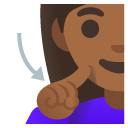
Appearance varies by platform and device. Google Noto, Twemoji, and OpenMoji are open-source.