🧏🏾
The Emoji
Deaf Person: Medium-dark Skin Tone
U+1F9CF U+1F3FE · :deaf_person_mediumdark_skin_tone:
Trend 55
Meaning layers
- interpretation
- Used to signal 'I literally cannot hear you / I'm not listening,' often as a playful or dismissive gesture. Also used in Deaf culture advocacy and ASL awareness content.
- tiktok usage
- Appears in Deaf TikTok, ASL tutorial videos, and as a metaphor for ignoring drama or bad takes. Common in 'not listening to negativity' content.
- irony level
- 5 / 10
Platform meanings
- meaning
- Represents Deaf identity, ASL content creators, or metaphorically 'not listening to bs'
- trend usage
- Heavily used in Deaf TikTok community, ASL tutorials, and 'tuning out negativity' trends
- hashtags
- #DeafTikTok#ASL#DeafCulture#HardOfHearing#DeafPride
- virality score
- 62 / 100
Cultural meanings
🇺🇸
Western / Gen-Z
Widely understood both as genuine Deaf identity representation and as an ironic 'not listening' response. Medium-dark skin tone is seen as important inclusive representation.
🇵🇰
Pakistan & India
Primarily interpreted literally as a sign for deafness or hearing impairment. Disability representation is increasingly recognized in urban digital spaces.
🌍
Middle East
Used mainly in literal contexts relating to deafness. Deaf awareness content is growing, but the ironic metaphorical use is less common.
🌐
Global Neutral
Universally understood as representing a deaf or hard-of-hearing person. The skin tone modifier signals diversity and inclusion.
🇧🇩
Bangladesh
Interpreted primarily in its literal sense as a disability indicator. Digital awareness of Deaf culture is emerging among younger users.
🇱🇰
Sri Lanka
Used mostly in disability advocacy and awareness contexts. Ironic usage is relatively uncommon outside of English-fluent digital communities.
🇨🇳
China
Disability-related emoji are used more carefully; this emoji is used in disability rights and education content, with limited ironic usage.
🇯🇵
Japan
Associated with hearing impairment awareness and accessibility conversations. Japanese digital culture tends toward literal interpretation of this emoji.
🇰🇷
South Korea
Used in disability representation content and occasionally in ironic 'not listening to k-drama spoilers' jokes among younger users.
🇹🇼
Taiwan
Appears in disability awareness posts and deaf community digital spaces. More literal than ironic in usage context.
🇭🇰
Hong Kong
Used in Deaf advocacy and English-influenced digital communities. Bilingual users may employ the ironic dismissal meaning as well.
🇵🇭
Philippines
Common in OFW communities when expressing 'not listening to drama.' Also used sincerely in Deaf Filipino community spaces.
🇮🇩
Indonesia
Primarily used in disability awareness contexts. The 'ignoring' metaphor is used among younger, English-influenced social media users.
🇹🇭
Thailand
Used in disability representation posts and occasionally to signal tuning out gossip or negativity in Thai social media.
🇻🇳
Vietnam
Seen in disability education content and Deaf community awareness campaigns. Literal interpretation dominates.
🇲🇾
Malaysia
English-fluent Malaysian users adopt both the literal and ironic interpretations. Used in Deaf community groups and casual dismissal contexts.
🇸🇦
Saudi Arabia
Used in disability awareness contexts and occasionally in posts about selective attention. Cultural sensitivity around disability representation is high.
🇦🇪
UAE
In the diverse, English-fluent UAE digital landscape, both literal and ironic uses are recognized, particularly among expat communities.
🇪🇬
Egypt
Used in disability solidarity and awareness posts. Younger Egyptian users may adopt the 'not listening' interpretation from global trends.
🇹🇷
Turkey
Appears in deaf community advocacy content. The dismissal interpretation is gaining traction among younger Turkish social media users.
🇮🇷
Iran
Used in disability rights contexts with careful intent. Ironic usage is less developed given platform restrictions and cultural norms.
🇳🇬
Nigeria
Used in disability inclusion content and often combined with the metaphorical meaning of 'not hearing negative energy.' Nollywood-adjacent humor occasionally incorporates it.
🇿🇦
South Africa
Active in Deaf South African community digital spaces and in broader conversations about disability inclusion in a multilingual context.
🇬🇧
UK & Ireland
Both literal and ironic uses are widespread. British humor particularly enjoys the deadpan 'not listening' application in Twitter/X culture.
🇫🇷
France
Used in disability rights discourse and occasionally in French social media as a metaphor for ignoring criticism or unwanted advice.
🇩🇪
Germany
Primarily used in disability awareness and accessibility advocacy. Germans tend toward literal interpretation with high respect for its representative purpose.
🇪🇸
Spain & Italy
Used in disability inclusion content and casually to signal tuning out drama or unnecessary noise in social feeds.
🇧🇷
Brazil
Popular in Deaf Brazilian community spaces (LIBRAS community) and used humorously to ignore drama, especially combined with 💅 energy.
🇲🇽
Mexico
Used in disability advocacy and in casual social media to signal 'no te escucho' (I don't hear you) toward negativity or drama.
🌎
Latin America
Across Latin America, used in Deaf community representation and as a playful dismissal of bad vibes or gossip.
🇦🇺
Australia & NZ
Used in Auslan (Australian Sign Language) community posts and widely understood as an ironic 'not hearing that nonsense' in casual digital contexts.
How its meaning shifted
- 2010
Emoji did not exist yet; disability representation in emoji was extremely limited and skin tone modifiers were not yet available.
- 2015
Still not introduced; disability and identity representation in emoji sets was a growing advocacy issue being raised by Deaf communities.
- 2020
Newly introduced (Unicode 12.0, 2019); primarily used in Deaf Pride content, ASL education, and disability representation posts. Ironic usage just beginning.
- 2026
Established in Deaf TikTok and across disability advocacy spaces. Dual use — genuine identity representation and metaphorical boundary-setting — is widely understood by Gen Z globally.
See it on every platform
Adjacent emojis
- Opposite
- earloudspeakertelephone receiver
- Often confused with
- person shruggingperson facepalmingperson gesturing ok
Share & embed
Frequently asked
01What does the 🧏🏾 Deaf Person: Medium-dark Skin Tone emoji mean?
A person with medium-dark skin tone using the universal sign for 'deaf' — hand touching the ear and then the mouth — indicating deafness or hearing impairment.
02What does 🧏🏾 mean on TikTok?
Represents Deaf identity, ASL content creators, or metaphorically 'not listening to bs'
03What does 🧏🏾 mean on WhatsApp?
Telling someone you're not listening to them or literally signaling hearing impairment
04What does 🧏🏾 mean in Gen-Z slang?
Used to signal 'I literally cannot hear you / I'm not listening,' often as a playful or dismissive gesture. Also used in Deaf culture advocacy and ASL awareness content.
05Is the 🧏🏾 emoji safe to use?
Represents Deaf and hard-of-hearing identity and culture; used for disability awareness, ASL education, and inclusivity.
06What does 🧏🏾 mean in texting?
Carries dual emotional weight — genuine representation of Deaf identity and pride, but also used metaphorically to express emotional boundaries or refusal to engage with negativity.
07What is the shortcode for 🧏🏾?
The shortcode for Deaf Person: Medium-dark Skin Tone is :deaf_person_mediumdark_skin_tone:
08What does 🧏🏾 mean in dating?
Rarely used in flirting; could be used humorously as 'I can't hear your excuses' when a partner is making weak justifications.
Safety & usage
- Safe meaning
- Represents Deaf and hard-of-hearing identity and culture; used for disability awareness, ASL education, and inclusivity.
- Caution
- Could potentially be misused to mock someone's hearing impairment, though this is rare. More commonly misused as dismissive 'ignoring' without awareness of Deaf representation.
Using this emoji purely as an 'ignoring' prop without awareness of its Deaf community significance may be seen as appropriative or insensitive by Deaf advocates.
How it looks across platforms
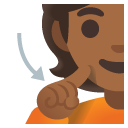


Appearance varies by platform and device. Google Noto, Twemoji, and OpenMoji are open-source.