🧏🏽♀️
The Emoji
Deaf Woman: Medium Skin Tone
U+1F9CF U+1F3FD U+200D U+2640 U+FE0F · :deaf_woman_medium_skin_tone:
Trend 52
Meaning layers
- interpretation
- Used to signal 'I'm not listening,' 'talk to the hand,' or 'I can't hear this negativity.' Often deployed as a humorous way to indicate selective hearing or ignoring someone.
- tiktok usage
- Appears in comment sections when someone wants to tune out criticism or drama, or in captions about ignoring bad takes.
- irony level
- 6 / 10
Platform meanings
- meaning
- Symbol of tuning out, ignoring drama, or unbothered energy; also used by Deaf creators for genuine representation.
- trend usage
- Appears in 'POV you can't hear the hate' trends and Deaf awareness content.
- hashtags
- #DeafTikTok#IgnoreTheNoise#Unbothered#DeafAwareness#SelectiveHearing
- virality score
- 58 / 100
Cultural meanings
🇺🇸
Western / Gen-Z
Widely used as a meme shorthand for 'I'm not listening' or 'ignoring negativity,' while also strongly embraced by actual Deaf community members for pride and identity.
🇵🇰
Pakistan & India
Primarily interpreted literally as representing a person with hearing impairment; disability stigma in some communities means it's used carefully, though urban youth may use it humorously.
🌍
Middle East
Mostly understood in its literal sense as representing hearing impairment; Deaf community members in the region use it for identity, while general use remains limited.
🌐
Global Neutral
Universally recognized as representing Deaf or hard-of-hearing women; the medium skin tone makes it broadly relatable across diverse populations.
🇧🇩
Bangladesh
Predominantly interpreted as a disability symbol; Deaf advocacy groups use it online, while mainstream ironic usage is limited.
🇱🇰
Sri Lanka
Used mainly in disability awareness contexts and by Deaf community advocates; humorous usage is rare.
🇨🇳
China
On platforms like WeChat or Weibo, interpreted as 'not wanting to listen' or ignoring someone, with literal Deaf representation less prominent in mainstream chat.
🇯🇵
Japan
Used with nuanced politeness — may signal 'I couldn't catch that' in a soft, non-confrontational way; Deaf community uses it for identity.
🇰🇷
South Korea
Younger Korean users use it humorously to signal blocking out criticism or K-drama-level drama; Deaf community also uses it for pride.
🇹🇼
Taiwan
Used similarly to South Korea — blend of humorous 'ignoring' usage and genuine Deaf community representation.
🇭🇰
Hong Kong
Appears in protest-adjacent contexts meaning 'the government isn't listening,' as well as in Deaf community spaces.
🇵🇭
Philippines
Used both literally for Deaf representation and humorously among younger Filipinos to signal 'not hearing' bad news or criticism.
🇮🇩
Indonesia
Primarily literal use for disability representation; some younger urban users adopt the humorous 'ignoring' interpretation.
🇹🇭
Thailand
Interpreted as a cute dismissal gesture by younger users; Deaf advocacy communities use it for serious representation.
🇻🇳
Vietnam
Used in Deaf awareness campaigns and occasionally by younger users to humorously signal tuning out unpleasant conversations.
🇲🇾
Malaysia
Bilingual digital culture means it's used both in Deaf community advocacy and in casual jokes about selective hearing.
🇸🇦
Saudi Arabia
Mostly literal disability representation; gender dynamics mean a woman-specific emoji may draw more attention, but Deaf advocacy uses it seriously.
🇦🇪
UAE
Used in multicultural digital spaces for both Deaf representation and the universal 'unbothered' meme context.
🇪🇬
Egypt
Primarily understood as a disability symbol; youth on TikTok-like platforms may adopt the ironic usage.
🇹🇷
Turkey
Used humorously among youth to indicate ignoring drama or unwanted advice, as well as in disability inclusion discussions.
🇮🇷
Iran
Mainly used in Deaf community advocacy circles; limited ironic mainstream usage due to conservative digital norms.
🇳🇬
Nigeria
Popular in Nollywood fan spaces and among Nigerian youth to express 'not hearing nonsense,' blending humor with mild Deaf representation.
🇿🇦
South Africa
Used in disability advocacy and also in youth slang for 'I'm deaf to the drama,' reflecting the country's rich emoji-as-slang culture.
🇬🇧
UK & Ireland
British users frequently use it sarcastically — 'sorry, what was that? 🧏🏽♀️' — while Deaf communities use it for pride during Deaf Awareness Week.
🇫🇷
France
Used in Deaf community spaces and occasionally in social commentary to signal not listening to political noise.
🇩🇪
Germany
Precise in usage — often either genuine Deaf representation or clear sarcasm; ambiguity is less common than in Anglo cultures.
🇪🇸
Spain & Italy
Expressive cultures use it dramatically to signal total refusal to engage, alongside genuine Deaf community pride.
🇧🇷
Brazil
Very popular in meme culture — Brazilians use it liberally for 'não ouvi nada' (I didn't hear anything) in humorous contexts.
🇲🇽
Mexico
Used both for Deaf representation and in relatable memes about ignoring problems or annoying relatives.
🌎
Latin America
Across Latin America, broadly used to signal unbothered energy and humor, with genuine Deaf representation growing in advocacy spaces.
🇦🇺
Australia & NZ
Casual ironic use is common — 'couldn't hear you over how unbothered I am 🧏🏽♀️' — alongside strong Deaf community representation.
How its meaning shifted
- 2010
Emoji did not exist yet; Deaf representation in digital communication was largely absent or limited to text-based acronyms like 'HoH' (hard of hearing).
- 2015
Early disability emojis were being discussed; signing and Deaf representation emojis were in proposal stages, not yet mainstream.
- 2020
Introduced as part of Unicode 12.0/12.1 expansion with skin tone support; adopted by Deaf communities and disability advocates immediately, with early meme usage beginning.
- 2026
Firmly established in dual usage — authentic Deaf identity representation and widespread ironic 'not listening' meme deployment across all major platforms.
See it on every platform
Adjacent emojis
- Often confused with
- person gesturing okraising handswoman shrugging
- Can replace
- muted speakerhand over mouthshushing face
Share & embed
Frequently asked
01What does the 🧏🏽♀️ Deaf Woman: Medium Skin Tone emoji mean?
A woman with medium skin tone placing her hand near her ear and mouth to indicate deafness or hearing impairment, based on the American Sign Language (ASL) sign for 'deaf'.
02What does 🧏🏽♀️ mean on TikTok?
Symbol of tuning out, ignoring drama, or unbothered energy; also used by Deaf creators for genuine representation.
03What does 🧏🏽♀️ mean on WhatsApp?
Signals 'I'm not listening' or used in Deaf community group chats for identity expression.
04What does 🧏🏽♀️ mean in Gen-Z slang?
Used to signal 'I'm not listening,' 'talk to the hand,' or 'I can't hear this negativity.' Often deployed as a humorous way to indicate selective hearing or ignoring someone.
05Is the 🧏🏽♀️ emoji safe to use?
Represents Deaf and hard-of-hearing women; used for disability inclusion, pride, and advocacy.
06What does 🧏🏽♀️ mean in texting?
The gesture psychologically signals a boundary — either genuine representation of Deaf identity or a metaphorical refusal to engage with unwanted input. It carries both solidarity and selective withdrawal.
07What is the shortcode for 🧏🏽♀️?
The shortcode for Deaf Woman: Medium Skin Tone is :deaf_woman_medium_skin_tone:
08What does 🧏🏽♀️ mean in dating?
Rarely used in flirting; may appear jokingly when someone says 'I didn't hear you ask me out yet 🧏🏽♀️'
Safety & usage
- Safe meaning
- Represents Deaf and hard-of-hearing women; used for disability inclusion, pride, and advocacy.
- Caution
- Can be used to mock someone by implying they are willfully ignoring important information, or to invalidate someone's concerns.
Using this emoji to dismiss or mock a Deaf or hard-of-hearing person is ableist. Ironic use in casual contexts is generally harmless, but context matters greatly.
How it looks across platforms
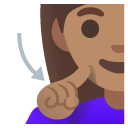
Appearance varies by platform and device. Google Noto, Twemoji, and OpenMoji are open-source.