👧🏿
The Emoji
Girl: Dark Skin Tone
U+1F467 U+1F3FF · :girl_dark_skin_tone:
Trend 58
Meaning layers
- interpretation
- Used to represent young Black girls, celebrate childhood innocence, or signal 'little sister energy.' Also used in self-referential posts by dark-skinned women reclaiming their childhood selves.
- tiktok usage
- Appears in videos celebrating Black girl magic, childhood nostalgia edits, and 'mini me' comparisons. Often paired with throwback content.
- irony level
- 2 / 10
Platform meanings
- meaning
- Represents young Black girls, childhood nostalgia, or the inner child of dark-skinned creators.
- trend usage
- Used in 'glow up' transformation videos, Black Girl Magic content, and childhood throwback trends.
- hashtags
- #BlackGirlMagic#LittleBlackGirl#BlackExcellence#GlowUp#RepresentationMatters
- virality score
- 62 / 100
Cultural meanings
🇺🇸
Western / Gen-Z
Widely used as a symbol of Black girl representation and empowerment; frequently paired with celebration and pride language in social media.
🇵🇰
Pakistan & India
Used to represent a young dark-complexioned girl; in some contexts, skin tone emojis carry colorism-adjacent sensitivity, but generally accepted as a child reference.
🌍
Middle East
Used to refer to young dark-skinned girls in family or community contexts; skin tone representation is less culturally emphasized but accepted.
🌐
Global Neutral
Universally understood as a young girl with dark skin; used in diverse contexts without strong cultural baggage.
🇧🇩
Bangladesh
Used to represent young girls in general; dark skin tone variants are used but skin tone diversity awareness is still growing.
🇱🇰
Sri Lanka
Understood as a young dark-skinned girl; used in family contexts and community discussions about children.
🇨🇳
China
Less commonly used due to limited cultural familiarity with skin tone modifier usage; when used, understood as a foreign or minority child.
🇯🇵
Japan
Recognized as a dark-skinned girl emoji; used in diversity-conscious contexts, though Japan's emoji culture tends toward default skin tones.
🇰🇷
South Korea
Used in diversity discussions and global pop culture contexts; K-culture increasingly embraces diverse emoji representations.
🇹🇼
Taiwan
Understood as a young dark-skinned girl; used in inclusive and international community discussions.
🇭🇰
Hong Kong
Used in multicultural discussions and family contexts; Hong Kong's international character makes diverse emojis widely accepted.
🇵🇭
Philippines
Used to represent dark-skinned young girls in a country where skin tone carries cultural significance; increasingly used in anti-colorism movements.
🇮🇩
Indonesia
Used to represent young girls with darker complexions; part of growing conversations about diversity and inclusivity in digital spaces.
🇹🇭
Thailand
Used in contexts referring to dark-skinned children; in a culture sensitive to skin tone, this emoji can carry nuanced connotations about representation.
🇻🇳
Vietnam
Understood as a young girl with dark skin; used in family and community contexts, with growing digital diversity awareness.
🇲🇾
Malaysia
Used in multicultural Malaysian contexts; recognized as representing a Malay, Indian, or African-descent young girl depending on context.
🇸🇦
Saudi Arabia
Used in family messaging to refer to young girls; skin tone distinction is understood but less culturally foregrounded.
🇦🇪
UAE
Used in the UAE's highly diverse population to represent young dark-skinned girls across various ethnic communities.
🇪🇬
Egypt
Used to refer to young dark-skinned girls; resonates in a country with diverse skin tones across its population.
🇹🇷
Turkey
Understood as a young dark-skinned girl; used in family and community messaging without strong additional cultural layers.
🇮🇷
Iran
Used in family contexts to refer to young girls; digital emoji diversity awareness is growing among younger Iranians.
🇳🇬
Nigeria
Widely embraced as a representation of Nigerian and African girlhood; used with pride in family, community, and empowerment contexts.
🇿🇦
South Africa
Strongly resonant in post-apartheid South Africa as a symbol of Black girlhood, diversity, and empowerment.
🇬🇧
UK & Ireland
Used in multicultural British and Irish communities to celebrate Black and dark-skinned girls; appears in diversity and inclusion conversations.
🇫🇷
France
Used in discussions of diversity and inclusion; resonates with France's large African-diaspora community.
🇩🇪
Germany
Used in multicultural contexts and diversity discussions; increasingly embraced in Germany's growing inclusive digital culture.
🇪🇸
Spain & Italy
Used in family contexts and, increasingly, in diversity conversations given growing African diaspora communities in both countries.
🇧🇷
Brazil
Highly resonant in Brazil where Afro-Brazilian culture is prominent; used in celebrations of Black girlhood and cultural pride.
🇲🇽
Mexico
Used to represent dark-skinned young girls; resonates with Afro-Mexican communities and diversity conversations.
🌎
Latin America
Across Latin America, used in Afro-Latino community discussions and celebrations of dark-skinned girlhood.
🇦🇺
Australia & NZ
Used in multicultural Australian and New Zealand contexts; appears in Indigenous and African-diaspora community discussions as well.
How its meaning shifted
- 2010
Emoji diversity was not yet available; a generic yellow-skin girl emoji was the only option, with no skin tone modifiers.
- 2015
Skin tone modifiers introduced by Unicode 8.0; the dark skin tone girl emoji became available, initially used primarily for representation by dark-skinned communities.
- 2020
Significantly expanded usage driven by the Black Lives Matter movement and global conversations about racial representation; became a common symbol of Black girl empowerment.
- 2026
Mainstream usage across cultural celebrations, education advocacy, and childhood empowerment; integrated naturally into diverse digital conversations globally.
See it on every platform
Adjacent emojis
- Often confused with
- girlwoman dark skin toneprincess dark skin tone
- Can replace
- girlblack heartcrown
Share & embed
Frequently asked
01What does the 👧🏿 Girl: Dark Skin Tone emoji mean?
Depicts a young girl with dark skin tone, represented by a child female figure with the Fitzpatrick scale type VI skin modifier applied.
02What does 👧🏿 mean on TikTok?
Represents young Black girls, childhood nostalgia, or the inner child of dark-skinned creators.
03What does 👧🏿 mean on WhatsApp?
Refers to a young dark-skinned girl in conversation, often used by parents, family members, or community members talking about a child.
04What does 👧🏿 mean in Gen-Z slang?
Used to represent young Black girls, celebrate childhood innocence, or signal 'little sister energy.' Also used in self-referential posts by dark-skinned women reclaiming their childhood selves.
05Is the 👧🏿 emoji safe to use?
Represents a young dark-skinned girl; used in family, cultural celebration, representation, and empowerment contexts.
06What does 👧🏿 mean in texting?
Carries significant emotional weight for Black and dark-skinned communities as a symbol of representation and visibility. Evokes protective instincts and pride in cultural identity.
07What is the shortcode for 👧🏿?
The shortcode for Girl: Dark Skin Tone is :girl_dark_skin_tone:
08What does 👧🏿 mean in dating?
Not typically used in flirting contexts; its usage in romantic scenarios would be inappropriate given it depicts a child.
Safety & usage
- Safe meaning
- Represents a young dark-skinned girl; used in family, cultural celebration, representation, and empowerment contexts.
- Caution
- Any sexualization of this emoji is deeply inappropriate; can be misused in harmful contexts involving children.
As this emoji depicts a child, any romantic or sexual context is a serious red flag and potentially indicative of predatory behavior. Platforms should monitor for misuse.
How it looks across platforms
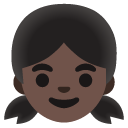

Appearance varies by platform and device. Google Noto, Twemoji, and OpenMoji are open-source.