🧚♂️
The Emoji
Man Fairy
U+1F9DA U+200D U+2642 U+FE0F · :man_fairy:
Trend 58
Meaning layers
- interpretation
- Used to express a whimsical, carefree, or 'not my problem' energy. Often used to describe someone who is flighty, unbothered, or living in their own magical world. Also reclaimed as a playful identity marker for fem-presenting or queer men.
- tiktok usage
- Appears in 'main character' content, fantasy aesthetics, and videos about being unbothered or ethereal. Used ironically to signal someone is delusional or out of touch with reality.
- irony level
- 6 / 10
Platform meanings
- meaning
- Represents unbothered, whimsical, or delusional energy. Used in fantasy aesthetics, queer identity content, and ironic 'not my problem' humor.
- trend usage
- Featured in 'main character syndrome' videos, cottagecore and dark academia aesthetics, and LGBTQ+ self-expression trends.
- hashtags
- #fairycore#maincharacter#unbothered#cottagecore#queeraesthetic
- virality score
- 62 / 100
Cultural meanings
🇺🇸
Western / Gen-Z
Widely used as a marker of queer identity, whimsical personality, and ironic 'unbothered' energy among Gen Z in North America and Western Europe.
🇵🇰
Pakistan & India
Less commonly used; may be seen in urban youth circles familiar with Western internet culture, primarily in fantasy or K-pop fan communities.
🌍
Middle East
Rarely used in mainstream contexts; may appear in private or youth-facing social media among fantasy fans or those influenced by Western pop culture.
🌐
Global Neutral
Universally understood as a fairy figure from folklore, though cultural associations with queer identity or irony vary widely.
🇧🇩
Bangladesh
Infrequently used; when used it is generally taken literally as a fairy character or in fantasy-themed content among younger internet users.
🇱🇰
Sri Lanka
Occasionally used in youth online spaces for fantasy-themed content; queer connotations are less prevalent due to cultural context.
🇨🇳
China
Used in fantasy and gaming communities, particularly in content related to fantasy RPGs or xianxia (Chinese fantasy) aesthetics; queer connotations are less visible due to platform censorship.
🇯🇵
Japan
Associated with Western fairy lore and fantasy games; may overlap with bishounen or fantasy anime aesthetics, used in doujinshi and fantasy fan communities.
🇰🇷
South Korea
Used in fantasy K-content and webtoon fan communities; also appears in queer-coded fandom spaces and idol fan edits with ethereal themes.
🇹🇼
Taiwan
More openly used in queer and fantasy contexts given Taiwan's progressive social climate; embraced in LGBTQ+ online communities.
🇭🇰
Hong Kong
Used in both fantasy fan communities and, to some extent, queer identity expression among younger users familiar with Western internet culture.
🇵🇭
Philippines
Popular in fantasy fan communities and among younger Filipinos who engage with Western social media trends; queer usage is growing.
🇮🇩
Indonesia
Primarily used in fantasy and gaming contexts; queer connotations are largely absent due to cultural norms, though awareness exists online.
🇹🇭
Thailand
Used in fantasy aesthetics and gaming; also embraced in Thailand's visible LGBTQ+ online communities, particularly among younger users.
🇻🇳
Vietnam
Mostly used for fantasy and gaming content; queer interpretations are less common but growing among internationally connected youth.
🇲🇾
Malaysia
Used in fantasy fan communities; queer connotations are less prominently displayed due to social and legal context.
🇸🇦
Saudi Arabia
Rarely used; when it appears it is typically in gaming or fantasy fan contexts with little awareness of queer connotations.
🇦🇪
UAE
Used among expatriate and younger urban populations in fantasy and gaming contexts; queer meanings are less publicly expressed.
🇪🇬
Egypt
Infrequently used; appears mainly in fantasy and gaming communities among younger, globally connected users.
🇹🇷
Turkey
Used in fantasy and gaming communities; also appears in queer online spaces, particularly among younger, urban, and internationally connected users.
🇮🇷
Iran
Very rarely used publicly; may appear in private or diaspora social media in fantasy or ironic humor contexts.
🇳🇬
Nigeria
Used in fantasy and gaming content among Nollywood fantasy fans and younger internet-savvy users; queer connotations are largely absent from public usage.
🇿🇦
South Africa
Used in both fantasy fan communities and LGBTQ+ spaces, reflecting South Africa's relatively progressive legal environment for queer expression.
🇬🇧
UK & Ireland
Popular in queer identity expression, fantasy aesthetics, and ironic humor; closely mirrors North American Gen Z usage.
🇫🇷
France
Used in fantasy and whimsical content; queer usage exists but is less emoji-forward than in Anglophone cultures.
🇩🇪
Germany
Appears in fantasy gaming and RPG communities; queer usage is present but emoji expression of identity is less prominent than in English-speaking cultures.
🇪🇸
Spain & Italy
Used in fantasy aesthetics and gaming; younger users also use it in queer identity contexts influenced by global social media trends.
🇧🇷
Brazil
Enthusiastically used in fantasy fan communities, queer identity expression, and playful ironic humor; Brazil's expressive online culture embraces it widely.
🇲🇽
Mexico
Used in fantasy content and among younger queer-identifying users; also appears in meme culture with ironic or playful meanings.
🌎
Latin America
Broadly used for fantasy aesthetics and gaming across Latin America; queer usage varies by country depending on local social norms.
🇦🇺
Australia & NZ
Mirrors UK and North American usage; popular in queer communities, fantasy aesthetics, and ironic Gen Z humor.
How its meaning shifted
- 2010
The emoji did not exist yet; fairy representations online were limited to text emoticons or image macros in fantasy forums.
- 2015
Still pre-release; the general fairy emoji concept was emerging in Unicode proposals, primarily discussed in fantasy and folklore digital art communities.
- 2020
Adopted by Gen Z for fairycore and cottagecore aesthetics on TikTok and Instagram; began gaining traction in queer identity expression and ironic 'not my problem' meme culture.
- 2026
Firmly established as a dual-use emoji: sincere queer and fantasy aesthetic marker on one hand, and ironic symbol of delusional unbothered energy on the other.
See it on every platform
Adjacent emojis
- Often confused with
- man in tuxedoprinceman dancing
- Can replace
- sparklesdizzyshooting star
Share & embed
Frequently asked
01What does the 🧚♂️ Man Fairy emoji mean?
The Man Fairy emoji depicts a male fairy figure with wings, often shown with a wand or magical elements. It is a gender-specific variant of the fairy emoji, introduced as part of Unicode 10.0 in 2017.
02What does 🧚♂️ mean on TikTok?
Represents unbothered, whimsical, or delusional energy. Used in fantasy aesthetics, queer identity content, and ironic 'not my problem' humor.
03What does 🧚♂️ mean on WhatsApp?
Sent to someone who seems carefree or out of touch, or playfully used when someone is acting magical and flighty.
04What does 🧚♂️ mean in Gen-Z slang?
Used to express a whimsical, carefree, or 'not my problem' energy. Often used to describe someone who is flighty, unbothered, or living in their own magical world. Also reclaimed as a playful identity marker for fem-presenting or queer men.
05Is the 🧚♂️ emoji safe to use?
A whimsical, fantasy fairy figure used for aesthetic expression, queer identity, and playful humor.
06What does 🧚♂️ mean in texting?
Psychologically signals a desire to transcend mundane reality and embrace imagination. Can reflect a coping mechanism of magical thinking or a genuine celebration of non-conformity and fantastical identity.
07What is the shortcode for 🧚♂️?
The shortcode for Man Fairy is :man_fairy:
08What does 🧚♂️ mean in dating?
Used by queer men flirting playfully, suggesting a fun, mischievous, or enchanting personality. Signals 'I'm playful and a little magical, come find out more.'
Safety & usage
- Safe meaning
- A whimsical, fantasy fairy figure used for aesthetic expression, queer identity, and playful humor.
- Caution
- Can be used mockingly to imply someone is effeminate, delusional, or out of touch; occasionally weaponized as a homophobic jab in hostile online spaces.
While generally benign, context matters — in hostile or conservative online spaces this emoji can be deployed to mock queer or gender-nonconforming individuals. Monitor for bullying patterns when combined with derogatory language.
How it looks across platforms
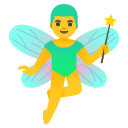
Appearance varies by platform and device. Google Noto, Twemoji, and OpenMoji are open-source.