🧚🏽♂️
The Emoji
Man Fairy: Medium Skin Tone
U+1F9DA U+1F3FD U+200D U+2642 U+FE0F · :man_fairy_medium_skin_tone:
Trend 61
Meaning layers
- interpretation
- Used to describe someone who is effortlessly charming, unbothered, whimsical, or living in their own magical world. Also used ironically for men who are flaky, unreliable, or seem to float through life without consequences.
- tiktok usage
- Appears in 'main character energy' videos, fantasy aesthetic content, and ironically to describe men who ghost or disappear like actual fairies.
- irony level
- 7 / 10
Platform meanings
- meaning
- Represents whimsical, ethereal, or chaotic male energy; frequently ironic shorthand for flaky or unbothered men.
- trend usage
- Used in 'POV: the guy you're talking to' formats, fantasy aesthetics, and 'not real he's a fairy' meme videos.
- hashtags
- #fairyboy#maincharacter#cottagecore#chaosmasc#hesfairy
- virality score
- 62 / 100
Cultural meanings
🇺🇸
Western / Gen-Z
Widely used ironically to describe flaky or chaotic men, as well as earnestly in fairycore and cottagecore aesthetics; a versatile emoji with strong ironic weight.
🇵🇰
Pakistan & India
Primarily understood in a fantasy or children's story context; less ironic usage, more literal association with magical creatures from folklore. Among younger urban users familiar with Western internet culture, the ironic usage is emerging.
🌍
Middle East
Interpreted mainly as a fantasy or children's character; the male fairy figure may seem unusual given cultural norms around masculinity, and is mostly used in gaming or fantasy contexts.
🌐
Global Neutral
Universally understood as a fantasy/magical male figure; ironic or dating-related usage requires cultural context to decode.
🇧🇩
Bangladesh
Understood as a magical creature from fairy tales; not widely used in everyday communication and primarily seen in children's content or fantasy media contexts.
🇱🇰
Sri Lanka
Associated with mythological and folkloric magical beings; used mostly in fantasy or children's contexts with little ironic subtext in everyday use.
🇨🇳
China
Connected to Western fairy tale imports and fantasy games; used by younger, internet-savvy users in gaming and fantasy fan communities without strong ironic connotations.
🇯🇵
Japan
Strongly associated with fantasy RPG and anime archetypes like the bishōnen (beautiful boy) fae character; used earnestly in fandom and gaming contexts with aesthetic appreciation.
🇰🇷
South Korea
Linked to fantasy K-drama aesthetics and idol 'ethereal' imagery; used to describe someone as otherworldly beautiful or as a playful compliment in fan communities.
🇹🇼
Taiwan
Used in fantasy game and anime fan contexts; younger users may adopt the Western ironic usage through exposure to global internet culture.
🇭🇰
Hong Kong
Used primarily in gaming and fantasy media discourse; bilingual internet culture means some users also pick up Western ironic usage patterns.
🇵🇭
Philippines
Associated with Philippine mythology's engkanto (fairy-like beings); can carry local folkloric meaning alongside modern fantasy and gaming use.
🇮🇩
Indonesia
Connected to both Western fantasy media and local fairy/spirit mythology; used in gaming, fantasy fan communities, and occasionally in aesthetic social media posts.
🇹🇭
Thailand
Used in fantasy game contexts and by users who follow K-pop or anime aesthetics; the ethereal, beautiful male image resonates with Thai pop culture ideals.
🇻🇳
Vietnam
Primarily associated with fantasy games and anime; used by younger users in gaming communities and increasingly in aesthetic social media contexts.
🇲🇾
Malaysia
Used in fantasy gaming and anime fan communities; multicultural internet exposure means some users also employ the Western ironic meaning.
🇸🇦
Saudi Arabia
Used mainly in gaming and fantasy contexts; the male fairy concept may be seen as unusual given cultural norms, so usage is limited to specific online subcultures.
🇦🇪
UAE
Cosmopolitan internet culture means both literal fantasy and ironic Western usage coexist; more common among expat communities and younger locals.
🇪🇬
Egypt
Primarily understood as a Western fantasy character; used in gaming and children's content, with limited adoption of ironic Western internet usage.
🇹🇷
Turkey
Used in fantasy gaming communities and among young people who follow Western internet culture; the ironic 'flaky man' meaning is beginning to circulate in Turkish social media.
🇮🇷
Iran
Found in fantasy and gaming contexts among younger users; Western ironic meaning is less common but present among those with access to global social media platforms.
🇳🇬
Nigeria
Used in fantasy and gaming content; among younger, digitally connected users the ironic meaning about men being elusive or chaotic has some currency.
🇿🇦
South Africa
Western ironic usage and fantasy/gaming usage both present due to strong exposure to global internet culture; used in both earnest and humorous contexts.
🇬🇧
UK & Ireland
Strong adoption of the ironic usage — describing flaky or chaotic men — alongside earnest fantasy and fairycore aesthetic use; very close to US Gen Z usage patterns.
🇫🇷
France
Used in fantasy gaming and aesthetic contexts; French internet culture has adapted the ironic male fairy shorthand somewhat, particularly among younger social media users.
🇩🇪
Germany
Primarily used in gaming, fantasy, and D&D communities; ironic usage is emerging among younger users influenced by Anglo-American internet culture.
🇪🇸
Spain & Italy
Used in fantasy and gaming contexts; romantic culture means the 'ethereal charming man' interpretation resonates, and ironic dating usage is growing among younger users.
🇧🇷
Brazil
Very active ironic usage in the Brazilian internet meme ecosystem; used to describe men who are flaky, charming, and untouchable by consequences in a humorous way.
🇲🇽
Mexico
Used both in fantasy gaming contexts and increasingly in ironic dating meme formats, influenced by both US Latinx internet culture and Mexican meme culture.
🌎
Latin America
Broadly used in fantasy and gaming communities; ironic usage about chaotic or elusive men is spreading rapidly through shared meme culture across Latin America.
🇦🇺
Australia & NZ
Very close to UK and US usage patterns — both ironic 'flaky man' shorthand and earnest fairycore aesthetic use are common among younger users.
How its meaning shifted
- 2010
Did not exist; fairy emoji were not yet part of Unicode and male-gendered variants were years away from introduction.
- 2015
Still non-existent as a standalone emoji; fantasy and fairy concepts were represented through workarounds like 🌟👼 or text descriptions.
- 2020
Newly introduced and used primarily in fantasy gaming, D&D communities, and early fairycore aesthetic content on TikTok and Instagram; ironic usage beginning to emerge.
- 2026
Firmly established as both a fairycore/fantasy aesthetic staple and a widely understood ironic shorthand for flaky, chaotic, or emotionally unavailable men in Gen Z internet culture.
See it on every platform
Adjacent emojis
- Often confused with
- person with wingsangelflying saucer
- Can replace
- sparklesdizzyfour leaf clover
Share & embed
Frequently asked
01What does the 🧚🏽♂️ Man Fairy: Medium Skin Tone emoji mean?
A male fairy with medium skin tone, depicted with wings and magical appearance, combining the man emoji with fairy and medium skin tone modifier.
02What does 🧚🏽♂️ mean on TikTok?
Represents whimsical, ethereal, or chaotic male energy; frequently ironic shorthand for flaky or unbothered men.
03What does 🧚🏽♂️ mean on WhatsApp?
Used among friends to call someone whimsical, flaky, or living in a fantasy. Can be affectionate or mildly insulting depending on tone.
04What does 🧚🏽♂️ mean in Gen-Z slang?
Used to describe someone who is effortlessly charming, unbothered, whimsical, or living in their own magical world. Also used ironically for men who are flaky, unreliable, or seem to float through life without consequences.
05Is the 🧚🏽♂️ emoji safe to use?
A whimsical fantasy character representing male fairy figures from folklore and fiction; used in aesthetic, gaming, and playful contexts.
06What does 🧚🏽♂️ mean in texting?
Evokes a sense of fantasy escapism and childlike wonder, but also signals emotional unavailability or flightiness when used in interpersonal contexts. The male gendering adds a layer of subversion since fairies are stereotypically feminine.
07What is the shortcode for 🧚🏽♂️?
The shortcode for Man Fairy: Medium Skin Tone is :man_fairy_medium_skin_tone:
08What does 🧚🏽♂️ mean in dating?
Used flirtatiously to say someone is magical, ethereal, or too good to be real. Can be a playful compliment implying someone has an otherworldly charm.
Safety & usage
- Safe meaning
- A whimsical fantasy character representing male fairy figures from folklore and fiction; used in aesthetic, gaming, and playful contexts.
- Caution
- Can be used mockingly toward men who don't conform to traditional masculinity norms, or deployed in misogynistic contexts to infantilize or dismiss someone.
Occasionally used to demean men perceived as effeminate or to mock LGBTQ+ individuals; context-dependent and generally benign but monitor for targeted harassment.
How it looks across platforms
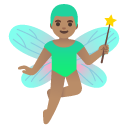
Appearance varies by platform and device. Google Noto, Twemoji, and OpenMoji are open-source.