👨🏿🎤
The Emoji
Man Singer: Dark Skin Tone
U+1F468 U+1F3FF U+200D U+1F3A4 · :man_singer_dark_skin_tone:
Trend 55
Meaning layers
- interpretation
- Used to flex musical talent, hype up a performer, or ironically caption someone being dramatically expressive. Also used to celebrate Black artists and musicians.
- tiktok usage
- Appears in music performance videos, lip-sync content, and artist appreciation posts. Often paired with fire or star emojis.
- irony level
- 3 / 10
Platform meanings
- meaning
- Represents musical performance, artist appreciation, or dramatic self-expression in video captions.
- trend usage
- Used heavily in Black music appreciation trends, artist tributes, and lip-sync challenges.
- hashtags
- #blackmusic#singer#rnb#musiclovers#vocalist
- virality score
- 62 / 100
Cultural meanings
🇺🇸
Western / Gen-Z
Widely used to celebrate Black male artists in music, associated with R&B, hip-hop, and soul genres. Often used in celebration posts and artist tributes.
🇵🇰
Pakistan & India
Primarily understood as a generic musician emoji, sometimes used to reference Bollywood playback singers or local musicians with darker complexions.
🌍
Middle East
Used to represent musicians and vocalists; the dark skin tone may carry specific connotations in regions where colorism is prevalent, though mostly interpreted neutrally as a performer.
🌐
Global Neutral
Universally understood as representing a male singer or performer with dark skin, used across language barriers to signal music and performance.
🇧🇩
Bangladesh
Interpreted as a musician or singer; used in contexts related to musical events, local concerts, or appreciation of popular Bangladeshi or international artists.
🇱🇰
Sri Lanka
Used to denote singers and performers; often appears alongside posts about local music events or appreciation of South Asian artists with darker skin tones.
🇨🇳
China
Relatively rare in everyday use; when used, it typically refers to foreign Black musicians like Michael Jackson or contemporary American R&B artists.
🇯🇵
Japan
Associated with American music culture, particularly R&B, soul, and hip-hop. Used by Japanese music fans who follow Black American artists.
🇰🇷
South Korea
Common among K-pop fans and music enthusiasts; may be used to reference Black American artists whose music influences K-pop, or to celebrate melanin-rich performers.
🇹🇼
Taiwan
Used in music appreciation contexts, often by fans of Western music or Black American cultural exports like hip-hop and R&B.
🇭🇰
Hong Kong
Associated with Western entertainment; used in posts about concerts, music awards, and appreciation of Black musical artists.
🇵🇭
Philippines
Widely used in music appreciation content; Filipinos are culturally close to American music, so this emoji resonates strongly in R&B and soul fan communities.
🇮🇩
Indonesia
Used to represent musicians broadly; sometimes specifically to celebrate Black Muslim artists or in contexts of music appreciation across genres.
🇹🇭
Thailand
Associated with American pop culture and music; used by Thai youth who follow international music scenes and Black artists.
🇻🇳
Vietnam
Primarily used in music fan contexts, representing international artists. Younger Vietnamese users use it in K-pop and Western music discussion.
🇲🇾
Malaysia
Used across multiracial communities; appreciated in both Malay and Chinese-Malaysian music fan groups for representing diverse performers.
🇸🇦
Saudi Arabia
Used cautiously in entertainment contexts given cultural sensitivities around music; more common among younger Saudis engaging with international pop culture online.
🇦🇪
UAE
Commonly used in cosmopolitan UAE contexts where diverse music cultures intersect; seen in entertainment and nightlife adjacent content.
🇪🇬
Egypt
Associated with musicians and performers; sometimes used in reference to African or Black American artists whose music is popular in Egypt.
🇹🇷
Turkey
Used by Turkish youth in music fan contexts, particularly in appreciation of R&B and hip-hop artists. Represents global musical talent.
🇮🇷
Iran
Used primarily in underground or private social media contexts by Iranian youth who follow international music despite restrictions.
🇳🇬
Nigeria
Highly resonant and celebrated; used proudly to represent Afrobeats artists, Nigerian musicians, and Black excellence in the global music industry.
🇿🇦
South Africa
Used with pride to represent Black South African musicians and the rich local music scene including Amapiano, Kwaito, and Gospel artists.
🇬🇧
UK & Ireland
Used by UK Grime, UK Drill, and R&B communities; associated with Black British artists and the vibrant Black music scene in the UK.
🇫🇷
France
Used in music circles to reference Black French artists, Afro-Caribbean performers, or American R&B/hip-hop artists popular in France.
🇩🇪
Germany
Associated with American music culture; used in hip-hop and R&B fan communities and increasingly in appreciation of Afrobeats and international Black artists.
🇪🇸
Spain & Italy
Used by younger generations familiar with American music culture; increasingly used to reference Latin artists with darker complexions as well.
🇧🇷
Brazil
Strongly resonant in Brazil given the significant Black Brazilian population; used to celebrate Black Brazilian musicians in funk, samba, and pagode genres.
🇲🇽
Mexico
Used in music contexts, particularly for appreciating international artists; also used by Afro-Mexican communities to represent their cultural identity in music.
🌎
Latin America
Widely used across Latin America to celebrate Afro-Latino musicians and the influence of Black culture on reggaeton, cumbia, and other regional genres.
🇦🇺
Australia & NZ
Used in music appreciation contexts; resonates in First Nations and Pacific Islander communities as a representation of darker-skinned performers.
How its meaning shifted
- 2010
This specific emoji did not exist in 2010; skin tone modifier combinations were not yet part of Unicode, so a generic person emoji was the closest equivalent.
- 2015
Skin tone modifiers were introduced in Unicode 8.0 (2015), making this emoji newly available. Initial usage was exploratory and primarily by those celebrating the new diversity representation.
- 2020
By 2020, firmly established as a representation of Black male musicians; widely used during BLM movement in contexts celebrating Black artistry and cultural contributions.
- 2026
Standard representation for Black male vocalists and performers; integrated naturally into music discourse, artist celebration content, and cultural pride expression across all major platforms.
See it on every platform
Adjacent emojis
Share & embed
Frequently asked
01What does the 👨🏿🎤 Man Singer: Dark Skin Tone emoji mean?
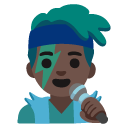
A man with dark skin tone depicted as a singer or rock star, holding a microphone and wearing performance-style clothing.
02What does 👨🏿🎤 mean on TikTok?
Represents musical performance, artist appreciation, or dramatic self-expression in video captions.
03What does 👨🏿🎤 mean on WhatsApp?
Indicates someone is a singer or is in a musical mood. Often sent to hype a friend's singing.
04What does 👨🏿🎤 mean in Gen-Z slang?
Used to flex musical talent, hype up a performer, or ironically caption someone being dramatically expressive. Also used to celebrate Black artists and musicians.
05Is the 👨🏿🎤 emoji safe to use?
Represents a Black male singer or performer; used in positive contexts to celebrate music, talent, and artistic expression.
06What does 👨🏿🎤 mean in texting?
Evokes feelings of artistic passion and cultural pride. The specific skin tone adds representational significance that resonates emotionally with communities historically underrepresented in mainstream emoji sets.
07What is the shortcode for 👨🏿🎤?
The shortcode for Man Singer: Dark Skin Tone is :man_singer_dark_skin_tone:
08What does 👨🏿🎤 mean in dating?
Could be used to say 'I'd serenade you' or to compliment someone's singing voice in a flirty context.
Safety & usage
- Safe meaning
- Represents a Black male singer or performer; used in positive contexts to celebrate music, talent, and artistic expression.
- Caution
- Rarely used toxically; in rare cases could be used in racially charged contexts online, though this is uncommon.
Generally safe for all audiences. The dark skin tone modifier was specifically designed for representation and inclusion. No significant misuse patterns documented.
How it looks across platforms


Appearance varies by platform and device. Google Noto, Twemoji, and OpenMoji are open-source.