👨🦯
The Emoji
Man With White Cane
U+1F468 U+200D U+1F9AF · :man_with_white_cane:
Trend 22
Meaning layers
- interpretation
- Used literally to represent blindness or visual impairment, but also metaphorically to describe someone who is 'blind' to obvious facts, ignoring red flags, or willfully unaware of a situation.
- tiktok usage
- Appears in comment sections when someone misses an obvious joke or trend, like 'bro really walked past the point 👨🦯'. Also used in disability representation and awareness content.
- irony level
- 5 / 10
Platform meanings
- meaning
- Represents literal blindness or visual impairment in accessibility content; metaphorically used to describe someone oblivious to obvious facts or social cues.
- trend usage
- Appears in comment sections mocking someone who missed an obvious point, in disability awareness duets, and in 'walking away from problems' trend videos.
- hashtags
- #DisabilityAwareness#BlindTikTok#Accessibility#RedFlagBlind#MissedThePoint
- virality score
- 28 / 100
Cultural meanings
🇺🇸
Western / Gen-Z
Gen Z in Western contexts uses this both genuinely for disability representation and sarcastically to imply someone is metaphorically blind to obvious truths or red flags.
🇵🇰
Pakistan & India
Primarily interpreted literally as representing a visually impaired person; disability representation is growing in digital discourse, though sarcastic usage is less common.
🌍
Middle East
Used mainly in literal contexts to represent visual impairment; disability representation is increasingly recognized, especially around awareness campaigns.
🌐
Global Neutral
Universally recognized as a symbol of blindness and visual impairment; the international white cane symbol lends it clear global meaning across cultures.
🇧🇩
Bangladesh
Primarily used literally to represent visual impairment or disability; disability awareness content on social media uses this emoji in educational contexts.
🇱🇰
Sri Lanka
Used in disability awareness and advocacy contexts; largely interpreted literally with little ironic or sarcastic usage in local digital culture.
🇨🇳
China
Used in accessibility and disability representation contexts; WeChat and Weibo users may use it in awareness posts, with little sarcastic usage.
🇯🇵
Japan
Associated with disability rights and accessibility awareness; Japan's strong visual communication culture means it's used carefully and respectfully in most contexts.
🇰🇷
South Korea
Used in disability representation and accessibility content; K-pop fan communities may use it sarcastically to describe fans 'blind' to their idol's flaws.
🇹🇼
Taiwan
Appears in disability advocacy and accessibility content; occasionally used with light irony in casual digital conversations.
🇭🇰
Hong Kong
Used in disability awareness content and occasionally in ironic commentary about someone ignoring obvious facts in political or social discussions.
🇵🇭
Philippines
Primarily used in disability representation and awareness content; the metaphorical 'blind to reality' usage is growing in social media commentary.
🇮🇩
Indonesia
Used in disability awareness campaigns and advocacy; respectful usage is standard, with sarcastic interpretations emerging among younger users.
🇹🇭
Thailand
Appears in accessibility awareness content; Thai social media may use it in humorous contexts about missing obvious information but primarily in literal sense.
🇻🇳
Vietnam
Used in disability representation and awareness posts; literal interpretation dominates, with sarcastic usage being less culturally prevalent.
🇲🇾
Malaysia
Used in disability advocacy and accessibility content; bilingual social media users may pair it with both Malay and English captions about visual impairment.
🇸🇦
Saudi Arabia
Used in disability awareness content, particularly around Islamic principles of caring for those with disabilities; respectful and literal usage is standard.
🇦🇪
UAE
Appears in inclusive design and accessibility content, especially given UAE's push for smart city accessibility; used respectfully in multicultural digital spaces.
🇪🇬
Egypt
Used in disability awareness and occasionally in humorous commentary about obliviousness; Egyptian social media humor may incorporate it in sarcastic exchanges.
🇹🇷
Turkey
Used in disability representation and accessibility discussions; Turkish social media users may also employ it to describe political obliviousness.
🇮🇷
Iran
Primarily used in disability awareness and empathy contexts; Iranian digital culture uses it respectfully with limited sarcastic interpretation.
🇳🇬
Nigeria
Used in disability representation content and increasingly in sarcastic commentary about ignoring obvious societal issues in Nollywood and political discussions.
🇿🇦
South Africa
Appears in disability advocacy content and accessibility awareness; occasionally used in political commentary to describe willful ignorance.
🇬🇧
UK & Ireland
Used literally for disability representation and sarcastically in dry British humor to describe someone missing an obvious point, often with understated wit.
🇫🇷
France
Used in disability rights discourse and occasionally in French social media humor about obliviousness; French digital culture appreciates ironic usage.
🇩🇪
Germany
Primarily used in disability representation and accessibility contexts; German users tend toward literal interpretation with less sarcastic use.
🇪🇸
Spain & Italy
Used in disability awareness content and occasionally in Mediterranean social media humor about being oblivious to obvious relationship or social dynamics.
🇧🇷
Brazil
Used in disability representation and in Brazilian social media humor about missing obvious cues, often with playful and warm-hearted sarcasm.
🇲🇽
Mexico
Appears in disability awareness posts and in humorous Mexican social media commentary about ignoring red flags or obvious truths.
🌎
Latin America
Broadly used for disability representation across Latin America, with growing ironic usage among younger social media users to describe obliviousness.
🇦🇺
Australia & NZ
Used literally for disability representation and sarcastically in typical Australian bluntness to call out someone missing an obvious point.
How its meaning shifted
- 2010
This emoji did not exist in 2010; the white cane concept was represented through text or other disability symbols.
- 2015
Still not in Unicode; disability representation online was limited to text-based descriptions and generic symbols, with growing advocacy for more inclusive emoji.
- 2020
Newly introduced in 2019, used primarily in disability advocacy, accessibility awareness campaigns, and representation discussions. Limited ironic usage.
- 2026
Established dual usage: genuine disability representation and identity expression, alongside widespread metaphorical use for describing obliviousness and ignoring red flags in digital communication.
See it on every platform
Compare with
Adjacent emojis
- Often confused with
- person walkingman with probing caneolder man
Share & embed
Frequently asked
01What does the 👨🦯 Man With White Cane emoji mean?
A man using a white cane, typically associated with visual impairment or blindness. The white cane is an internationally recognized symbol of blindness and low vision.
02What does 👨🦯 mean on TikTok?
Represents literal blindness or visual impairment in accessibility content; metaphorically used to describe someone oblivious to obvious facts or social cues.
03What does 👨🦯 mean on WhatsApp?
Used to represent a visually impaired person or to describe oneself as metaphorically blind to something. Commonly used in disability-related group chats.
04What does 👨🦯 mean in Gen-Z slang?
Used literally to represent blindness or visual impairment, but also metaphorically to describe someone who is 'blind' to obvious facts, ignoring red flags, or willfully unaware of a situation.
05Is the 👨🦯 emoji safe to use?
Represents a visually impaired or blind man navigating with a white cane; used for disability representation, accessibility advocacy, and identity expression.
06What does 👨🦯 mean in texting?
This emoji can evoke feelings of empathy and solidarity when used in disability contexts, but may also carry undertones of condescension when used sarcastically to imply someone is 'blind' to something obvious. Careful contextual reading is essential.
07What is the shortcode for 👨🦯?
The shortcode for Man With White Cane is :man_with_white_cane:
08What does 👨🦯 mean in dating?
Rarely used in flirting contexts. Could appear in a self-deprecating joke like 'I must be 👨🦯 because I keep missing your hints.'
Safety & usage
- Safe meaning
- Represents a visually impaired or blind man navigating with a white cane; used for disability representation, accessibility advocacy, and identity expression.
- Caution
- Can be weaponized in ableist commentary or used mockingly to belittle someone's intelligence by implying they are 'blind' to obvious facts.
Usage as a sarcastic tool to demean someone's intelligence can be considered ableist, as it conflates blindness with stupidity. Should be used with cultural sensitivity in disability contexts.
How it looks across platforms
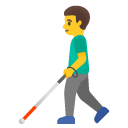


Appearance varies by platform and device. Google Noto, Twemoji, and OpenMoji are open-source.