👩🦯
The Emoji
Woman With White Cane
U+1F469 U+200D U+1F9AF · :woman_with_white_cane:
Trend 38
Meaning layers
- interpretation
- Used to signal being metaphorically 'blind' to something obvious, navigating life without direction, or clumsily stumbling through situations. Also used genuinely in disability advocacy and representation contexts.
- tiktok usage
- Appears in 'I am so blind to red flags' content, disability awareness videos, and ironically when someone admits they couldn't see something obvious in hindsight.
- irony level
- 4 / 10
Platform meanings
- meaning
- Represents genuine disability content or ironic self-deprecation about being oblivious to obvious things.
- trend usage
- Appears in red flag awareness videos, disability representation TikToks, and 'POV: you finally see what everyone else saw' narrative content.
- hashtags
- #DisabilityTikTok#BlindToRedFlags#DisabilityPride#AccessibilityMatters#BlindLife
- virality score
- 42 / 100
Cultural meanings
🇺🇸
Western / Gen-Z
Primarily used in two ways: genuinely for disability representation and pride, or ironically to signal being 'blind to red flags' or obvious truths in relationships and life situations.
🇵🇰
Pakistan & India
Predominantly interpreted literally as representing a blind or visually impaired woman; used in disability awareness posts and occasionally in content about navigating hardship with dignity.
🌍
Middle East
Interpreted mostly literally; used in disability advocacy content, Islamic charity discussions around helping the visually impaired, and awareness campaigns during relevant national or international disability days.
🌐
Global Neutral
Universally recognized as representing a woman with a visual disability using a white cane; understood as a symbol of independence and mobility for visually impaired individuals.
🇧🇩
Bangladesh
Used mainly in disability awareness and NGO-related social media content; occasionally appears in inspirational posts about overcoming challenges with limited resources.
🇱🇰
Sri Lanka
Primarily literal in usage, appearing in disability rights discussions and posts about accessibility challenges in public spaces and transportation.
🇨🇳
China
Used in disability-related content and awareness campaigns; the metaphorical 'blindness' interpretation is less culturally dominant compared to Western contexts.
🇯🇵
Japan
Interpreted literally in most contexts; disability representation is treated respectfully and carefully, so ironic or humorous use is less common and may be considered insensitive.
🇰🇷
South Korea
Mostly used in literal disability advocacy contexts; disability-related humor is less normalized in Korean internet culture, so ironic usage is relatively rare.
🇹🇼
Taiwan
Used in disability rights discussions and accessibility advocacy; may appear in posts supporting inclusive infrastructure and public transit accessibility initiatives.
🇭🇰
Hong Kong
Appears in disability awareness content and discussions about accessibility in the city's urban environment; both literal and occasional ironic use exist among younger users.
🇵🇭
Philippines
Used literally in disability advocacy and inspiration posts; occasionally used humorously in the context of 'not seeing what's obvious,' reflecting the local humor style of self-deprecation.
🇮🇩
Indonesia
Primarily literal; appears in disability rights and social welfare content, often shared by NGOs or community organizations focused on disability inclusion.
🇹🇭
Thailand
Used in disability awareness contexts and occasionally in humorous content; Thai internet culture has begun adopting the metaphorical blindness interpretation among younger users.
🇻🇳
Vietnam
Mainly literal in usage; associated with disability support content, charity campaigns, and discussions about improving accessibility in Vietnamese cities.
🇲🇾
Malaysia
Used in disability advocacy and awareness posts; the multicultural online environment means both literal and mild ironic uses coexist among younger Malaysian netizens.
🇸🇦
Saudi Arabia
Interpreted literally and used in charity, disability awareness, and Islamic social responsibility content; humor or irony with disability emojis is culturally discouraged.
🇦🇪
UAE
Used in disability inclusion campaigns and corporate social responsibility content; the UAE's strong push for accessibility standards makes this emoji relevant in professional advocacy contexts.
🇪🇬
Egypt
Predominantly literal; associated with disability rights discussions and social media campaigns during international disability awareness events.
🇹🇷
Turkey
Used in disability awareness and social advocacy contexts; younger Turkish users have begun adopting the Western ironic interpretation of metaphorical blindness in meme culture.
🇮🇷
Iran
Mostly literal; used in disability support and charity contexts, often shared by NGOs and welfare organizations on social media platforms.
🇳🇬
Nigeria
Used in disability advocacy and inspirational content; Nigerian internet culture also uses it humorously to describe people who are oblivious to clear situations or red flags.
🇿🇦
South Africa
Used in disability rights discussions and awareness content; also appears in humorous social media posts about 'not seeing what's right in front of you' in both Zulu and English language communities.
🇬🇧
UK & Ireland
Used both literally in disability representation and advocacy, and in dry British humorous contexts to describe cluelessness or willful ignorance with characteristic understatement.
🇫🇷
France
Used in disability awareness and social inclusion discussions; French internet culture occasionally uses it ironically in the context of political or social 'blindness' to issues.
🇩🇪
Germany
Primarily used in disability advocacy, accessibility discussions, and workplace inclusion content; Germans tend to use it more literally, with irony being less common due to cultural sensitivities around disability.
🇪🇸
Spain & Italy
Used in disability representation and social welfare content; younger Southern European internet users also deploy it in humorous self-deprecating contexts about missing obvious things.
🇧🇷
Brazil
Used widely in disability advocacy and also popularly in Brazilian meme culture to represent being oblivious to obvious situations, blending seamlessly with local self-deprecating humor.
🇲🇽
Mexico
Used literally in disability awareness posts and humorously in Mexican internet culture to describe missing obvious red flags or clueless navigation of social situations.
🌎
Latin America
Broadly used across Latin America in disability advocacy content; the metaphorical blindness usage is growing among younger users influenced by North American meme formats.
🇦🇺
Australia & NZ
Used in disability representation and advocacy, as well as in casual self-deprecating humor about being oblivious; Australian internet culture embraces both literal and ironic interpretations.
How its meaning shifted
- 2010
This emoji did not exist in 2010; Unicode had not yet introduced disability-specific representation emojis, and digital disability representation was extremely limited.
- 2015
Still not introduced; disability emoji representation was minimal, and conversations about inclusive emoji design were beginning but had not yet resulted in this specific emoji.
- 2020
Newly introduced in Unicode 12.0 (2019), the emoji was initially used primarily in disability advocacy, representation discussions, and accessibility awareness campaigns across platforms.
- 2026
Widely recognized in dual contexts — literal disability representation and pride, and as a popular ironic symbol of being metaphorically blind to red flags or obvious truths, especially in Gen Z meme culture.
See it on every platform
Compare with
Adjacent emojis
- Often confused with
- woman walkingman with white canewoman with probing cane
- Can replace
- eyeswoman walkingdeaf woman
Share & embed
Frequently asked
01What does the 👩🦯 Woman With White Cane emoji mean?
A woman using a white cane, typically associated with visual impairment or blindness. The white cane is an internationally recognized mobility tool for people who are blind or have low vision.
02What does 👩🦯 mean on TikTok?
Represents genuine disability content or ironic self-deprecation about being oblivious to obvious things.
03What does 👩🦯 mean on WhatsApp?
Used to say 'I completely missed that' or to represent blindness/vision issues in a casual conversation.
04What does 👩🦯 mean in Gen-Z slang?
Used to signal being metaphorically 'blind' to something obvious, navigating life without direction, or clumsily stumbling through situations. Also used genuinely in disability advocacy and representation contexts.
05Is the 👩🦯 emoji safe to use?
Represents a woman with visual impairment using a white cane for mobility; used in disability advocacy, representation, and awareness contexts.
06What does 👩🦯 mean in texting?
Evokes feelings of admiration for independence and navigation of challenges. Can also trigger empathy or solidarity. For disabled users, it signals pride and visibility; for non-disabled users, it can signal awareness or advocacy.
07What is the shortcode for 👩🦯?
The shortcode for Woman With White Cane is :woman_with_white_cane:
08What does 👩🦯 mean in dating?
Rarely used in flirting contexts; occasionally used humorously as 'I was blind to how good-looking you are' or 'you make me feel like I can't see straight.'
Safety & usage
- Safe meaning
- Represents a woman with visual impairment using a white cane for mobility; used in disability advocacy, representation, and awareness contexts.
- Caution
- Can potentially be used mockingly to demean visually impaired individuals or to make ableist jokes, though this is not the dominant usage pattern.
Care should be taken when using this emoji in ironic or humorous contexts to ensure it does not trivialize or mock the lived experiences of visually impaired individuals. Context matters significantly.
How it looks across platforms
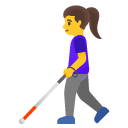


Appearance varies by platform and device. Google Noto, Twemoji, and OpenMoji are open-source.