👨🏻🦯➡️
The Emoji
Man With White Cane Facing Right: Light Skin Tone
U+1F468 U+1F3FB U+200D U+1F9AF U+200D U+27A1 U+FE0F · :man_with_white_cane_facing_right_light_skin_tone:
Trend 22
Meaning layers
- interpretation
- Used to represent being lost, wandering blindly through life, or metaphorically 'not seeing what's right in front of you.' Also used for self-deprecating humor about cluelessness.
- tiktok usage
- Appears in POV videos about being oblivious, navigating life without a clue, or in accessibility awareness content.
- irony level
- 5 / 10
Platform meanings
- meaning
- Symbolizes moving forward despite not fully seeing the path, used in motivational and relatable content about life struggles.
- trend usage
- Appears in disability awareness challenges, 'blind to the chaos' trend formats, and self-deprecating humor videos.
- hashtags
- #DisabilityAwareness#BlindToIt#NavigatingLife#InclusionMatters#MobilityAid
- virality score
- 28 / 100
Cultural meanings
🇺🇸
Western / Gen-Z
Used both literally for disability representation and ironically for being oblivious or clueless in everyday situations.
🇵🇰
Pakistan & India
Primarily interpreted literally as representing a visually impaired person; used in disability awareness content and social media campaigns.
🌍
Middle East
Seen as a straightforward disability symbol; used in accessibility advocacy and occasionally in motivational content about overcoming challenges.
🌐
Global Neutral
Universally recognized as representing a person with visual impairment using a cane, understood as a symbol of navigation and independence.
🇧🇩
Bangladesh
Interpreted as a symbol of disability and resilience; used in social welfare and disability rights discussions.
🇱🇰
Sri Lanka
Used in disability awareness posts and occasionally in metaphorical contexts about navigating life's difficulties.
🇨🇳
China
Primarily literal, used in accessibility and disability welfare discussions; less common in metaphorical contexts due to cultural directness.
🇯🇵
Japan
Recognized as a symbol of visual impairment; used respectfully in disability inclusion campaigns and rarely in humor.
🇰🇷
South Korea
Used in disability awareness content; younger users may use it metaphorically for being lost or unaware in social situations.
🇹🇼
Taiwan
Interpreted as a disability symbol with positive connotations of independence and resilience; used in inclusion campaigns.
🇭🇰
Hong Kong
Used in disability rights and social welfare contexts; occasionally adopted metaphorically in younger digital communities.
🇵🇭
Philippines
Primarily literal and used in disability awareness; also appears in motivational content about persevering despite challenges.
🇮🇩
Indonesia
Seen as a representation of disability; used in social media campaigns for inclusion and accessibility rights.
🇹🇭
Thailand
Used in disability awareness and social welfare contexts; directional aspect (facing right) may be noted as auspicious movement.
🇻🇳
Vietnam
Primarily literal in disability contexts; metaphorical use is rare but growing among younger social media users.
🇲🇾
Malaysia
Used in disability inclusion campaigns; among youth it sometimes signals navigating confusion or uncertainty in daily life.
🇸🇦
Saudi Arabia
Interpreted as a disability symbol; used in government and NGO campaigns for disability rights and inclusion.
🇦🇪
UAE
Common in accessibility and inclusion campaigns aligned with UAE's disability rights initiatives; rarely used metaphorically.
🇪🇬
Egypt
Used in disability awareness and religious compassion contexts; seen as a symbol of someone in need of communal support.
🇹🇷
Turkey
Primarily a disability symbol; used in accessibility advocacy and occasionally as a metaphor for wandering or uncertainty.
🇮🇷
Iran
Interpreted respectfully as representing visual impairment; appears in disability support and charity campaign content.
🇳🇬
Nigeria
Used in disability advocacy and inclusion posts; metaphorical use for being 'in the dark' about something is emerging.
🇿🇦
South Africa
Used in disability rights content and accessibility campaigns; also appears in social commentary about navigating systemic barriers.
🇬🇧
UK & Ireland
Used both literally for disability representation and sarcastically in online banter for someone being oblivious.
🇫🇷
France
Seen as a disability symbol with emphasis on independence; used in accessibility discussions and occasionally in ironic social commentary.
🇩🇪
Germany
Interpreted precisely as a disability representation; used in formal accessibility and inclusion discussions rather than casual humor.
🇪🇸
Spain & Italy
Used in disability awareness content; younger users may use it expressively for feeling lost or overwhelmed.
🇧🇷
Brazil
Used in disability inclusion campaigns; also adopted metaphorically by younger users to describe navigating chaotic social situations.
🇲🇽
Mexico
Primarily a disability symbol used in awareness campaigns; metaphorical use for cluelessness is growing in younger digital culture.
🌎
Latin America
Interpreted as a disability representation across Latin America; increasingly used by youth as a metaphor for navigating uncertainty.
🇦🇺
Australia & NZ
Used for disability awareness and inclusion; also used humorously in casual digital communication for being clueless or lost.
How its meaning shifted
- 2010
Emoji did not exist in this form; basic accessibility symbols were just beginning to be discussed for Unicode inclusion.
- 2015
Early disability emojis were being advocated for; white cane symbol was gaining traction in accessibility lobbying efforts.
- 2020
Available after Unicode expansions; primarily used in disability awareness content and representation discussions during increased social justice dialogue.
- 2026
Widely recognized; used in both genuine disability representation and as a metaphorical Gen Z expression for navigating life blindly or being oblivious.
See it on every platform
Adjacent emojis
- Opposite
- eyeperson runningeyes
- Often confused with
- person walkingman with probing canepedestrian
Share & embed
Frequently asked
01What does the 👨🏻🦯➡️ Man With White Cane Facing Right: Light Skin Tone emoji mean?
A man with light skin tone using a white cane, facing right, indicating movement or navigation in that direction. The white cane is a universal symbol of visual impairment or blindness.
02What does 👨🏻🦯➡️ mean on TikTok?
Symbolizes moving forward despite not fully seeing the path, used in motivational and relatable content about life struggles.
03What does 👨🏻🦯➡️ mean on WhatsApp?
Sent to indicate someone is clueless or wandering without direction in a conversation.
04What does 👨🏻🦯➡️ mean in Gen-Z slang?
Used to represent being lost, wandering blindly through life, or metaphorically 'not seeing what's right in front of you.' Also used for self-deprecating humor about cluelessness.
05Is the 👨🏻🦯➡️ emoji safe to use?
A respectful representation of a visually impaired person navigating independently with a white cane, used in disability advocacy and awareness.
06What does 👨🏻🦯➡️ mean in texting?
Evokes both empathy for navigating challenges and admiration for independence; can also trigger feelings of resilience when used in personal storytelling.
07What is the shortcode for 👨🏻🦯➡️?
The shortcode for Man With White Cane Facing Right: Light Skin Tone is :man_with_white_cane_facing_right_light_skin_tone:
08What does 👨🏻🦯➡️ mean in dating?
Rarely used flirtatiously; if used, it might imply 'I'm blind to everyone else but you' in a playful context.
Safety & usage
- Safe meaning
- A respectful representation of a visually impaired person navigating independently with a white cane, used in disability advocacy and awareness.
- Caution
- Can be used mockingly to imply someone is blind to obvious facts, which may feel ableist or dismissive of visual impairment.
Avoid using this emoji as a punchline or to mock obliviousness in contexts where it trivializes visual disability. Use thoughtfully in metaphorical contexts.
How it looks across platforms
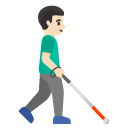
Appearance varies by platform and device. Google Noto, Twemoji, and OpenMoji are open-source.