🧑🏾🦽
The Emoji
Person In Manual Wheelchair: Medium-dark Skin Tone
U+1F9D1 U+1F3FE U+200D U+1F9BD · :person_in_manual_wheelchair_mediumdark_skin_tone:
Trend 42
Meaning layers
- interpretation
- Used to represent disability pride, accessibility advocacy, or as a self-identifier by wheelchair users. Also used ironically to express exhaustion or 'can't move' energy.
- tiktok usage
- Appears in disability awareness content, #DisabilityTok, crip culture videos, and sometimes in 'I'm not getting up' lazy humor.
- irony level
- 3 / 10
Platform meanings
- meaning
- Disability identity, accessibility advocacy, crip culture humor, or exhaustion metaphor.
- trend usage
- Used heavily in #DisabilityTok, adaptive sports content, and awareness campaigns. Occasionally in tired/lazy humor skits.
- hashtags
- #DisabilityTok#WheelchairLife#CripCulture#AccessibilityMatters#DisabilityPride
- virality score
- 48 / 100
Cultural meanings
🇺🇸
Western / Gen-Z
Widely recognized as a disability pride and representation symbol; used naturally by disabled Gen Z for self-identification and by allies in advocacy spaces.
🇵🇰
Pakistan & India
Primarily used in a literal, practical sense to indicate disability or reference a family member using a wheelchair; disability discourse is growing but stigma can still shape interpretation.
🌍
Middle East
Used mainly in medical or family contexts to indicate disability; disability advocacy is emerging but societal conversation is still limited in many areas.
🌐
Global Neutral
Universally understood as representing a person using a manual wheelchair, serving as a symbol of mobility assistance and disability inclusion.
🇧🇩
Bangladesh
Interpreted primarily in literal terms relating to physical disability; used in healthcare discussions and family contexts with growing awareness of disability rights.
🇱🇰
Sri Lanka
Used to represent wheelchair users or disability in practical communication; disability rights awareness is increasing, especially in urban areas.
🇨🇳
China
Understood as representing a disabled person in a wheelchair; often appears in contexts discussing disability services, accessibility infrastructure, or family situations.
🇯🇵
Japan
Recognized literally as a wheelchair user symbol; Japan's strong accessibility culture (JIS symbols, universal design) gives this emoji a respected, practical context.
🇰🇷
South Korea
Associated with disability awareness and accessibility; growing disability rights movement means it's increasingly used in advocacy contexts beyond just literal description.
🇹🇼
Taiwan
Used in disability advocacy and accessibility discussions; Taiwan's progressive disability rights framework gives this emoji positive, empowering connotations.
🇭🇰
Hong Kong
Primarily used in practical contexts for disability reference; also appears in social policy discussions about accessibility and inclusive infrastructure.
🇵🇭
Philippines
Used in family conversations about disability and in healthcare contexts; disability advocacy communities use it on social media for awareness campaigns.
🇮🇩
Indonesia
Interpreted literally in most contexts; used in healthcare, family, and increasingly in disability advocacy social media content.
🇹🇭
Thailand
Mainly used to represent physical disability; disability representation is growing on social media, and the emoji appears in related awareness campaigns.
🇻🇳
Vietnam
Used to indicate disability in practical and family communication contexts; disability rights awareness is expanding among younger generations.
🇲🇾
Malaysia
Understood as representing wheelchair users; used in accessibility discussions, healthcare contexts, and disability advocacy social media content.
🇸🇦
Saudi Arabia
Used primarily in medical and family contexts to describe disability; increasing awareness of disability rights and accessibility in Vision 2030 gives it emerging advocacy usage.
🇦🇪
UAE
Appears in contexts of disability inclusion, accessibility in urban planning, and healthcare; the UAE's push for inclusivity gives this emoji positive institutional associations.
🇪🇬
Egypt
Primarily literal usage for disability and wheelchair reference in family and medical conversations; disability awareness social media use is growing.
🇹🇷
Turkey
Used to represent disability and wheelchair users; growing disability rights discourse means it appears in both practical and advocacy contexts.
🇮🇷
Iran
Mainly used in medical or family contexts to indicate disability; digital disability advocacy communities use it but broader societal disability conversation remains limited.
🇳🇬
Nigeria
Used to represent disability; in a context where disability stigma is being challenged, it appears in awareness campaigns and social media advocacy by disability rights organizations.
🇿🇦
South Africa
Used in disability advocacy, accessibility discussions, and by disabled communities; South Africa's disability rights framework encourages positive representation.
🇬🇧
UK & Ireland
Commonly used by disability advocates, wheelchair users, and allies; strong disability rights culture means it's embraced in both personal identity and advocacy contexts.
🇫🇷
France
Used in disability representation and accessibility discussions; French disability rights movements use it in social media campaigns and advocacy.
🇩🇪
Germany
Associated with disability inclusion and accessibility rights; used in professional, advocacy, and personal contexts related to wheelchair users and mobility.
🇪🇸
Spain & Italy
Used to represent disability and wheelchair users; increasingly appears in disability pride and accessibility advocacy social media in both countries.
🇧🇷
Brazil
Used in disability rights advocacy and personal identity contexts; Brazil's vibrant disability community uses it alongside accessibility and inclusion hashtags.
🇲🇽
Mexico
Represents disability and wheelchair users in practical and advocacy contexts; disability awareness is growing on social media platforms.
🌎
Latin America
Broadly understood as disability representation; used in accessibility advocacy and disability pride content across Latin American social media communities.
🇦🇺
Australia & NZ
Commonly used in disability advocacy, accessible tourism, and by wheelchair users for self-representation; strong disability rights culture in both countries.
How its meaning shifted
- 2010
Wheelchair emoji was not yet standardized with skin tones; disability representation in digital communication was minimal and largely limited to the international wheelchair accessibility symbol.
- 2015
Basic wheelchair emoji existed but skin tone variants were not available; used primarily in literal, functional contexts to denote disability or accessibility.
- 2020
Skin-tone wheelchair emojis were introduced (Unicode 12.0, 2019); began appearing in disability pride content, accessibility advocacy, and personal identity expression online.
- 2026
Fully integrated into disability pride culture, DEI conversations, accessibility tech discussions, and adaptive sports communities; used both for self-identification and allyship across all major platforms.
See it on every platform
Adjacent emojis
Share & embed
Frequently asked
01What does the 🧑🏾🦽 Person In Manual Wheelchair: Medium-dark Skin Tone emoji mean?
A person of medium-dark skin tone seated in a manual wheelchair, propelling themselves with their hands on the wheels.
02What does 🧑🏾🦽 mean on TikTok?
Disability identity, accessibility advocacy, crip culture humor, or exhaustion metaphor.
03What does 🧑🏾🦽 mean on WhatsApp?
Represents a wheelchair user or disability in personal conversations. May be used to describe someone's mobility situation.
04What does 🧑🏾🦽 mean in Gen-Z slang?
Used to represent disability pride, accessibility advocacy, or as a self-identifier by wheelchair users. Also used ironically to express exhaustion or 'can't move' energy.
05Is the 🧑🏾🦽 emoji safe to use?
Represents disability, wheelchair users, mobility aid, accessibility, disability pride, and inclusive representation.
06What does 🧑🏾🦽 mean in texting?
For wheelchair users and the disabled community, this emoji carries significant personal identity weight. For non-disabled users, it often signals allyship or awareness. Can evoke empathy, advocacy, or community belonging.
07What is the shortcode for 🧑🏾🦽?
The shortcode for Person In Manual Wheelchair: Medium-dark Skin Tone is :person_in_manual_wheelchair_mediumdark_skin_tone:
08What does 🧑🏾🦽 mean in dating?
Rarely used in flirting contexts; when it is, it may be a self-identifier by a wheelchair user on a dating profile.
Safety & usage
- Safe meaning
- Represents disability, wheelchair users, mobility aid, accessibility, disability pride, and inclusive representation.
- Caution
- Can be used mockingly to demean disabled people or used inappropriately by non-disabled people to joke about laziness or inability, which is considered ableist.
Using this emoji to mock disability or as a lazy humor stand-in without disability context can be perceived as ableist. Non-disabled users should be mindful of appropriating disability identity symbols. Always use respectfully.
How it looks across platforms
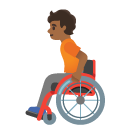


Appearance varies by platform and device. Google Noto, Twemoji, and OpenMoji are open-source.