🤾🏾
The Emoji
Person Playing Handball: Medium-dark Skin Tone
U+1F93E U+1F3FE · :person_playing_handball_mediumdark_skin_tone:
Trend 28
Meaning layers
- interpretation
- Used to flex athletic activity, represent hustle/grind energy, or ironically signal 'I'm out here putting in work' — sometimes used as a metaphor for throwing something (problems, drama, tasks) away.
- tiktok usage
- Appears in sports highlight reels, fitness motivation videos, or ironically when someone is 'throwing' a situation or responsibility away.
- irony level
- 4 / 10
Platform meanings
- meaning
- Represents athletic hustle, sports content, or the act of throwing/discarding something metaphorically.
- trend usage
- Used in sports montage videos, fitness motivation content, and POV videos where someone is 'throwing away' drama or negativity.
- hashtags
- #handball#athlete#sportslife#fitnessmotivation#throwaway
- virality score
- 32 / 100
Cultural meanings
🇺🇸
Western / Gen-Z
Used by Gen Z in the West as a flex for athletic identity or ironically to signal 'throwing away' problems with self-aware humor.
🇵🇰
Pakistan & India
Represents sports enthusiasm, often used by cricket or kabaddi fans extending to general athletic pride; handball is niche but growing in awareness.
🌍
Middle East
Used in sports contexts, particularly as handball is moderately popular in Arab countries; also conveys active lifestyle values.
🌐
Global Neutral
Universally understood as a sports emoji representing an active, athletic person; skin tone adds representation value globally.
🇧🇩
Bangladesh
Relatively niche usage; mostly understood as a sports figure emoji, occasionally used in fitness and youth sports community content.
🇱🇰
Sri Lanka
Used in sports communities, particularly youth athletics; appreciated for the diverse skin tone representation reflecting South Asian identity.
🇨🇳
China
Handball is an Olympic sport followed in China; the emoji is used in sports discussions and Olympic coverage contexts.
🇯🇵
Japan
Used in sports content and Olympic discussions; Japanese users appreciate the active, disciplined energy the emoji conveys.
🇰🇷
South Korea
Used in sports and fitness contexts; K-pop fan communities might use it ironically to describe intense practice routines.
🇹🇼
Taiwan
Used in sports and fitness discussions; the skin tone modifier may be less culturally significant but the athletic meaning is universal.
🇭🇰
Hong Kong
Used in sports contexts and fitness culture; seen in posts about active lifestyles and competitive sports participation.
🇵🇭
Philippines
Used in sports communities and basketball-adjacent content; the throwing motion may be compared humorously to basketball culture.
🇮🇩
Indonesia
Used in sports discussions and youth athletics; increasingly popular in fitness social media content among active Indonesian youth.
🇹🇭
Thailand
Used in fitness and sports contexts; Muay Thai-dominant sports culture may see this as a secondary athletic emoji.
🇻🇳
Vietnam
Used in sports content, particularly youth athletics and community sports events; generally understood as a fitness/sports symbol.
🇲🇾
Malaysia
Used in sports community content and fitness culture; the medium-dark skin tone resonates with Malay and mixed heritage users.
🇸🇦
Saudi Arabia
Used in sports contexts; handball is played in Saudi Arabia and the emoji appears in sports club and national team discussions.
🇦🇪
UAE
Used in multicultural sports contexts; Dubai and Abu Dhabi's diverse sports culture makes this emoji relatable across communities.
🇪🇬
Egypt
Handball is popular in Egypt; the emoji is genuinely used in sports discussions, team content, and fan pages.
🇹🇷
Turkey
Used in sports content; handball has a following in Turkey and the emoji appears in athletic community posts.
🇮🇷
Iran
Used in sports discussions; handball is an Olympic sport followed in Iran, and the emoji signals athletic activity.
🇳🇬
Nigeria
Used in sports contexts; while football dominates, the medium-dark skin tone makes this emoji particularly resonant for Nigerian users expressing athletic pride.
🇿🇦
South Africa
The medium-dark skin tone is culturally significant; used in sports content and represents diverse South African athletic identity.
🇬🇧
UK & Ireland
Used in sports content; handball is a growing sport in the UK and the emoji appears in school sports and competitive handball communities.
🇫🇷
France
Handball is extremely popular in France (world champions); this emoji is widely and genuinely used in French sports culture and fan discussions.
🇩🇪
Germany
Germany has a strong handball culture; the emoji is commonly used in sports discussions, Bundesliga handball content, and fan pages.
🇪🇸
Spain & Italy
Used in sports contexts; handball has a following particularly in Spain and the emoji appears in sports club and fan content.
🇧🇷
Brazil
Used in sports content; while football dominates, the emoji signals general athletic energy and is used in fitness communities.
🇲🇽
Mexico
Used in general sports and fitness contexts; the athletic motion resonates in active lifestyle communities across Mexican social media.
🌎
Latin America
Used broadly in sports and fitness content across Latin America; the throwing motion sometimes used humorously in relatable content.
🇦🇺
Australia & NZ
Used in sports content; handball in Australia often refers to a different playground game, creating slight cultural ambiguity but generally read as 'active sport.'
How its meaning shifted
- 2010
Emoji did not exist in 2010; handball and skin tone modifier emojis had not yet been introduced to Unicode.
- 2015
Handball emoji was introduced around this period; primarily used literally by sports enthusiasts and handball players to represent the sport.
- 2020
Gained traction during Tokyo Olympics anticipation; used in sports diversity discussions and fitness content; skin tone modifiers became culturally significant.
- 2026
Used across sports, fitness, and metaphorical 'throwing' contexts; medium-dark skin tone appreciated for representation; moderately niche but consistent usage in athletic communities.
See it on every platform
Compare with
Adjacent emojis
- Opposite
- person in bedcouch and lampzzz
- Often confused with
- person playing water poloperson throwing ballperson golfing
- Can replace
- basketballsoccer balltrophy
Share & embed
Frequently asked
01What does the 🤾🏾 Person Playing Handball: Medium-dark Skin Tone emoji mean?
A person playing handball with a medium-dark skin tone, shown in a throwing or jumping motion typical of the sport of handball.
02What does 🤾🏾 mean on TikTok?
Represents athletic hustle, sports content, or the act of throwing/discarding something metaphorically.
03What does 🤾🏾 mean on WhatsApp?
Signals playing handball, being active, or heading to sports practice. Used casually to say 'I'm at the gym/sports hall.'
04What does 🤾🏾 mean in Gen-Z slang?
Used to flex athletic activity, represent hustle/grind energy, or ironically signal 'I'm out here putting in work' — sometimes used as a metaphor for throwing something (problems, drama, tasks) away.
05Is the 🤾🏾 emoji safe to use?
A person playing handball; represents sport, athleticism, and active lifestyle in a completely benign and positive way.
06What does 🤾🏾 mean in texting?
Evokes feelings of physical empowerment, competitive drive, and team spirit. The skin tone representation adds a layer of cultural pride and identity affirmation for medium-dark skinned users.
07What is the shortcode for 🤾🏾?
The shortcode for Person Playing Handball: Medium-dark Skin Tone is :person_playing_handball_mediumdark_skin_tone:
08What does 🤾🏾 mean in dating?
Rarely used in direct flirting; may appear when someone wants to show off their athletic physique or active lifestyle to impress a potential partner.
Safety & usage
- Safe meaning
- A person playing handball; represents sport, athleticism, and active lifestyle in a completely benign and positive way.
- Caution
- No known toxic usage patterns; extremely low risk of misuse or harmful interpretation.
No significant warning notes. The emoji is sports-specific and carries minimal risk of misuse or offensive interpretation in any known context.
How it looks across platforms
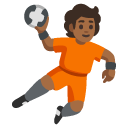


Appearance varies by platform and device. Google Noto, Twemoji, and OpenMoji are open-source.