🧍🏿
The Emoji
Person Standing: Dark Skin Tone
U+1F9CD U+1F3FF · :person_standing_dark_skin_tone:
Trend 48
Meaning layers
- interpretation
- Used to signal awkward stillness, being left on read, or existing in a state of passive confusion — basically the emoji equivalent of 'I am just standing here, unbothered or completely bothered.'
- tiktok usage
- Appears in comment sections to represent someone awkwardly lingering or waiting, often paired with silence or deadpan humor. Used as a reaction when you have nothing to say but need to say something.
- irony level
- 7 / 10
Platform meanings
- meaning
- Represents passive observation, awkward existence, or the 'I'm just here' energy in comment threads and video captions.
- trend usage
- Used in POV videos and 'nobody:' meme formats. Creators drop it to signal their character is just standing around while everything unfolds.
- hashtags
- #awkward#standingthere#nobodyasked#justvibing#standinghere
- virality score
- 55 / 100
Cultural meanings
🇺🇸
Western / Gen-Z
Heavily used for ironic detachment and awkward-waiting humor; a staple of deadpan Gen Z communication that says everything by saying nothing.
🇵🇰
Pakistan & India
Used informally to represent someone present but unresponsive in group chats, or to signal 'I am here, waiting patiently' in casual digital conversations.
🌍
Middle East
Interpreted as a neutral presence indicator; often used in group chats to signal attendance or readiness without words.
🌐
Global Neutral
Universally understood as a person standing still, used across cultures to indicate presence, waiting, or passive observation.
🇧🇩
Bangladesh
Used casually in messaging apps to represent oneself as available or idle, particularly among younger urban users.
🇱🇰
Sri Lanka
Appears in casual chats among youth to signal 'I'm here and listening' or to humorously depict standing around doing nothing.
🇨🇳
China
Less commonly used due to preference for animated stickers and WeChat-specific emoji sets, but interpreted as a neutral human figure when seen.
🇯🇵
Japan
Appreciated for its clean, minimal representation of a standing human; used in contexts suggesting patience or quiet presence.
🇰🇷
South Korea
Used among younger Koreans to represent the '남들 다 바쁜데 나만 멈춰있는' (everyone's busy but I'm just standing here) feeling, popular in relatable memes.
🇹🇼
Taiwan
Casually used in LINE and Instagram messages to indicate being present and available, or as a playful substitute for 'I'm here.'
🇭🇰
Hong Kong
Used in Cantonese digital culture to humorously represent someone frozen in decision or awkwardly present in a social scene.
🇵🇭
Philippines
Popular in Messenger and TikTok comments to represent the 'nandito lang ako' (I'm just here) vibe — present but passive.
🇮🇩
Indonesia
Used in WhatsApp and TikTok to signal idle presence or passive witnessing of chaotic events in group chats.
🇹🇭
Thailand
Appears in LINE sticker-adjacent usage to signal quiet patience or awkward stillness, resonating with Thai concepts of 'jai yen' (cool heart, patience).
🇻🇳
Vietnam
Used among Zalo and Facebook Messenger users to indicate you're present in a conversation but have nothing specific to add.
🇲🇾
Malaysia
Common in WhatsApp group chats to signal 'I'm here but staying quiet,' fitting the Malaysian cultural tendency toward indirect communication.
🇸🇦
Saudi Arabia
Interpreted as a person waiting or standing by; used in messaging apps to indicate presence and availability in a formal or informal context.
🇦🇪
UAE
Used across multicultural digital spaces in the UAE to signal a composed, observing presence — neither disengaged nor reactive.
🇪🇬
Egypt
Used humorously among Egyptian youth on Facebook and TikTok to represent the feeling of standing around while chaos unfolds nearby.
🇹🇷
Turkey
Appears in WhatsApp and Instagram to signal 'ben buradayım' (I am here) energy — present, waiting, slightly resigned.
🇮🇷
Iran
Used on Telegram and Instagram (where accessible) to represent quiet presence or patient waiting, resonating with themes of endurance.
🇳🇬
Nigeria
Widely used on WhatsApp and Twitter/X to represent the 'standing and watching' energy during drama or to signal unbothered cool.
🇿🇦
South Africa
Used across platforms to signal casual presence or the 'just standing here' reaction to absurd or chaotic social media moments.
🇬🇧
UK & Ireland
Embraced for its dry, understated humor value — the British and Irish equivalent of a shrug, used to react to awkward or painfully relatable situations.
🇫🇷
France
Used with a certain philosophical nonchalance, representing 'je suis là' (I am here) — present, composed, not particularly fussed.
🇩🇪
Germany
Interpreted straightforwardly as indicating someone is present and available; used in group coordination and casual chats.
🇪🇸
Spain & Italy
Used expressively to signal 'eccomi/aquí estoy' (here I am) — often with a touch of theatrical self-awareness in social media contexts.
🇧🇷
Brazil
Used on WhatsApp and TikTok to represent the quiet presence before a reaction, often the calm before an expressive follow-up emoji.
🇲🇽
Mexico
Dropped in group chats and comment sections to represent patiently standing by or watching drama unfold with resigned amusement.
🌎
Latin America
Broadly used across Latin American digital spaces to signal presence, waiting, or the 'I'm just here' energy during online discourse.
🇦🇺
Australia & NZ
Used with signature laid-back humor to represent someone who is physically or emotionally just standing around, not making a fuss.
How its meaning shifted
- 2010
Did not exist — emoji of this type with skin tone modifiers had not yet been introduced to Unicode or mainstream keyboard sets.
- 2015
Early skin tone modifier system was being introduced; standing person emojis were beginning to appear but adoption was minimal and representation was still primarily default yellow.
- 2020
Gained traction alongside broader diversity emoji adoption; used sincerely to represent oneself with dark skin tone representation in casual digital communication.
- 2026
Heavily ironic and meme-coded in Gen Z usage while also maintaining sincere representation value; dual-layered meaning as both a cultural symbol of inclusion and a deadpan humor device.
See it on every platform
Compare with
Adjacent emojis
Share & embed
Frequently asked
01What does the 🧍🏿 Person Standing: Dark Skin Tone emoji mean?
A person standing upright with dark skin tone, shown in a neutral, stationary pose facing forward or slightly angled.
02What does 🧍🏿 mean on TikTok?
Represents passive observation, awkward existence, or the 'I'm just here' energy in comment threads and video captions.
03What does 🧍🏿 mean on WhatsApp?
Sent to indicate you're waiting for a response or that you're available but idle — a digital 'I'm here, hello?'
04What does 🧍🏿 mean in Gen-Z slang?
Used to signal awkward stillness, being left on read, or existing in a state of passive confusion — basically the emoji equivalent of 'I am just standing here, unbothered or completely bothered.'
05Is the 🧍🏿 emoji safe to use?
A neutral emoji representing a person standing still with dark skin tone; safe for all standard communication and representation contexts.
06What does 🧍🏿 mean in texting?
The standing still figure psychologically connotes a liminal state — neither fleeing nor engaging — which resonates with feelings of social paralysis, quiet resilience, or deliberate non-reaction.
07What is the shortcode for 🧍🏿?
The shortcode for Person Standing: Dark Skin Tone is :person_standing_dark_skin_tone:
08What does 🧍🏿 mean in dating?
Rarely used flirtatiously; occasionally sent after an awkward silence in a conversation to humorously acknowledge the tension.
Safety & usage
- Safe meaning
- A neutral emoji representing a person standing still with dark skin tone; safe for all standard communication and representation contexts.
- Caution
- In rare cases, could be used in targeted harassment to mockingly represent a specific person as passive or inactive, though this is uncommon.
Generally safe. The skin tone modifier adds important representation value. No inherent harmful associations, though contextual misuse in targeted trolling is theoretically possible.
How it looks across platforms
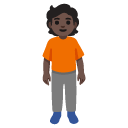


Appearance varies by platform and device. Google Noto, Twemoji, and OpenMoji are open-source.