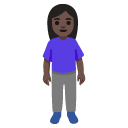
🧍🏿♀️
The Emoji
Woman Standing: Dark Skin Tone
U+1F9CD U+1F3FF U+200D U+2640 U+FE0F · :woman_standing_dark_skin_tone:
Trend 48
Meaning layers
- interpretation
- Used to convey unbothered energy, awkward pauses, or the feeling of just existing in a situation with no strong reaction — the emoji equivalent of standing there silently.
- tiktok usage
- Appears in comment sections to signal 'I have nothing to say to this' or 'I'm just watching this unfold' — a visual shrug with more attitude.
- irony level
- 7 / 10
Platform meanings
- meaning
- Signals unbothered or awkward 'just existing' energy, often placed in comments when users have no words for what they just watched.
- trend usage
- Used in duet and stitch comment sections to represent the viewer's silent, wide-eyed reaction to chaotic or unhinged content.
- hashtags
- #unbothered#juststanding#darkskintok#fyp#silentreaction
- virality score
- 52 / 100
Cultural meanings
🇺🇸
Western / Gen-Z
Heavily used ironically to represent the 'unbothered' or 'I have no reaction' archetype, often in meme and comment culture celebrating dark-skinned women's quiet power.
🇵🇰
Pakistan & India
Used neutrally or in representation contexts, though skin tone specificity may not be widely noted; generally understood as 'woman standing' without deep cultural irony.
🌍
Middle East
Interpreted primarily as a literal depiction of a woman; the dark skin tone may be noted but the emoji is rarely used with ironic subtext in this region.
🌐
Global Neutral
Universally understood as a dark-skinned woman in a standing position, used for representation, neutrality, or straightforward communication.
🇧🇩
Bangladesh
Used in casual messaging as a generic 'woman' emoji with the skin tone modifier; representation discourse around it is limited but growing.
🇱🇰
Sri Lanka
Similar to Bangladesh — taken at face value as a standing woman; occasionally used in diaspora communities to celebrate darker-skinned South Asian representation.
🇨🇳
China
Infrequently used; when used, it is typically taken literally as a woman standing, with minimal awareness of the ironic Western Gen Z usage.
🇯🇵
Japan
Used in representation and diversity discussions, particularly in global-facing communities; Japanese users may be unfamiliar with the ironic unbothered connotation.
🇰🇷
South Korea
Occasionally used in K-pop fan communities to represent inclusivity and diversity; the dark skin tone is specifically noted as meaningful in representation conversations.
🇹🇼
Taiwan
Primarily interpreted literally; Taiwanese users engaged in global internet culture may be familiar with the 'unbothered' meme usage from Western platforms.
🇭🇰
Hong Kong
Used in bilingual digital spaces with awareness of both literal and ironic interpretations; representation discussions are present in global-facing Cantonese communities.
🇵🇭
Philippines
Used in casual chats to mean 'woman standing'; Filipino internet culture, being deeply integrated with global meme culture, also picks up the ironic usage.
🇮🇩
Indonesia
Interpreted mostly at face value; in younger, globally connected Indonesian communities, the 'just standing here' meme usage is beginning to filter in.
🇹🇭
Thailand
Used literally in most contexts; among Thai youth active on TikTok and Twitter, the unbothered connotation is gradually recognized.
🇻🇳
Vietnam
Primarily used as a neutral 'woman' emoji; representation awareness is growing in younger, urban, digitally connected Vietnamese communities.
🇲🇾
Malaysia
Used in multicultural digital spaces; the emoji is generally understood literally, though ironic usage is familiar to Malaysian Gen Z active on global platforms.
🇸🇦
Saudi Arabia
Used carefully in gender-mixed digital spaces; often interpreted literally, and the dark skin tone is noted as representing African or South Asian women.
🇦🇪
UAE
In the UAE's highly diverse digital culture, this emoji sees broader multicultural usage and is sometimes used by African diaspora communities for self-representation.
🇪🇬
Egypt
Interpreted as a woman standing; in Egyptian social media, it may be used in discussions about African identity or diversity, particularly in pan-African digital spaces.
🇹🇷
Turkey
Used straightforwardly as a standing woman emoji; younger Turkish users familiar with global meme culture recognize the ironic 'unbothered' usage.
🇮🇷
Iran
Rarely used with ironic intent; in Iranian digital culture it is understood literally, with some awareness in diaspora communities of its Western meme connotations.
🇳🇬
Nigeria
Widely embraced as a representation emoji for dark-skinned Nigerian women; used with pride and celebratory energy, especially in self-love and empowerment contexts.
🇿🇦
South Africa
Strongly embraced for representation of Black South African women; used in both casual and empowerment contexts celebrating melanin and Black femininity.
🇬🇧
UK & Ireland
Adopted by British Black communities for self-representation; Gen Z usage mirrors American ironic 'unbothered' culture, especially on UK Black Twitter.
🇫🇷
France
Used in representation and diversity discussions, particularly in Afro-French communities; the ironic usage is present but less dominant than in anglophone cultures.
🇩🇪
Germany
Primarily interpreted literally; in German digital culture, it is used in diversity and inclusion conversations, with ironic meme usage limited to globally connected youth.
🇪🇸
Spain & Italy
Used mostly at face value; in Spain and Italy, representation discourse around the emoji is growing, particularly in Afro-Latino and African diaspora digital spaces.
🇧🇷
Brazil
In Brazil's racially diverse social media landscape, the emoji is used for Afro-Brazilian representation and self-love, with strong resonance in Black Brazilian communities.
🇲🇽
Mexico
Used among Afro-Mexican and darker-skinned communities for self-representation; the ironic unbothered usage is recognized by Mexican Gen Z active on TikTok.
🌎
Latin America
Across Latin America, embraced in Afro-descendent and Indigenous communities for skin tone representation; ironic usage varies by country and digital platform engagement.
🇦🇺
Australia & NZ
Used by Aboriginal, Māori, and Pacific Islander communities for self-representation; Gen Z usage mirrors global ironic 'unbothered' culture seen on TikTok and Twitter.
How its meaning shifted
- 2010
This emoji did not exist in 2010; standing person emojis and skin tone modifiers had not yet been introduced to Unicode.
- 2015
Skin tone modifiers were introduced in Unicode 8.0 in 2015, but the standing figure emoji specifically came later; early diversity emoji conversations were just beginning.
- 2020
By 2020, the emoji was in active use for representation and diversity, appearing in self-identification bios, Black Lives Matter related posts, and casual messaging as a neutral woman emoji.
- 2026
By 2026, the emoji has taken on layered ironic and meme meaning — simultaneously a representation tool for dark-skinned women and a Gen Z shorthand for unbothered, silent, or 'I'm just standing here' energy.
See it on every platform
Compare with
Adjacent emojis
Share & embed
Frequently asked
01What does the 🧍🏿♀️ Woman Standing: Dark Skin Tone emoji mean?
A woman standing upright with dark skin tone, depicted in a neutral, relaxed pose with arms at her sides.
02What does 🧍🏿♀️ mean on TikTok?
Signals unbothered or awkward 'just existing' energy, often placed in comments when users have no words for what they just watched.
03What does 🧍🏿♀️ mean on WhatsApp?
Indicates waiting, patience wearing thin, or being left on read — 'I'm just standing here waiting for you to respond.'
04What does 🧍🏿♀️ mean in Gen-Z slang?
Used to convey unbothered energy, awkward pauses, or the feeling of just existing in a situation with no strong reaction — the emoji equivalent of standing there silently.
05Is the 🧍🏿♀️ emoji safe to use?
A straightforward representation of a dark-skinned woman in a standing pose; used for identity expression, casual communication, and meme culture.
06What does 🧍🏿♀️ mean in texting?
Psychologically represents a passive, observer state — someone who has emotionally stepped back from a situation. It communicates low arousal and detached composure, often used as a coping mechanism for emotional overload.
07What is the shortcode for 🧍🏿♀️?
The shortcode for Woman Standing: Dark Skin Tone is :woman_standing_dark_skin_tone:
08What does 🧍🏿♀️ mean in dating?
Rarely used flirtatiously on its own; occasionally sent after an awkward or bold text to signal 'I said what I said and I'm standing here waiting for your reaction.'
Safety & usage
- Safe meaning
- A straightforward representation of a dark-skinned woman in a standing pose; used for identity expression, casual communication, and meme culture.
- Caution
- In rare cases could be used in racist or colorist contexts to mock or stereotype dark-skinned women, though this is not a primary or common misuse.
As with all skin-tone-specific emojis, context matters — use by people of the represented skin tone is celebratory, while use by others in mocking contexts can be offensive. Generally considered safe.
How it looks across platforms
Appearance varies by platform and device. Google Noto, Twemoji, and OpenMoji are open-source.