🧑🏼🦯➡️
The Emoji
Person With White Cane Facing Right: Medium-light Skin Tone
U+1F9D1 U+1F3FC U+200D U+1F9AF U+200D U+27A1 U+FE0F · :person_with_white_cane_facing_right_mediumlight_skin_tone:
Trend 28
Meaning layers
- interpretation
- Used metaphorically to say someone is 'blind' to obvious things, walking into a situation without seeing the signs, or navigating life clueless. Also used genuinely to represent disability pride.
- tiktok usage
- Appears in 'walking into [situation] like' memes, disability awareness content, and sometimes as humor for 'I clearly can't see what's right in front of me'.
- irony level
- 5 / 10
Platform meanings
- meaning
- Represents navigating life obliviously, disability awareness, or comedic 'I didn't see the signs' storytelling.
- trend usage
- Paired with trending audio about walking into chaos, used in disability TikTok community (#DisabilityTok), and in self-deprecating 'me walking into trouble' edits.
- hashtags
- #DisabilityTok#BlindToTheRedFlags#Accessibility#DisabilityPride#WalkingBlind
- virality score
- 38 / 100
Cultural meanings
🇺🇸
Western / Gen-Z
Widely used as both genuine disability representation and ironic shorthand for being 'blind to the obvious'; disability pride is respected in this context.
🇵🇰
Pakistan & India
Primarily interpreted literally as representing a visually impaired person; used in disability awareness posts and social media advocacy content.
🌍
Middle East
Understood as a symbol of physical disability; used respectfully in accessibility and charity-related content with less ironic usage.
🌐
Global Neutral
Universally recognized as representing a blind or visually impaired person using a white cane; the medium-light skin tone adds specificity to the representation.
🇧🇩
Bangladesh
Taken at face value as a disability representation emoji; used in awareness posts about services and support for visually impaired communities.
🇱🇰
Sri Lanka
Used in disability rights content and social media posts about accessibility; less common in casual or ironic usage.
🇨🇳
China
Understood literally as representing visual impairment; appears in content about disability welfare, rehabilitation, and accessibility infrastructure.
🇯🇵
Japan
Associated with disability awareness and universal design (UD) culture; used respectfully in accessibility and social welfare discussions.
🇰🇷
South Korea
Used in disability awareness campaigns and inclusive content; occasionally appears in ironic internet culture for 'didn't see that coming' humor.
🇹🇼
Taiwan
Appears in disability rights discussions and accessibility content; the skin tone modifier is noted as adding inclusive representation.
🇭🇰
Hong Kong
Used in disability advocacy and social welfare content; occasionally adopted in meme culture for oblivious commentary.
🇵🇭
Philippines
Used to represent visually impaired individuals; common in disability awareness social media posts and fundraising content.
🇮🇩
Indonesia
Primarily literal usage in disability representation and social welfare content; respectful connotations in most contexts.
🇹🇭
Thailand
Associated with disability rights and accessibility advocacy; used in content about support for visually impaired communities.
🇻🇳
Vietnam
Used in disability awareness content and charitable posts; literal interpretation is dominant with limited ironic usage.
🇲🇾
Malaysia
Appears in disability representation content and inclusive community posts; skin tone modifier appreciated for representation diversity.
🇸🇦
Saudi Arabia
Used respectfully in disability awareness and charitable content; closely tied to social welfare and religious charity contexts.
🇦🇪
UAE
Common in inclusive workplace and accessibility content; the UAE's focus on accessibility infrastructure makes this relevant in professional contexts.
🇪🇬
Egypt
Used in disability awareness posts and social charity content; literal interpretation dominates with the white cane as a widely recognized symbol.
🇹🇷
Turkey
Appears in disability rights and accessibility discussions; occasionally used in ironic social media commentary about missing obvious signs.
🇮🇷
Iran
Used in disability representation and social welfare content; the white cane symbol is universally understood across the culture.
🇳🇬
Nigeria
Used in disability awareness posts and inclusive community content; growing use in social media disability advocacy circles.
🇿🇦
South Africa
Appears in disability rights content and accessibility advocacy; also used in ironic social media commentary consistent with local meme culture.
🇬🇧
UK & Ireland
Used both literally for disability representation and ironically in British humor for 'blind to the obvious'; fits well into dry sarcastic commentary.
🇫🇷
France
Used in disability advocacy and accessible society discussions; the ironic metaphorical usage is present but secondary to literal representation.
🇩🇪
Germany
Associated with disability rights and accessibility standards (Barrierefreiheit); used in professional and advocacy contexts with high respect for literal meaning.
🇪🇸
Spain & Italy
Used in disability representation and social awareness content; occasionally appears in expressive meme culture for comedic obliviousness.
🇧🇷
Brazil
Widely used in disability advocacy and inclusive content; Brazilian internet culture adopts the ironic 'walking blind into situations' usage with humor.
🇲🇽
Mexico
Used in disability representation content and social awareness posts; the ironic usage for missing obvious signs is common in meme culture.
🌎
Latin America
Across Latin America, the emoji represents disability inclusion and is also used humorously for walking into predictable problems or ignoring red flags.
🇦🇺
Australia & NZ
Used in both genuine disability representation and dry ironic humor; fits into Australian 'taking the piss' culture for obliviousness jokes.
How its meaning shifted
- 2010
This specific emoji did not exist in 2010; disability emojis were not yet part of standard sets and the concept of skin tone modifiers was not yet implemented.
- 2015
Early disability emoji proposals were being submitted to Unicode; the concept was still in advocacy stages with basic accessibility emoji discussions underway.
- 2020
Introduced as part of Unicode's disability representation expansion; initial usage was primarily in disability awareness, accessibility advocacy, and representation discussions.
- 2026
Established in both genuine disability representation content and ironic meme culture; widely used in 'walking blind into situations' humor while maintaining strong disability pride community usage.
See it on every platform
Adjacent emojis
Share & embed
Frequently asked
01What does the 🧑🏼🦯➡️ Person With White Cane Facing Right: Medium-light Skin Tone emoji mean?
A person using a white cane facing right, shown with medium-light skin tone. The white cane is a universal symbol of blindness or visual impairment.
02What does 🧑🏼🦯➡️ mean on TikTok?
Represents navigating life obliviously, disability awareness, or comedic 'I didn't see the signs' storytelling.
03What does 🧑🏼🦯➡️ mean on WhatsApp?
Sent to imply someone missed something obvious or is navigating a situation without full awareness.
04What does 🧑🏼🦯➡️ mean in Gen-Z slang?
Used metaphorically to say someone is 'blind' to obvious things, walking into a situation without seeing the signs, or navigating life clueless. Also used genuinely to represent disability pride.
05Is the 🧑🏼🦯➡️ emoji safe to use?
Represents a blind or visually impaired person using a white cane for navigation; used in disability advocacy, representation, and awareness content.
06What does 🧑🏼🦯➡️ mean in texting?
The cane emoji can evoke feelings of solidarity and representation for disabled individuals, while also carrying a metaphorical weight about navigating uncertainty or being unaware of one's surroundings.
07What is the shortcode for 🧑🏼🦯➡️?
The shortcode for Person With White Cane Facing Right: Medium-light Skin Tone is :person_with_white_cane_facing_right_mediumlight_skin_tone:
08What does 🧑🏼🦯➡️ mean in dating?
Rarely used flirtatiously; could jokingly mean 'I'm blind to everyone else but you' in a playful context.
Safety & usage
- Safe meaning
- Represents a blind or visually impaired person using a white cane for navigation; used in disability advocacy, representation, and awareness content.
- Caution
- Can be used mockingly to call someone 'blind' or stupid in a derogatory way if deployed with hostile intent.
Generally safe and positive; care should be taken not to use this emoji in contexts that mock or demean blind or visually impaired individuals. Ironic usage should be self-directed rather than targeted.
How it looks across platforms
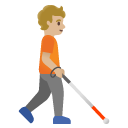
Appearance varies by platform and device. Google Noto, Twemoji, and OpenMoji are open-source.