🌒
The Emoji
Waxing Crescent Moon
U+1F312 · :waxing_crescent_moon:
Trend 58
Meaning layers
- interpretation
- Symbolizes mystery, a brooding aesthetic, late-night energy, or a soft 'dark side' persona. Often used to signal that someone is in their 'villain era' or feeling mysterious and introspective.
- tiktok usage
- Appears in dark academia, witchcore, and cottagecore content; used in captions to signal moody late-night vibes or spiritual moon rituals.
- irony level
- 3 / 10
Platform meanings
- meaning
- Signals dark academia, witchcore, or late-night moody content; used to establish a mysterious or celestial persona.
- trend usage
- Appears in 'moon phase' trend videos, manifestation rituals, night routine aesthetics, and 'dark era' transformation content.
- hashtags
- #moonphase#darkacademia#witchtok#celestial#nightvibes
- virality score
- 62 / 100
Cultural meanings
🇺🇸
Western / Gen-Z
Represents the 'villain era,' witchcore aesthetics, and mysterious late-night energy; heavily used in spiritual and dark romantic subcultures.
🇵🇰
Pakistan & India
Associated with the Islamic lunar calendar and the sighting of the crescent moon for religious occasions; also used poetically in Urdu and Hindi to express beauty or longing.
🌍
Middle East
Deeply tied to Islamic tradition and the lunar calendar; represents the new month, Ramadan beginning, and religious observance across the region.
🌐
Global Neutral
Universally understood as representing nighttime, the moon's phase, and a transitional moment between darkness and light.
🇧🇩
Bangladesh
Carries religious significance tied to lunar Islamic observances; also used in everyday digital communication to indicate night or a peaceful evening.
🇱🇰
Sri Lanka
Used to reference the lunar calendar important in both Buddhist and Hindu traditions; also employed for nighttime or nature-related contexts.
🇨🇳
China
Associated with the lunar calendar and moon festivals like Mid-Autumn Festival; used in poetic and cultural contexts to evoke longing and reflection.
🇯🇵
Japan
Connected to traditional moon-viewing culture (tsukimi) and poetic imagery; used to express aesthetic appreciation for the night and cyclical beauty.
🇰🇷
South Korea
Used in aesthetic and K-pop fan contexts; associated with moody, romantic, or ethereal imagery common in idol and webtoon culture.
🇹🇼
Taiwan
Used in conjunction with lunar calendar events and Mid-Autumn Festival; also popular in aesthetic digital communication among youth.
🇭🇰
Hong Kong
Employed in lunar new year and moon festival contexts; younger users adopt it for its aesthetic and mysterious appeal in digital spaces.
🇵🇭
Philippines
Used casually to indicate nighttime or a romantic mood; also appears in spiritual and folk contexts referencing the moon's mystical properties.
🇮🇩
Indonesia
Carries Islamic lunar significance, especially around Ramadan; also used in everyday chat to signify night or a reflective state.
🇹🇭
Thailand
Used in contexts related to lunar Buddhist holidays and moon-based festivals; also appears in aesthetic and romantic digital expression.
🇻🇳
Vietnam
Tied to the lunar calendar and Tết and Mid-Autumn Festival traditions; also used by younger Vietnamese users for aesthetic night-themed content.
🇲🇾
Malaysia
Holds Islamic lunar calendar significance; also used casually in youth digital culture for nighttime aesthetics and mysterious vibes.
🇸🇦
Saudi Arabia
Strongly associated with the Islamic crescent symbol, Ramadan moon sighting, and religious lunar observance; treated with reverence.
🇦🇪
UAE
Used in religious contexts for Ramadan and lunar holidays; also adopted by younger, cosmopolitan users for aesthetic and celestial digital expression.
🇪🇬
Egypt
Deeply tied to Islamic tradition and Ramadan; also used in romantic and poetic digital expression drawing on Arabic literary moon symbolism.
🇹🇷
Turkey
Connected to the crescent as a national and Islamic symbol; used both in patriotic contexts and in casual digital communication for night and mystery.
🇮🇷
Iran
Associated with Persian poetry's rich moon imagery and Islamic lunar tradition; used in romantic, poetic, and spiritual digital contexts.
🇳🇬
Nigeria
Used to indicate nighttime or evening moods; in northern Muslim communities, it carries significance related to Islamic lunar observations.
🇿🇦
South Africa
Primarily used for nighttime or aesthetic purposes in digital communication; no dominant cultural-specific meaning beyond universal moon symbolism.
🇬🇧
UK & Ireland
Used for nighttime vibes, dark academia aesthetics, and gothic or mystical subcultures; common in alternative and indie digital communities.
🇫🇷
France
Employed in poetic and romantic digital expression; associated with nighttime elegance and the French tradition of moon symbolism in literature.
🇩🇪
Germany
Used straightforwardly to indicate night or lunar phases; also appears in spiritual and nature-oriented communities for its symbolic value.
🇪🇸
Spain & Italy
Associated with romantic nighttime imagery and Mediterranean night culture; used in poetic captions and aesthetic social media content.
🇧🇷
Brazil
Used for nighttime vibes and aesthetic content; also appears in spiritual contexts tied to Candomblé and Umbanda lunar traditions.
🇲🇽
Mexico
Connected to indigenous lunar traditions and Día de los Muertos aesthetic; used in both spiritual and artistic digital expression.
🌎
Latin America
Broadly used to indicate nighttime, mystery, and spiritual energy; moon symbolism is strong across Latin American indigenous and syncretic traditions.
🇦🇺
Australia & NZ
Used for nighttime aesthetics and outdoor night experiences like stargazing; also appears in indigenous cultural contexts referencing lunar cycles.
How its meaning shifted
- 2010
Used almost exclusively in its literal sense to represent the moon's phase, nighttime, or astronomy-related content in early smartphone messaging.
- 2015
Began appearing in aesthetic Tumblr and early Instagram contexts as part of celestial and mystical visual language.
- 2020
Fully integrated into witchcore, dark academia, and astrology aesthetics on TikTok and Instagram; adopted by Gen Z as a symbol of mysterious personal branding.
- 2026
A staple of celestial and spiritual aesthetics across all platforms; used in moon-phase compatibility trends, manifestation content, and late-night emotional expression with layered ironic and sincere meanings.
See it on every platform
Emoji combinations
Adjacent emojis
- Opposite
- sunsunrisebright sun
- Often confused with
- crescent moonnew moonwaxing gibbous moon
- Can replace
- crescent moonnight with starsstar
Share & embed
Frequently asked
01What does the 🌒 Waxing Crescent Moon emoji mean?
The waxing crescent moon emoji depicts the moon in its second phase, showing a thin sliver of illuminated surface on the right side, transitioning from new moon toward first quarter.
02What does 🌒 mean on TikTok?
Signals dark academia, witchcore, or late-night moody content; used to establish a mysterious or celestial persona.
03What does 🌒 mean on WhatsApp?
Indicates it is nighttime or signals a late-night conversation; sometimes used to say 'goodnight' with a poetic touch.
04What does 🌒 mean in Gen-Z slang?
Symbolizes mystery, a brooding aesthetic, late-night energy, or a soft 'dark side' persona. Often used to signal that someone is in their 'villain era' or feeling mysterious and introspective.
05Is the 🌒 emoji safe to use?
Represents nighttime, lunar phases, mystery, celestial aesthetics, and spiritual or astronomical interest.
06What does 🌒 mean in texting?
The crescent moon evokes liminal feelings — a transitional state between darkness and light, resonating with emotions of hope tinged with uncertainty or introspection.
07What is the shortcode for 🌒?
The shortcode for Waxing Crescent Moon is :waxing_crescent_moon:
08What does 🌒 mean in dating?
Sent late at night as a subtle 'I'm thinking of you in the dark' signal; often paired with 'can't sleep' texts to hint at romantic longing.
Safety & usage
- Safe meaning
- Represents nighttime, lunar phases, mystery, celestial aesthetics, and spiritual or astronomical interest.
- Caution
- Occasionally used in occult-adjacent harassment communities as a symbolic marker, though this is rare and fringe.
Generally safe and benign; no widespread toxic usage patterns. The crescent moon is a sacred religious symbol in Islam, so contextual sensitivity is advised when using it in religious discussions.
How it looks across platforms
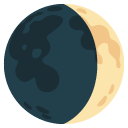


Appearance varies by platform and device. Google Noto, Twemoji, and OpenMoji are open-source.