🦯
The Emoji
White Cane
U+1F9AF · :white_cane:
Trend 32
Meaning layers
- interpretation
- Used metaphorically to call someone oblivious, blind to obvious facts, or completely unaware of a situation. Also used in disability pride contexts or when someone is navigating something confusing like a 'maze' of drama or information.
- tiktok usage
- Appears in comment sections to say 'you need this 🦯' at people who missed an obvious point or are being willfully ignorant. Also used in accessibility advocacy content.
- irony level
- 5 / 10
Platform meanings
- meaning
- Signals someone is oblivious or missing obvious information; also appears in disability representation, mobility aid awareness, and accessibility advocacy videos.
- trend usage
- Comment section weapon against bad takes — dropping 🦯 under a video where someone clearly misses the point. Also used in 'blind to the truth' storytelling videos.
- hashtags
- #WhiteCane#DisabilityAwareness#BlindTikTok#AccessibilityMatters#DisabilityPride
- virality score
- 38 / 100
Cultural meanings
🇺🇸
Western / Gen-Z
Primarily used in two modes: sincerely for disability pride and accessibility advocacy, or ironically to call out oblivious people. White Cane Safety Day (Oct 15) generates spikes in use.
🇵🇰
Pakistan & India
Used primarily in literal contexts related to disability awareness campaigns and support for the visually impaired; the metaphorical 'oblivious' usage is less common but growing in urban online spaces.
🌍
Middle East
Associated with charitable giving and support for the disabled — Islamic traditions of care for vulnerable community members give it a dignified, compassionate connotation. Used in awareness campaigns.
🌐
Global Neutral
Universally recognized as a symbol of visual impairment and blindness; the accessibility meaning is consistent across cultures even if ironic usage varies by region.
🇧🇩
Bangladesh
Used primarily in disability awareness and NGO communications focused on supporting visually impaired individuals; less meme usage, more sincere advocacy context.
🇱🇰
Sri Lanka
Appears in disability support organization communications and awareness days; limited ironic usage, primarily sincere representation of visual impairment.
🇨🇳
China
Used in disability awareness campaigns and to represent the visually impaired community; Chinese internet culture may use it metaphorically for being 'blind' to obvious trends or truths (瞎了).
🇯🇵
Japan
Deeply associated with the formal concept of disability support (障害者支援); used respectfully in accessibility discussions and awareness campaigns, with minimal ironic usage respecting social norms.
🇰🇷
South Korea
Used in disability awareness content and increasingly in K-internet culture to call out someone who is 눈치 없는 (clueless/without social awareness), blending sincere and ironic usage.
🇹🇼
Taiwan
Associated with White Cane Day awareness and disability rights advocacy; online communities may use it humorously when someone misses context, similar to other East Asian internet cultures.
🇭🇰
Hong Kong
Used in both Cantonese-language disability advocacy and as a comment on someone being oblivious (冇眼睇 vibes) in online discourse.
🇵🇭
Philippines
Used in disability awareness, with sincere usage in NGO and advocacy contexts; Filipino internet culture might deploy it humorously when someone clearly 'doesn't see' an obvious joke or situation.
🇮🇩
Indonesia
Primarily found in disability advocacy content (tunanetra awareness) and social media campaigns; ironic usage is emerging but less dominant than in Western contexts.
🇹🇭
Thailand
Associated with disability support organizations and awareness campaigns; used respectfully in Thai online communities, with some ironic crossover in younger social media users.
🇻🇳
Vietnam
Used in disability awareness and NGO communications; Vietnamese online culture may use it occasionally to suggest someone is 'blind' to obvious social dynamics, but sincerity dominates.
🇲🇾
Malaysia
Appears in OKU (Orang Kurang Upaya) awareness campaigns and disability rights discussions; dual usage — sincere advocacy and mild irony for obliviousness — both present.
🇸🇦
Saudi Arabia
Used in disability support and charity contexts aligned with Islamic values of caring for the disabled; organizational and awareness campaign usage is most prominent.
🇦🇪
UAE
Appears in accessibility advocacy and disability inclusion corporate campaigns; the UAE's focus on inclusivity (Vision 2030 adjacent) means it gets legitimate organizational usage.
🇪🇬
Egypt
Found in disability awareness campaigns and charitable giving contexts; Egyptian social media might use it metaphorically to describe political or social blindness in commentary.
🇹🇷
Turkey
Used in disability awareness (görme engelliler) contexts and increasingly in ironic Turkish Twitter/X culture to point out when someone is missing an obvious point.
🇮🇷
Iran
Primarily sincere usage in disability support contexts; Persian internet culture may use it in commentary about political or social obliviousness with a metaphorical edge.
🇳🇬
Nigeria
Used in disability awareness campaigns and NGO communications; Nigerian social media culture may deploy it satirically when calling out hypocrisy or willful ignorance in public discourse.
🇿🇦
South Africa
Found in disability rights advocacy and awareness campaigns; South African English-speaking online communities may use it in the 'you need this' meme format to call out oblivious takes.
🇬🇧
UK & Ireland
Used with quintessential British dry humor — dropped as a single emoji response to someone being utterly clueless — alongside sincere disability advocacy usage. Common on UK Twitter/X.
🇫🇷
France
Used in disability awareness and accessibility rights discussions; French online culture may deploy it sarcastically with characteristic ironic detachment when mocking oblivious arguments.
🇩🇪
Germany
Predominantly sincere usage in disability representation and accessibility advocacy; German internet culture is less prone to ironic emoji use but it appears in Behindertenrechte (disability rights) discourse.
🇪🇸
Spain & Italy
Used in disability awareness contexts; Mediterranean internet culture may use it expressively to indicate dramatic disbelief — 'I can't believe you don't see this obvious thing.'
🇧🇷
Brazil
Brazilian internet culture enthusiastically uses it as a sarcastic 'here you go, you're blind' response to bad takes, alongside genuine disability awareness content on key awareness dates.
🇲🇽
Mexico
Used in disability awareness and also in Mexican social media humor to tell someone they are clearly not seeing what everyone else sees — vibrant ironic usage alongside sincere advocacy.
🌎
Latin America
Across Latin America, dual usage exists: sincere disability awareness on regional awareness days and ironic deployment when someone misses an obvious truth in online debate.
🇦🇺
Australia & NZ
Used in disability advocacy contexts and with dry Antipodean humor — casually dropped to imply someone is stumbling around clueless. White Cane Day awareness content spikes usage annually.
How its meaning shifted
- 2010
This emoji did not exist in 2010. Disability representation in emoji was nearly absent, and the concept of a white cane emoji had not been proposed to Unicode.
- 2015
Still did not exist. Advocacy groups like the American Foundation for the Blind were beginning to push for disability-related emoji, but the white cane was not yet in Unicode.
- 2020
Newly released (Unicode 12.0, 2019), used almost exclusively for sincere disability representation, White Cane Safety Day awareness, and accessibility advocacy. Ironic usage was minimal.
- 2026
Established dual-purpose emoji: sincere disability pride and advocacy tool on one hand, and a widely understood internet shorthand for calling out obliviousness on the other. Consistently used around October 15 and in accessibility tech discourse.
See it on every platform
Compare with
Adjacent emojis
- Often confused with
- walking stickgolfmagic wand
- Can replace
- eyesquestion markperson walking
Share & embed
Frequently asked
01What does the 🦯 White Cane emoji mean?
A white cane used by visually impaired or blind individuals as a mobility and orientation tool. The long white stick helps navigate surroundings and signals to others that the user has a visual impairment.
02What does 🦯 mean on TikTok?
Signals someone is oblivious or missing obvious information; also appears in disability representation, mobility aid awareness, and accessibility advocacy videos.
03What does 🦯 mean on WhatsApp?
Used to tell someone they are being oblivious or to discuss accessibility and disability-related topics in group chats.
04What does 🦯 mean in Gen-Z slang?
Used metaphorically to call someone oblivious, blind to obvious facts, or completely unaware of a situation. Also used in disability pride contexts or when someone is navigating something confusing like a 'maze' of drama or information.
05Is the 🦯 emoji safe to use?
Symbol of visual impairment, disability pride, accessibility advocacy, and independence for blind and low-vision individuals.
06What does 🦯 mean in texting?
Carries connotations of both limitation and empowerment — symbolizing the challenge of navigating the world with a disability while also representing independence and adaptability. Evokes empathy when used sincerely.
07What is the shortcode for 🦯?
The shortcode for White Cane is :white_cane:
08What does 🦯 mean in dating?
Rarely used flirtatiously. Could appear in the phrase 'navigating my feelings for you like 🦯' but this is uncommon and niche.
Safety & usage
- Safe meaning
- Symbol of visual impairment, disability pride, accessibility advocacy, and independence for blind and low-vision individuals.
- Caution
- Can be used mockingly to call someone stupid or blind to obvious facts in a condescending or ableist way, though this is less common than with other ironic emojis.
Using this emoji to mock or demean someone's intelligence risks appropriating a disability symbol in an ableist manner. Community guidelines on most platforms would flag blatant ableist usage but subtle ironic deployment is rarely moderated.
How it looks across platforms
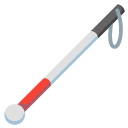


Appearance varies by platform and device. Google Noto, Twemoji, and OpenMoji are open-source.