👩🏿🎨
The Emoji
Woman Artist: Dark Skin Tone
U+1F469 U+1F3FF U+200D U+1F3A8 · :woman_artist_dark_skin_tone:
Trend 58
Meaning layers
- interpretation
- Used to signal creative energy, artistic identity, or a 'main character who makes art' vibe. Often used by Black women creators to proudly claim their artistic space.
- tiktok usage
- Appears in captions like 'she's an artist and she knows it 👩🏿🎨' or in 'POV: you're a dark-skinned art girlie' content celebrating melanin and creativity.
- irony level
- 2 / 10
Platform meanings
- meaning
- Symbol of Black female creative excellence; used in art tutorials, aesthetic vlogs, and 'dark-skinned girl thriving' content.
- trend usage
- Featured in trending sounds about artistic self-expression, 'soft life as an artist' POVs, and melanin celebration challenges.
- hashtags
- #BlackArtist#MelaninArtist#DarkSkinArtGirlie#BlackCreatives#ArtistLife
- virality score
- 62 / 100
Cultural meanings
🇺🇸
Western / Gen-Z
Strongly positive symbol of Black creative excellence and representation; widely used by Gen Z to celebrate and uplift dark-skinned Black women in creative fields.
🇵🇰
Pakistan & India
Less commonly used; when used, it straightforwardly represents a female artist, though skin tone specificity is often overlooked in favor of the general artist meaning.
🌍
Middle East
Used to represent female creatives in a general sense; the dark skin tone may be associated with African diaspora communities within the region.
🌐
Global Neutral
Universally understood as representing a woman artist; the dark skin tone signals specific representation of Black or dark-skinned women globally.
🇧🇩
Bangladesh
Primarily interpreted as a generic female artist emoji; cultural awareness of skin tone representation varies among younger, globally connected users.
🇱🇰
Sri Lanka
Seen as a female artist emoji; skin tone representation resonates with some darker-complexioned Sri Lankan women who appreciate the inclusion.
🇨🇳
China
Generally interpreted as a foreign (non-Chinese) female artist due to skin tone; used in international creative contexts or when discussing African art.
🇯🇵
Japan
Seen as an international female artist; Japanese users appreciate the diversity inclusion but may not personally identify with it.
🇰🇷
South Korea
Interpreted as a non-Korean female artist; K-pop fandoms may use it when celebrating dark-skinned Black female creatives they admire.
🇹🇼
Taiwan
Used in creative communities to represent international or global diversity in the arts; appreciated for representation by globally aware users.
🇭🇰
Hong Kong
Understood in the context of global diversity conversations; used to represent African or dark-skinned female artists in international art discussions.
🇵🇭
Philippines
Appreciated by some Filipinos with darker skin tones (morena) as a form of colorism-defying representation; also used generally for female artists.
🇮🇩
Indonesia
Used to represent female artists in a general sense; darker-skinned Indonesian women may identify with the representation positively.
🇹🇭
Thailand
Given Thailand's beauty standards that favor lighter skin, this emoji is sometimes used in anti-colorism discussions by progressive Thai youth.
🇻🇳
Vietnam
Primarily seen as representing a foreign female artist; appreciation for the diversity representation is growing among younger, globally connected Vietnamese.
🇲🇾
Malaysia
Resonates with the Indian Tamil and African diaspora communities in Malaysia; used broadly to represent female creatives of darker complexion.
🇸🇦
Saudi Arabia
Used to represent female artists in a general creative context; the dark skin tone is associated with African or Sub-Saharan African communities.
🇦🇪
UAE
Given UAE's diverse population including large African and South Asian communities, this emoji is used positively to represent dark-skinned women in creative industries.
🇪🇬
Egypt
Associated with sub-Saharan African identity; used in Egypt's growing contemporary art scene to discuss representation and diversity.
🇹🇷
Turkey
Used in diversity and inclusion conversations; resonates with Turkey's African diaspora community and progressive creative circles.
🇮🇷
Iran
Used primarily in artistic contexts; the skin tone specificity is noted in cosmopolitan creative communities engaged with global diversity discourse.
🇳🇬
Nigeria
Highly celebrated — represents the thriving Nigerian art scene and dark-skinned Black women as powerful creative forces; widely used with pride.
🇿🇦
South Africa
Deeply resonant in post-apartheid South Africa; used to celebrate Black South African women artists and resist historical exclusion from creative spaces.
🇬🇧
UK & Ireland
Strong positive usage in Black British communities and creative scenes; used to celebrate underrepresented Black women artists in UK galleries and media.
🇫🇷
France
Used in conversations about Afro-French identity and representation in French art institutions; resonates with the Black French creative community.
🇩🇪
Germany
Used in diversity discourse and by Afro-German communities; appears in conversations about representation in German arts and culture.
🇪🇸
Spain & Italy
Used to represent African diaspora women in creative fields; resonates in anti-racism and representation discussions within southern European art communities.
🇧🇷
Brazil
Powerful symbol in Brazil given its African heritage — used to celebrate Black Brazilian women artists (mulheres negras) and the Afro-Brazilian creative renaissance.
🇲🇽
Mexico
Used in discussions of Afro-Mexican identity and representation; resonates with communities in Guerrero and Oaxaca celebrating African roots.
🌎
Latin America
Broadly used across Latin America to celebrate Afrodescendant women in creative fields; tied to Afro-Latina identity movements.
🇦🇺
Australia & NZ
Used positively in Indigenous and Pacific Islander creative communities and in diversity advocacy; celebrates dark-skinned women of color in Australian arts.
How its meaning shifted
- 2010
This specific emoji did not exist in 2010; general artist representation was limited to generic, non-skin-tone-specific emojis.
- 2015
Introduced as part of Unicode 8.0 skin tone modifier rollout; initially used sparingly as users and platforms were still adjusting to diverse emoji representation.
- 2020
Gained significant traction during the Black Lives Matter movement and global conversations about representation; became a symbol of Black creative empowerment and visibility.
- 2026
Firmly established as a staple in Black women's creative identity expression online; used casually and proudly across all platforms as representation becomes normalized.
See it on every platform
Compare with
Adjacent emojis
- Opposite
- man office workersuitbriefcase
- Often confused with
- woman artist medium dark skin tonewoman singer dark skin tonewoman teacher dark skin tone
- Can replace
- palettepaintbrushsparkles
Share & embed
Frequently asked
01What does the 👩🏿🎨 Woman Artist: Dark Skin Tone emoji mean?
A woman with dark skin tone holding a paint palette and brush, representing a female artist or creative professional with dark brown/black skin tone.
02What does 👩🏿🎨 mean on TikTok?
Symbol of Black female creative excellence; used in art tutorials, aesthetic vlogs, and 'dark-skinned girl thriving' content.
03What does 👩🏿🎨 mean on WhatsApp?
Used to identify oneself or a friend as an artist or creative person with dark skin; casual identifier in group chats about hobbies.
04What does 👩🏿🎨 mean in Gen-Z slang?
Used to signal creative energy, artistic identity, or a 'main character who makes art' vibe. Often used by Black women creators to proudly claim their artistic space.
05Is the 👩🏿🎨 emoji safe to use?
Representation of a dark-skinned Black woman in a creative profession; used to celebrate artistic identity, diversity, and creative empowerment.
06What does 👩🏿🎨 mean in texting?
For users of African descent, this emoji carries significant psychological weight as representation — seeing oneself reflected in a professional creative emoji fosters a sense of belonging and affirmation in predominantly white creative spaces.
07What is the shortcode for 👩🏿🎨?
The shortcode for Woman Artist: Dark Skin Tone is :woman_artist_dark_skin_tone:
08What does 👩🏿🎨 mean in dating?
Might be dropped in DMs to signal 'I see you as a creative and intriguing person' — less overtly flirty, more admiring.
Safety & usage
- Safe meaning
- Representation of a dark-skinned Black woman in a creative profession; used to celebrate artistic identity, diversity, and creative empowerment.
- Caution
- Rarely weaponized, but could theoretically be used in a dismissive or fetishizing context; misuse is uncommon.
No significant toxic usage patterns identified. Skin tone emojis should only be used by people who identify with or are respectfully referencing that skin tone to avoid appropriation concerns.
How it looks across platforms
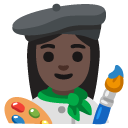


Appearance varies by platform and device. Google Noto, Twemoji, and OpenMoji are open-source.