🧗🏾♀️
The Emoji
Woman Climbing: Medium-dark Skin Tone
U+1F9D7 U+1F3FE U+200D U+2640 U+FE0F · :woman_climbing_mediumdark_skin_tone:
Trend 65
Meaning layers
- interpretation
- Used to symbolize hustle, grinding through challenges, leveling up, or refusing to quit. Often metaphorical for someone climbing their way to success or persisting through difficulties.
- tiktok usage
- Appears in motivational content, gym transformation videos, and 'glow-up' narratives. Used to signal someone is in their 'grind era' or actively working toward goals.
- irony level
- 3 / 10
Platform meanings
- meaning
- Symbol of the grind, self-improvement, and resilience. Used in workout motivation, Black girl magic content, and 'I will not give up' energy.
- trend usage
- Paired with audio tracks about perseverance. Common in #blackgirlmagic and #climbingtheladder motivational stitches and duets.
- hashtags
- #blackgirlmagic#grindmode#climbingthetop#womenempowerment#fitnessmotivation
- virality score
- 62 / 100
Cultural meanings
🇺🇸
Western / Gen-Z
Strongly associated with female empowerment and the hustle narrative. Widely used by young Black women and allies to represent resilience and ambition.
🇵🇰
Pakistan & India
Less common in everyday use but recognized in fitness and urban youth communities. May symbolize aspirational progress or literal outdoor sports among mountaineering enthusiasts.
🌍
Middle East
Relatively niche; used primarily in fitness and expat communities. May be seen as a symbol of active lifestyle, though gender representation aspects may be interpreted differently across conservative contexts.
🌐
Global Neutral
Universally understood as a representation of climbing and physical effort. Metaphorical use for perseverance and goal-pursuit translates across most global audiences.
🇧🇩
Bangladesh
Mainly used in fitness and sports contexts among urban youth. Skin tone representation resonates with some users; climbing as a sport is emerging but still niche.
🇱🇰
Sri Lanka
Used in outdoor sports circles and fitness content. The medium-dark skin tone is positively received as culturally relatable. Metaphorical empowerment use is growing among younger users.
🇨🇳
China
Used primarily in literal sports contexts, as climbing has grown significantly in popularity post-2020 Olympics. Motivational metaphor use is present in hustle culture content.
🇯🇵
Japan
Adopted in sports and fitness communities following the 2020 Tokyo Olympics, which featured sport climbing. Used earnestly to represent athletic discipline and effort.
🇰🇷
South Korea
Popular in fitness and outdoor sports content. Used in motivational contexts aligned with Korean hustle and self-improvement culture. The empowerment angle resonates with young women.
🇹🇼
Taiwan
Used in outdoor and adventure sports communities. Metaphorical use for overcoming challenges is growing among progressive youth circles.
🇭🇰
Hong Kong
Appears in fitness and outdoor recreation content. Carries some metaphorical resonance around perseverance in a politically and socially complex environment.
🇵🇭
Philippines
Used in fitness influencer content and motivational posts. Relatable skin tone representation is appreciated. Hustle narrative aligns strongly with Filipino work ethic culture.
🇮🇩
Indonesia
Used in fitness and outdoor sports contexts. The combination of female representation and skin tone resonates positively with diverse Indonesian audiences.
🇹🇭
Thailand
Appears in sports and adventure travel content. Motivational use is growing among Thai youth. Skin tone representation may carry nuanced reception given colorism discourse in the region.
🇻🇳
Vietnam
Used in fitness and outdoor content, with metaphorical empowerment use growing. Young Vietnamese women increasingly adopt it in career and self-improvement narratives.
🇲🇾
Malaysia
Recognized in fitness and outdoor recreation communities. Representation aspect appreciated by the Malay and Indian communities. Used in motivational social media content.
🇸🇦
Saudi Arabia
Used primarily in sports and fitness contexts, especially as women's participation in sports increases following social reforms. Empowerment connotation is cautiously positive.
🇦🇪
UAE
Common in cosmopolitan fitness and outdoor adventure communities. Resonates with the diverse expatriate population and increasingly with local Emirati women in sports.
🇪🇬
Egypt
Used in sports content and among urban youth in motivational contexts. Represents ambition and overcoming obstacles, which resonates with Egyptian hustle culture.
🇹🇷
Turkey
Appears in outdoor sports and fitness content. Metaphorical use for career and personal ambition is growing among young Turkish women.
🇮🇷
Iran
Used in fitness and sports communities, often among younger users who follow global trends. Female empowerment connotation carries particular significance given social restrictions.
🇳🇬
Nigeria
Strongly resonant — the combination of female representation and darker skin tone aligns with Nigerian pride and Black empowerment narratives. Widely used in motivational content.
🇿🇦
South Africa
Highly resonant across communities for its representation of Black women's strength. Used widely in empowerment content and fitness culture, particularly in urban areas.
🇬🇧
UK & Ireland
Common in fitness, outdoor sports, and women's empowerment content. The Black community specifically embraces it as a representation of ambition and resilience.
🇫🇷
France
Used in sports and outdoor recreation contexts. Among French Black communities, carries empowerment and representation significance. Generally understood metaphorically as ambition.
🇩🇪
Germany
Recognized in outdoor sports and fitness communities. Used earnestly in motivational content. Skin tone representation appreciated in diversity-forward communities.
🇪🇸
Spain & Italy
Appears in adventure sports and fitness content. Motivational metaphorical use is present among younger audiences. Skin tone representation resonates in multicultural urban communities.
🇧🇷
Brazil
Strongly adopted in fitness culture and empowerment content. Skin tone representation is particularly meaningful given Brazil's rich racial diversity and ongoing racial justice conversations.
🇲🇽
Mexico
Used in fitness and motivational content. Resonates with themes of perseverance and upward mobility that are central to many Mexican cultural narratives.
🌎
Latin America
Broadly understood as a symbol of ambition and female strength. Skin tone representation resonates across Afro-Latinx and Indigenous communities throughout Latin America.
🇦🇺
Australia & NZ
Common in outdoor adventure and fitness content. Used in empowerment and diversity contexts. Resonates strongly in Indigenous and multicultural communities.
How its meaning shifted
- 2010
This specific emoji did not exist yet. Rock climbing emojis and skin tone modifiers were not part of the Unicode standard at this time.
- 2015
Emoji with skin tone modifiers began rolling out. Climbing emojis were in early development. Women in sports representation was an emerging conversation in emoji design.
- 2020
Gained significant traction following sport climbing's Olympic debut. Used heavily in empowerment content, fitness communities, and diversity-in-outdoor-sports discussions.
- 2026
Firmly established in the fitness, empowerment, and hustle content lexicon. Frequently used in career advancement narratives, Black girl magic content, and motivational media.
See it on every platform
Adjacent emojis
- Often confused with
- person climbingman climbingwoman climbing
- Can replace
- flexed bicepsfirewoman running
Share & embed
Frequently asked
01What does the 🧗🏾♀️ Woman Climbing: Medium-dark Skin Tone emoji mean?
A woman engaged in rock climbing or bouldering activity, depicted with medium-dark skin tone. Shows a female figure scaling a wall or cliff face.
02What does 🧗🏾♀️ mean on TikTok?
Symbol of the grind, self-improvement, and resilience. Used in workout motivation, Black girl magic content, and 'I will not give up' energy.
03What does 🧗🏾♀️ mean on WhatsApp?
Sent to indicate someone is working hard, pushing through a tough task, or literally going rock climbing. Often used as encouragement like 'you've got this!'
04What does 🧗🏾♀️ mean in Gen-Z slang?
Used to symbolize hustle, grinding through challenges, leveling up, or refusing to quit. Often metaphorical for someone climbing their way to success or persisting through difficulties.
05Is the 🧗🏾♀️ emoji safe to use?
Represents athletic activity, female empowerment, perseverance, and diversity in sports. Almost entirely positive in mainstream usage.
06What does 🧗🏾♀️ mean in texting?
Climbing imagery psychologically evokes upward movement and goal-pursuit. Combined with a woman and medium-dark skin tone, it carries strong connotations of overcoming systemic barriers and self-driven achievement.
07What is the shortcode for 🧗🏾♀️?
The shortcode for Woman Climbing: Medium-dark Skin Tone is :woman_climbing_mediumdark_skin_tone:
08What does 🧗🏾♀️ mean in dating?
Rarely used in direct flirting, but may signal someone is adventurous, outdoorsy, or active — a subtle flex of an active lifestyle on a dating profile.
Safety & usage
- Safe meaning
- Represents athletic activity, female empowerment, perseverance, and diversity in sports. Almost entirely positive in mainstream usage.
- Caution
- Extremely rare negative usage. Could theoretically be used dismissively in contexts mocking someone's ambition, but this is uncommon.
No significant safety concerns. The skin tone modifier adds important representation value and is generally received positively. No known toxic meme associations.
How it looks across platforms
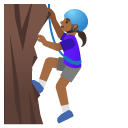
Appearance varies by platform and device. Google Noto, Twemoji, and OpenMoji are open-source.