🚵🏾♀️
The Emoji
Woman Mountain Biking: Medium-dark Skin Tone
U+1F6B5 U+1F3FE U+200D U+2640 U+FE0F · :woman_mountain_biking_mediumdark_skin_tone:
Trend 48
Meaning layers
- interpretation
- Used to signal an adventurous, outdoorsy, independent energy. Often signals 'I don't need anyone, I'm out here doing my own thing' vibes. Also used ironically when someone is barely managing their life but pretending to be thriving.
- tiktok usage
- Appears in 'that girl' aesthetic content, outdoor adventure montages, and ironically in 'me running away from my problems' trends.
- irony level
- 5 / 10
Platform meanings
- meaning
- Represents hustle culture, outdoor girl energy, and the 'that girl' wellness aesthetic. Also used humorously to depict fleeing a situation.
- trend usage
- Featured in outdoor adventure POV videos, fitness transformation stories, and ironic 'me escaping adulthood' content.
- hashtags
- #outdoorgirl#mountainbike#thatgirl#traillife#activelifestyle
- virality score
- 52 / 100
Cultural meanings
🇺🇸
Western / Gen-Z
Seen as a symbol of independence, outdoorsy empowerment, and 'main character energy.' Skin tone representation is appreciated and actively used by Black and mixed-race communities.
🇵🇰
Pakistan & India
Less commonly used in everyday chat; may appear in urban fitness communities or among women advocating for outdoor sports participation by women.
🌍
Middle East
Rare in casual use; more likely seen in progressive outdoor sports communities and by women pushing back against gender norms in recreation.
🌐
Global Neutral
Universally understood as representing a woman mountain biking with medium-dark skin tone — used in sports and fitness contexts worldwide.
🇧🇩
Bangladesh
Rarely used in daily communication; more likely to appear in sports promotion or fitness-related social media among younger urban populations.
🇱🇰
Sri Lanka
Limited casual use; more visible in content by cycling clubs or women's empowerment-focused outdoor organizations.
🇨🇳
China
Used primarily in sports and fitness contexts; skin tone specificity may be less culturally emphasized, but the athletic activity is universally appreciated.
🇯🇵
Japan
Used in outdoor sports and cycling communities; the skin tone component may be less prominent culturally, but the sporty aesthetic fits well with active lifestyle content.
🇰🇷
South Korea
Appears in active lifestyle and sports content; fits the 'healthy living' trend popular on Korean social platforms.
🇹🇼
Taiwan
Used in cycling and outdoor adventure content, fitting Taiwan's strong cycling culture; the skin tone representation is a positive inclusion signal.
🇭🇰
Hong Kong
Relevant in cycling and outdoor sports communities; appreciated in progressive spaces that value diverse representation in sport.
🇵🇭
Philippines
Used in outdoor sports communities and by women in adventure sports groups; also seen in fitness motivation content on Instagram and TikTok.
🇮🇩
Indonesia
Appears in outdoor adventure and fitness content; cycling is popular and the emoji resonates with active youth communities.
🇹🇭
Thailand
Used in cycling and outdoor sports contexts, particularly in tourist and adventure travel communities; positive association with active living.
🇻🇳
Vietnam
Found in cycling club content and fitness communities; Vietnam's growing cycling culture makes this emoji increasingly relevant.
🇲🇾
Malaysia
Used in cycling and trail communities; Malaysia's diverse population makes skin tone representation more relevant and appreciated.
🇸🇦
Saudi Arabia
Rarely used in traditional contexts; increasingly visible among young Saudi women in fitness and empowerment communities as social freedoms expand.
🇦🇪
UAE
Used in Dubai and Abu Dhabi's active lifestyle and fitness communities; fits well with the UAE's push for diverse sports participation.
🇪🇬
Egypt
Seen in fitness and outdoor sports content, particularly among urban youth; represents a progressive, active image.
🇹🇷
Turkey
Used in cycling and outdoor sports communities; fits Turkey's growing adventure tourism and fitness culture.
🇮🇷
Iran
Rarely used publicly; may appear in private or diaspora communities to express freedom, athleticism, and independence.
🇳🇬
Nigeria
Celebrated in Black fitness and outdoor communities; the medium-dark skin tone is particularly resonant and empowering in Nigerian social media spaces.
🇿🇦
South Africa
Used proudly in fitness, cycling, and outdoor adventure communities; resonates with Black South Africans in sports and empowerment contexts.
🇬🇧
UK & Ireland
Common in cycling and outdoor fitness content; the skin tone is positively recognized in diversity-conscious British social media spaces.
🇫🇷
France
Used in cycling and outdoor sports content — highly relevant given France's cycling culture; seen in empowerment and diversity conversations.
🇩🇪
Germany
Appears in outdoor sports and cycling communities; Germany's strong cycling infrastructure makes this emoji culturally relevant.
🇪🇸
Spain & Italy
Used in cycling and outdoor fitness contexts; fits the Mediterranean active lifestyle aesthetic popular on social media.
🇧🇷
Brazil
Used in fitness and outdoor adventure content; resonates strongly with Brazil's diverse population and growing cycling culture.
🇲🇽
Mexico
Appears in outdoor sports and fitness communities; increasingly used by women promoting active and adventurous lifestyles.
🌎
Latin America
Used across Latin American fitness and outdoor communities; the skin tone is relatable for many and carries positive empowerment connotations.
🇦🇺
Australia & NZ
Common in outdoor adventure, trail biking, and fitness communities; Australia and NZ's strong outdoor culture makes this emoji very relevant and well-received.
How its meaning shifted
- 2010
This specific emoji did not exist yet; mountain biking was represented generically without gender or skin tone variation.
- 2015
Basic mountain bike emoji existed but without skin tone modifiers; gender-specific variants were not yet standard in Unicode.
- 2020
Skin tone and gender variants widely adopted; used actively in representation conversations, Black fitness communities, and outdoor sports content on Instagram and TikTok.
- 2026
Strongly embedded in empowerment, representation, and outdoor fitness culture; used across platforms to celebrate diversity in adventure sports and as a general active-lifestyle signal.
See it on every platform
Adjacent emojis
- Often confused with
- woman bikingperson mountain bikingwoman cartwheeling
- Can replace
- bicyclewoman runningperson mountain biking
Share & embed
Frequently asked
01What does the 🚵🏾♀️ Woman Mountain Biking: Medium-dark Skin Tone emoji mean?
A woman riding a mountain bike, depicted with medium-dark skin tone. Represents mountain biking as a sport and outdoor recreational activity.
02What does 🚵🏾♀️ mean on TikTok?
Represents hustle culture, outdoor girl energy, and the 'that girl' wellness aesthetic. Also used humorously to depict fleeing a situation.
03What does 🚵🏾♀️ mean on WhatsApp?
Signals you're heading out for a bike ride, are busy doing something active, or are feeling energetic and free.
04What does 🚵🏾♀️ mean in Gen-Z slang?
Used to signal an adventurous, outdoorsy, independent energy. Often signals 'I don't need anyone, I'm out here doing my own thing' vibes. Also used ironically when someone is barely managing their life but pretending to be thriving.
05Is the 🚵🏾♀️ emoji safe to use?
Represents a woman of medium-dark skin tone mountain biking — a positive, empowering, and sporty emoji with no harmful connotations.
06What does 🚵🏾♀️ mean in texting?
Evokes a sense of physical liberation and self-sufficiency. Psychologically linked to achievement, autonomy, and the joy of conquering challenges — common in sport and adventure psychology.
07What is the shortcode for 🚵🏾♀️?
The shortcode for Woman Mountain Biking: Medium-dark Skin Tone is :woman_mountain_biking_mediumdark_skin_tone:
08What does 🚵🏾♀️ mean in dating?
Signals an active, outdoorsy personality. Could be used as 'I'm a catch — I'm fit and adventurous, come find me.' May also be sent after planning a date outdoors.
Safety & usage
- Safe meaning
- Represents a woman of medium-dark skin tone mountain biking — a positive, empowering, and sporty emoji with no harmful connotations.
- Caution
- No documented toxic or harmful usage patterns associated with this emoji.
No significant warnings. The skin tone modifier is an important representation tool and should be used respectfully and authentically.
How it looks across platforms
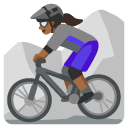
Appearance varies by platform and device. Google Noto, Twemoji, and OpenMoji are open-source.