🤾🏾♀️
The Emoji
Woman Playing Handball: Medium-dark Skin Tone
U+1F93E U+1F3FE U+200D U+2640 U+FE0F · :woman_playing_handball_mediumdark_skin_tone:
Trend 28
Meaning layers
- interpretation
- Used to flex athleticism, hustle energy, or competitive spirit. Sometimes used ironically to say 'I'm throwing this back at you' or 'not my problem anymore.'
- tiktok usage
- Appears in sports highlight captions, 'girlboss' montages, or ironically when someone is 'throwing' a situation back to someone else.
- irony level
- 4 / 10
Platform meanings
- meaning
- Signals athleticism, competitive energy, or 'I'm in my sports era' vibes.
- trend usage
- Used in workout montages, handball/sports content, girl power compilations, and 'POV: you're built different' videos.
- hashtags
- #sportsera#girlathlete#handball#competitivegirl#shesgotgame
- virality score
- 32 / 100
Cultural meanings
🇺🇸
Western / Gen-Z
Used as a symbol of athletic empowerment and girlboss energy; skin tone modifier appreciated for representation and identity expression.
🇵🇰
Pakistan & India
Handball is a growing sport but not mainstream; emoji may be interpreted generically as a sporty or active woman, appreciated in urban fitness contexts.
🌍
Middle East
Women's sports participation is increasing in visibility; this emoji can symbolize pride in female athletic achievement and modern empowerment narratives.
🌐
Global Neutral
Universally read as a woman playing handball or a generic athletic/sporty woman; the skin tone adds a layer of representation.
🇧🇩
Bangladesh
Handball is relatively unknown; emoji likely interpreted as a generic sporty woman or ball-sport player in casual digital communication.
🇱🇰
Sri Lanka
Sports emoji with a woman of darker skin tone may resonate with local athletes; interpreted as active lifestyle or sports enthusiasm.
🇨🇳
China
Handball has moderate recognition due to Olympic coverage; emoji used in sports contexts or to symbolize competitive energy among female users.
🇯🇵
Japan
Handball is part of Olympic culture in Japan; emoji appreciated for representing women's sports and used by sports fans and athletes.
🇰🇷
South Korea
South Korea has a strong handball tradition especially in women's handball; this emoji resonates deeply with fans and female athletes.
🇹🇼
Taiwan
Used in sports and fitness communities; the skin tone may prompt identity discussions around representation in Asian contexts.
🇭🇰
Hong Kong
Interpreted as a sporty, active woman; used in fitness and sports communities, with skin tone seen as a representation marker.
🇵🇭
Philippines
Sports emoji appreciated in active communities; handball less known but emoji used broadly for athletic energy and girlboss culture.
🇮🇩
Indonesia
Broadly interpreted as an active sportswoman; used in fitness groups and sports content, with growing awareness of skin tone representation.
🇹🇭
Thailand
Used in sports and wellness contexts; handball not widely played but emoji resonates as a symbol of female strength and athleticism.
🇻🇳
Vietnam
Interpreted as an athletic woman; used in sports content and fitness motivation posts, with handball gaining some recognition.
🇲🇾
Malaysia
Sporty and active connotations; used in fitness communities and women's sports advocacy content online.
🇸🇦
Saudi Arabia
As women's sports participation grows in the Kingdom, this emoji is increasingly used to celebrate female athletes and active lifestyles.
🇦🇪
UAE
Used in cosmopolitan contexts to represent active, modern women; appreciated in fitness and sports communities across the diverse population.
🇪🇬
Egypt
Handball is well-known in North Africa; emoji used in sports discussions and to celebrate women's athletic achievements.
🇹🇷
Turkey
Handball has a following in Turkey; emoji used in sports media, female athlete celebrations, and fitness motivation content.
🇮🇷
Iran
Women's sports representation is a sensitive and evolving topic; emoji may carry extra significance as a symbol of female athletic identity and aspiration.
🇳🇬
Nigeria
Sports culture is vibrant; while handball is less prominent than football, the emoji resonates as a representation of strong, competitive women.
🇿🇦
South Africa
Used in sports and fitness contexts; the medium-dark skin tone is particularly resonant for representation among South African users.
🇬🇧
UK & Ireland
Handball is growing in popularity; emoji used in sports commentary, women's athletics support, and empowerment content.
🇫🇷
France
France has a strong handball culture and is a world handball powerhouse; this emoji carries genuine sports significance and is used proudly.
🇩🇪
Germany
Germany is a handball nation; emoji widely recognized and used in sports contexts, fan communities, and women's athletics discussions.
🇪🇸
Spain & Italy
Handball has dedicated fan bases; emoji used in sports media, female athlete tributes, and competitive sports culture discussions.
🇧🇷
Brazil
More associated with football culture, but emoji used to represent active Brazilian women and growing interest in diverse sports.
🇲🇽
Mexico
Handball is niche; emoji interpreted as a general sporty woman and used in fitness, empowerment, and women's sports advocacy content.
🌎
Latin America
Broadly interpreted as an athletic, empowered woman; used across fitness and sports communities in Latin America.
🇦🇺
Australia & NZ
Sports culture is strong; emoji used in women's sports support, fitness content, and casual sports commentary.
How its meaning shifted
- 2010
Emoji did not exist yet; handball and skin-tone modifier support were not yet part of Unicode standards.
- 2015
Handball emojis were introduced in Unicode 9.0 (2016); in 2015 only basic sports emoji existed without skin tone or gender variants.
- 2020
Gained usage during COVID-era fitness content boom and the growing visibility of women in sports; used in Olympic anticipation content and female empowerment posts.
- 2026
Regularly used by Gen Z and Millennial athletes for identity expression, sports content, and representation; skin tone variants normalized and celebrated in digital communication.
See it on every platform
Adjacent emojis
- Often confused with
- woman throwing ballwoman playing basketballwoman golfing
- Can replace
- woman runningflexed bicepssports medal
Share & embed
Frequently asked
01What does the 🤾🏾♀️ Woman Playing Handball: Medium-dark Skin Tone emoji mean?
A woman with medium-dark skin tone playing handball, depicted in a throwing or jumping motion typical of the sport.
02What does 🤾🏾♀️ mean on TikTok?
Signals athleticism, competitive energy, or 'I'm in my sports era' vibes.
03What does 🤾🏾♀️ mean on WhatsApp?
Telling someone you're off to play sports or signaling you're active and busy.
04What does 🤾🏾♀️ mean in Gen-Z slang?
Used to flex athleticism, hustle energy, or competitive spirit. Sometimes used ironically to say 'I'm throwing this back at you' or 'not my problem anymore.'
05Is the 🤾🏾♀️ emoji safe to use?
Represents a woman playing handball; used in sports, fitness, and empowerment contexts.
06What does 🤾🏾♀️ mean in texting?
Signals confidence, physical agency, and pride in one's athleticism or hustle. The medium-dark skin tone modifier adds a layer of cultural representation and identity affirmation for users who identify with that tone.
07What is the shortcode for 🤾🏾♀️?
The shortcode for Woman Playing Handball: Medium-dark Skin Tone is :woman_playing_handball_mediumdark_skin_tone:
08What does 🤾🏾♀️ mean in dating?
Rarely used for direct flirting; may appear in a profile to signal an active, sporty lifestyle which can be an attractive trait signal.
Safety & usage
- Safe meaning
- Represents a woman playing handball; used in sports, fitness, and empowerment contexts.
- Caution
- Virtually no toxic usage; extremely rare edge case where 'throwing' metaphor is used aggressively.
No significant safety concerns. Skin tone modifier may occasionally invite unsolicited commentary about race representation, but this is rare.
How it looks across platforms
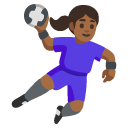
Appearance varies by platform and device. Google Noto, Twemoji, and OpenMoji are open-source.