🤾🏼♀️
The Emoji
Woman Playing Handball: Medium-light Skin Tone
U+1F93E U+1F3FC U+200D U+2640 U+FE0F · :woman_playing_handball_mediumlight_skin_tone:
Trend 28
Meaning layers
- interpretation
- Used to signal athletic energy, hustle, or 'throwing hands' metaphorically. Sometimes used when someone is in full go-mode or being competitive.
- tiktok usage
- Appears in sports content, workout motivation clips, or ironically when someone is dramatically overreacting to a situation.
- irony level
- 4 / 10
Platform meanings
- meaning
- Represents athletic hustle, sports motivation, or comedic over-exertion in everyday life.
- trend usage
- Appears in POV sports videos, workout challenges, and ironic 'main character' content.
- hashtags
- #sportsgirlera#athleticlife#girlswholift#handball#gymtok
- virality score
- 32 / 100
Cultural meanings
🇺🇸
Western / Gen-Z
Used by sporty Gen Z women to signal athletic identity or ironically in memes about overexerting energy on mundane tasks.
🇵🇰
Pakistan & India
Primarily used literally to celebrate women in sports, gaining traction as women's cricket and kabaddi visibility grows; rarely used ironically.
🌍
Middle East
Used to represent female athletes in contexts where women's sports participation is growing, often in a celebratory or empowering tone.
🌐
Global Neutral
Universally understood as a female athlete playing handball; used cross-culturally in sports contexts without significant cultural deviation.
🇧🇩
Bangladesh
Mostly used in sports-related contexts; represents a growing interest in women's athletics in the country.
🇱🇰
Sri Lanka
Used in sports community posts; the sport of handball is niche here so the emoji is often used more broadly to represent female athleticism.
🇨🇳
China
Handball is relatively niche; the emoji may be used broadly for female sports or athletic energy, particularly during Olympic seasons.
🇯🇵
Japan
Used in sports and fitness content; carries a sense of discipline and dedication aligned with Japanese athletic culture.
🇰🇷
South Korea
Associated with active, sporty lifestyles popular in K-sports culture; may be used by female athletes or fitness influencers.
🇹🇼
Taiwan
Used in sports and wellness content; represents an active, healthy lifestyle popular in Taiwanese social media.
🇭🇰
Hong Kong
Used in fitness and sports communities; sometimes adopted in motivational content about hustling and effort.
🇵🇭
Philippines
Used to celebrate female athletes; the sporty aesthetic aligns with rising fitness culture among Filipino youth.
🇮🇩
Indonesia
Represents female athleticism; used in sports content and gym culture posts, growing alongside Indonesian women's fitness trends.
🇹🇭
Thailand
Used in sports and motivational content; represents an energetic, active woman in a culture that increasingly celebrates female athletes.
🇻🇳
Vietnam
Appears in sports and fitness content; represents modern, active Vietnamese women participating in athletics.
🇲🇾
Malaysia
Used in sports and gym content; represents a sporty, active lifestyle embraced by Malaysian fitness communities.
🇸🇦
Saudi Arabia
Carries positive connotations amid a growing culture of women's sports participation following social reforms; used celebratorily.
🇦🇪
UAE
Used in a largely positive, empowering context reflecting the UAE's growing investment in women's sports and fitness culture.
🇪🇬
Egypt
Associated with female athletes and sports; used in contexts celebrating Egyptian women's achievements in competitive sports.
🇹🇷
Turkey
Used in sports communities and fitness content; represents the energetic, competitive Turkish women's sports culture.
🇮🇷
Iran
Carries nuanced meaning given social context; used in women's sports communities to express pride and support for female athletes despite restrictions.
🇳🇬
Nigeria
Used to celebrate female athletes; aligns with growing pride in Nigerian women's sports achievements on the global stage.
🇿🇦
South Africa
Used in sports and fitness contexts; represents active women and ties into the culture of sports pride in South Africa.
🇬🇧
UK & Ireland
Used in sports content and ironically in everyday British/Irish humor about 'going in hard' on something, similar to hustle memes.
🇫🇷
France
Handball is hugely popular in France; this emoji holds special cultural significance and is used with genuine sporting pride.
🇩🇪
Germany
Handball is a major sport; this emoji is used authentically in sports discussions, fan communities, and athletic content with cultural weight.
🇪🇸
Spain & Italy
Used in sports and fitness content; handball has a moderate following, and the emoji represents female athletic energy.
🇧🇷
Brazil
Used in sports and fitness content; while handball is growing, the emoji often represents general female athletic hustle in Brazilian culture.
🇲🇽
Mexico
Used in sports communities; represents active women in a fitness culture that is gaining momentum among Mexican youth.
🌎
Latin America
Broadly used to represent sporty, energetic women; handball is growing in the region and the emoji is appreciated in athletic contexts.
🇦🇺
Australia & NZ
Used in sports and gym content; carries a casual, active-lifestyle vibe consistent with Australian and Kiwi outdoor culture.
How its meaning shifted
- 2010
This specific emoji did not exist in 2010; handball and skin-tone modifier emojis were not yet part of the Unicode standard.
- 2015
The base handball emoji was introduced around this period; skin tone variants followed shortly after as diversity in emoji representation became a priority.
- 2020
Gained traction during the Tokyo Olympics buildup; used in women's sports advocacy posts and fitness content during pandemic-era home workout trends.
- 2026
Increasingly used in women's sports empowerment content, meme culture around effort and hustle, and niche TikTok fitness communities.
See it on every platform
Compare with
Adjacent emojis
- Often confused with
- woman playing water poloperson bouncing ballwoman cartwheeling
- Can replace
- woman runningflexed bicepsfire
Share & embed
Frequently asked
01What does the 🤾🏼♀️ Woman Playing Handball: Medium-light Skin Tone emoji mean?
A woman with medium-light skin tone playing handball, depicted in a throwing or jumping motion typical of the sport.
02What does 🤾🏼♀️ mean on TikTok?
Represents athletic hustle, sports motivation, or comedic over-exertion in everyday life.
03What does 🤾🏼♀️ mean on WhatsApp?
Signals someone is active, sporty, or in the middle of something physical.
04What does 🤾🏼♀️ mean in Gen-Z slang?
Used to signal athletic energy, hustle, or 'throwing hands' metaphorically. Sometimes used when someone is in full go-mode or being competitive.
05Is the 🤾🏼♀️ emoji safe to use?
Represents a female handball player or athletic woman in action; entirely positive and sport-focused.
06What does 🤾🏼♀️ mean in texting?
Evokes feelings of physicality, competitiveness, and empowerment — particularly for women in sports. Can channel the excitement of athletic achievement.
07What is the shortcode for 🤾🏼♀️?
The shortcode for Woman Playing Handball: Medium-light Skin Tone is :woman_playing_handball_mediumlight_skin_tone:
08What does 🤾🏼♀️ mean in dating?
Rarely used in flirting, but could be sent to show off an active lifestyle or athletic identity to a potential partner.
Safety & usage
- Safe meaning
- Represents a female handball player or athletic woman in action; entirely positive and sport-focused.
- Caution
- Extremely rare; could theoretically be used in contexts mocking women in sports, but this is not an established pattern.
No significant misuse patterns detected. The emoji is overwhelmingly used in wholesome, sports-positive contexts.
How it looks across platforms
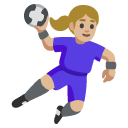
Appearance varies by platform and device. Google Noto, Twemoji, and OpenMoji are open-source.