🏃🏿♀️➡️
The Emoji
Woman Running Facing Right: Dark Skin Tone
U+1F3C3 U+1F3FF U+200D U+2640 U+FE0F U+200D U+27A1 U+FE0F · :woman_running_facing_right_dark_skin_tone:
Trend 68
Meaning layers
- interpretation
- Used to express escaping a situation, running toward something exciting, or hyping up a baddie on the move. The dark skin tone adds cultural specificity and representation pride. Often used to say 'she's that girl and she's going places.'
- tiktok usage
- Appears in 'run girl run' energy videos, POV escape content, fitness motivation clips, and Black girl excellence edits. Frequently paired with empowerment audio.
- irony level
- 4 / 10
Platform meanings
- meaning
- Symbolizes movement, escape, empowerment, and chasing goals. Used heavily in Black girl fitness content, running motivation, and 'POV you're running from your problems' humor.
- trend usage
- Paired with trending audio about confidence, survival, or dramatic escapes. Appears in stitch and duet contexts when reacting to wild situations with 'she ran.'
- hashtags
- #BlackGirlRun#RunningGirl#ShesGoing#FitnessTok#BlackGirlMagic
- virality score
- 72 / 100
Cultural meanings
🇺🇸
Western / Gen-Z
Primarily used as an empowerment symbol and escape meme. Celebrates Black women's athleticism and the cultural pride of representation in emoji design.
🇵🇰
Pakistan & India
Used in fitness contexts and empowerment messaging, though the dark skin tone may carry additional social commentary given colorism discussions in the region. Increasingly used in urban progressive communities.
🌍
Middle East
Used mainly in fitness and wellness contexts. The skin tone representation is appreciated by darker-skinned Arab and South Asian communities in the region who feel seen.
🌐
Global Neutral
Universally understood as a woman running to the right — motion, urgency, and forward progress. Skin tone modifier adds specificity without changing core meaning for most global users.
🇧🇩
Bangladesh
Used in fitness communities and by younger progressive users. The dark skin tone resonates with local complexions and is increasingly embraced as representation grows.
🇱🇰
Sri Lanka
Appreciated in fitness and wellness contexts. The dark skin tone is relatable to many Sri Lankans and is used with pride by those embracing natural skin representation.
🇨🇳
China
Primarily interpreted as a running figure for fitness or urgency content. Skin tone diversity is less culturally emphasized but is noted in global representation discussions.
🇯🇵
Japan
Used in fitness and exercise contexts, often in running or marathon communities. The directional specificity appeals to Japan's precision-oriented emoji culture.
🇰🇷
South Korea
Common in athletic and K-fitness content. The dark skin tone is noted as part of global emoji diversity, increasingly embraced in progressive online spaces.
🇹🇼
Taiwan
Used in fitness motivation and wellness content. Taiwanese social media users appreciate the directional clarity and use it in running group chats.
🇭🇰
Hong Kong
Appears in fitness posts and escape-narrative memes. Used in international-facing content that acknowledges global emoji diversity.
🇵🇭
Philippines
Popular in fitness motivation content. The dark skin tone resonates with morena pride movements and is used celebratorily by those embracing darker complexions.
🇮🇩
Indonesia
Used in sports and wellness communities. The dark skin tone connects with local skin tone diversity and is used positively by fitness influencers.
🇹🇭
Thailand
Fitness-forward usage dominates. The dark skin tone representation sparks occasional conversations about skin tone diversity given Thailand's complex relationship with colorism.
🇻🇳
Vietnam
Used in running groups and fitness content. Younger users appreciate the representation angle as global emoji diversity conversations reach Vietnamese social media.
🇲🇾
Malaysia
Common in multi-ethnic fitness communities. Embraced positively across Malay, Chinese, and Indian Malaysian communities in athletic contexts.
🇸🇦
Saudi Arabia
Used in female fitness spaces, especially after the lifting of restrictions on women's sports. The emoji is empowering for Saudi women athletes and gym-goers.
🇦🇪
UAE
Widely used in the diverse, multicultural UAE context. Resonates with South Asian and African expat communities alongside Emirati women in sports.
🇪🇬
Egypt
Used in fitness contexts and increasingly in empowerment content. Darker-skinned Egyptians and Sudanese communities in Egypt find the representation meaningful.
🇹🇷
Turkey
Applied in sports and fitness content. The directional emoji is appreciated for clarity; the skin tone adds a global diversity note increasingly discussed in Turkish digital spaces.
🇮🇷
Iran
Used primarily in fitness and movement contexts. The female figure is sometimes used symbolically in online spaces to celebrate women's freedom of movement.
🇳🇬
Nigeria
Highly resonant — the dark skin tone is celebrated as authentic representation. Used extensively in Nigerian fitness communities, Black excellence content, and empowerment messaging.
🇿🇦
South Africa
Strongly embraced across communities. The dark skin tone representation is meaningful in the post-apartheid context, used in fitness, empowerment, and celebratory cultural content.
🇬🇧
UK & Ireland
Used in fitness communities and Black British culture online spaces. The representation angle is actively discussed and celebrated in diverse UK social media communities.
🇫🇷
France
Used in fitness and empowerment contexts. Resonates with Afro-French communities who celebrate seeing darker skin tones in mainstream emoji sets.
🇩🇪
Germany
Primarily fitness-forward usage. The dark skin tone is noted in diversity and inclusion discussions, and embraced by Afro-German and Black European communities.
🇪🇸
Spain & Italy
Used in athletic and fitness content. The dark skin tone representation is celebrated by African diaspora communities in southern Europe who historically lacked digital representation.
🇧🇷
Brazil
Very popular — Brazil's deeply melanin-rich population finds the dark skin tone highly relatable. Used in fitness, Afro-Brazilian pride content, and empowerment movements.
🇲🇽
Mexico
Used in fitness and movement contexts. Resonates with Afro-Mexican communities and broader discussions of skin tone diversity in Mexican identity.
🌎
Latin America
Broadly used across Latin America in fitness contexts. The dark skin tone is particularly meaningful for Afro-Latinx communities advocating for visibility and representation.
🇦🇺
Australia & NZ
Used in fitness communities and by Indigenous, Pacific Islander, and African diaspora communities who celebrate the darker skin tone representation in digital culture.
How its meaning shifted
- 2010
This specific emoji did not exist in 2010. Running figure emojis were not yet part of Unicode and skin tone modifiers had not been introduced.
- 2015
Skin tone modifiers for emoji were introduced by Unicode in 2015, but directional running variants had not yet been created. The base running woman emoji existed without directional specificity.
- 2020
By 2020, the dark skin tone running woman was in active use across fitness communities and Black digital culture spaces. Black Lives Matter and Black excellence movements amplified representation-focused emoji usage.
- 2026
The rightward-facing variant became widely recognized. It is used across fitness, empowerment, meme, and escape-narrative contexts. Deeply embedded in Black social media culture and broadly understood by Gen Z globally.
See it on every platform
Compare with
Adjacent emojis
Share & embed
Frequently asked
01What does the 🏃🏿♀️➡️ Woman Running Facing Right: Dark Skin Tone emoji mean?
A woman running while facing to the right, depicted with dark skin tone. The rightward direction emphasizes forward motion, progress, and movement toward a goal.
02What does 🏃🏿♀️➡️ mean on TikTok?
Symbolizes movement, escape, empowerment, and chasing goals. Used heavily in Black girl fitness content, running motivation, and 'POV you're running from your problems' humor.
03What does 🏃🏿♀️➡️ mean on WhatsApp?
Usually means someone is in a hurry, running late, or literally going for a run. Also used humorously to say 'I'm out of this conversation.'
04What does 🏃🏿♀️➡️ mean in Gen-Z slang?
Used to express escaping a situation, running toward something exciting, or hyping up a baddie on the move. The dark skin tone adds cultural specificity and representation pride. Often used to say 'she's that girl and she's going places.'
05Is the 🏃🏿♀️➡️ emoji safe to use?
Represents a woman running, physical activity, empowerment, forward progress, and escape from negative situations. Broadly positive and celebratory.
06What does 🏃🏿♀️➡️ mean in texting?
Running as an emoji conveys agency and forward motion. The rightward direction psychologically reads as progress in left-to-right cultures. Combined with dark skin tone, it carries additional layers of representation and pride, resonating deeply with communities that have historically been underrepresented in digital expression.
07What is the shortcode for 🏃🏿♀️➡️?
The shortcode for Woman Running Facing Right: Dark Skin Tone is :woman_running_facing_right_dark_skin_tone:
08What does 🏃🏿♀️➡️ mean in dating?
Rarely flirtatious on its own; can be used playfully to say 'come catch me' or in a chase dynamic. Sometimes used to express excitement about running to meet someone.
Safety & usage
- Safe meaning
- Represents a woman running, physical activity, empowerment, forward progress, and escape from negative situations. Broadly positive and celebratory.
- Caution
- In rare misuse cases, could be used to mock someone for running away from consequences or responsibilities. Extremely low risk of harmful application.
No significant safety concerns. The dark skin tone modifier means it can be used insensitively if applied mockingly in racially charged contexts, but this is uncommon and not an inherent property of the emoji.
How it looks across platforms
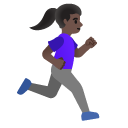
Appearance varies by platform and device. Google Noto, Twemoji, and OpenMoji are open-source.