👩🏼🎤
The Emoji
Woman Singer: Medium-light Skin Tone
U+1F469 U+1F3FC U+200D U+1F3A4 · :woman_singer_mediumlight_skin_tone:
Trend 58
Meaning layers
- interpretation
- Used to express main character energy, performing arts identity, or to signal someone who is 'that girl' — confident, artistic, and unapologetically expressive. Also used ironically when someone is being dramatic or over-the-top.
- tiktok usage
- Dropped in comment sections under dramatic videos, talent showcases, or whenever someone is giving 'pop star moment.' Often paired with 🎤 or 🌟.
- irony level
- 5 / 10
Platform meanings
- meaning
- Represents a pop star moment, artistic confidence, or theatrical self-expression. Commonly used in performance content or ironic 'I'm a star' humor.
- trend usage
- Placed in captions of lip-sync videos, POV performance trends, and 'day in the life of a pop star' content. Frequently used in audition TikToks.
- hashtags
- #WomanSinger#PopStarVibes#MainCharacter#SingerLife#MusicTikTok
- virality score
- 62 / 100
Cultural meanings
🇺🇸
Western / Gen-Z
Widely used to express main character energy, artistic confidence, and pop star aspirations. Common in ironic 'I'm literally a pop star' humor.
🇵🇰
Pakistan & India
Used to celebrate female singers like Bollywood playback singers or Coke Studio artists. Also used to hype up girls who post singing reels on Instagram.
🌍
Middle East
Used cautiously but increasingly, especially among younger urban populations celebrating Arab female artists like Fairuz tribute content or modern pop singers.
🌐
Global Neutral
Universally understood as representing a female singer or musical performer with medium-light skin, used to indicate music-related content.
🇧🇩
Bangladesh
Used in social media posts celebrating local female singers and TV talent show contestants. Associated with singing competitions like Bangladeshi Idol.
🇱🇰
Sri Lanka
Appears in posts about Sri Lankan female vocalists and used by fans of local music shows and cultural performance events.
🇨🇳
China
Used to represent female C-pop singers and idols. Common in fan edits and idol support posts on Weibo and Douyin, though skin tone specificity is less emphasized.
🇯🇵
Japan
Associated with J-pop female idols and karaoke culture. Frequently used alongside karaoke emojis in group chat planning for karaoke nights.
🇰🇷
South Korea
Tied strongly to K-pop female idol culture. Used heavily in fan accounts and posts discussing girl group members and solo female artists.
🇹🇼
Taiwan
Used in music fandom contexts and Taiwanese pop (Mandopop) discussions. Appears in fan posts for artists like A-Mei or newer gen singers.
🇭🇰
Hong Kong
Associated with Cantopop female artists and used in concert promotion posts. Resonates with fans of classic and modern HK female vocalists.
🇵🇭
Philippines
Very common in OPM (Original Pilipino Music) fan communities. Used to hype up female singers on shows like The Voice Philippines and ASAP.
🇮🇩
Indonesia
Used to celebrate Indonesian female singers and dangdut performers. Appears in fan communities for artists like Raisa, Isyana, and others.
🇹🇭
Thailand
Tied to Thai pop and lakorn (drama) music culture. Used by fans of female T-pop artists and Thai singing competition show participants.
🇻🇳
Vietnam
Used in V-pop fan communities and posts about Vietnamese female singers. Appears in comments on music show content and talent competition posts.
🇲🇾
Malaysia
Used in Malaysian music fan circles to celebrate female vocalists in Malay pop and independent music scenes.
🇸🇦
Saudi Arabia
Increasingly used by younger Saudis engaging with global pop culture, though with some cultural nuance around public female performance norms.
🇦🇪
UAE
Common in Dubai's cosmopolitan social media culture to celebrate diverse female artists at UAE-based concerts and music festivals.
🇪🇬
Egypt
Used in Egyptian music fan content celebrating female artists in Arabic pop. Associated with diva culture and theatrical musical performance traditions.
🇹🇷
Turkey
Used widely in Turkish pop music fan communities. Associated with female pop stars and music competition shows like O Ses Türkiye.
🇮🇷
Iran
Used carefully in diaspora communities and younger Iranians online to represent female musicians, with awareness of restrictions on female public performance in Iran.
🇳🇬
Nigeria
Used in Afrobeats and Afropop fan communities to celebrate Nigerian female artists like Tiwa Savage, Yemi Alade, and Tems.
🇿🇦
South Africa
Used in South African music fan communities spanning Amapiano, gospel, and pop genres to represent female vocalists and performers.
🇬🇧
UK & Ireland
Represents British and Irish female pop and indie artists. Used in commentary about X Factor/The Voice alumni and chart-topping female vocalists.
🇫🇷
France
Associated with chanson française and modern French pop female artists. Used in music commentary and concert post captions.
🇩🇪
Germany
Used in German music fan contexts and Schlager music communities, as well as mainstream pop fan circles celebrating female performers.
🇪🇸
Spain & Italy
Tied to flamenco, Latin pop, and Italian cantautrice (singer-songwriter) culture. Used to celebrate passionate and expressive female vocalists.
🇧🇷
Brazil
Associated with Brazilian female sertanejo, pagode, and pop artists. Hugely popular in fan communities celebrating artists like Anitta and Marília Mendonça.
🇲🇽
Mexico
Used to celebrate female ranchera, banda, and pop singers. Associated with powerful female vocal traditions and artists like Paquita la del Barrio and modern pop stars.
🌎
Latin America
Broadly used across Latin America to represent female musical talent, from reggaeton to salsa to indie pop, often with celebratory and empowering connotations.
🇦🇺
Australia & NZ
Used in Australian and New Zealand music fan communities, pub karaoke culture references, and celebration of female artists at festivals like Splendour in the Grass.
How its meaning shifted
- 2010
This specific emoji did not exist yet — profession emojis with skin tone modifiers were not part of Unicode until later. General music emoji use was limited to 🎵 and 🎤.
- 2015
The base singer emoji was introduced around this era but skin tone variants were still being rolled out. Early use was literal — indicating someone is a singer.
- 2020
Became widely adopted as part of the 'main character energy' trend. Used in TikTok-driven pop star content and K-pop/stan culture emoji sets.
- 2026
Integrated into AI-generated music content promotion, used alongside virtual artist branding, and embedded in music streaming social features. Ironic use has normalized alongside sincere usage.
See it on every platform
Adjacent emojis
- Often confused with
- woman artistwoman in tuxedoperforming arts
- Can replace
- microphonemusical notesstar
Share & embed
Frequently asked
01What does the 👩🏼🎤 Woman Singer: Medium-light Skin Tone emoji mean?
A woman with medium-light skin tone depicted as a singer or performer, often shown with a microphone and rockstar-style hair or clothing.
02What does 👩🏼🎤 mean on TikTok?
Represents a pop star moment, artistic confidence, or theatrical self-expression. Commonly used in performance content or ironic 'I'm a star' humor.
03What does 👩🏼🎤 mean on WhatsApp?
Sent to hype up a friend before a performance or karaoke night. Also used when someone shares a singing voice note.
04What does 👩🏼🎤 mean in Gen-Z slang?
Used to express main character energy, performing arts identity, or to signal someone who is 'that girl' — confident, artistic, and unapologetically expressive. Also used ironically when someone is being dramatic or over-the-top.
05Is the 👩🏼🎤 emoji safe to use?
Represents a female singer or musical performer. Used to celebrate music, artistic expression, confidence, and performance culture.
06What does 👩🏼🎤 mean in texting?
The emoji taps into the human desire for self-expression and recognition. It symbolizes creative courage — the act of standing on a stage and being seen, which carries both vulnerability and empowerment.
07What is the shortcode for 👩🏼🎤?
The shortcode for Woman Singer: Medium-light Skin Tone is :woman_singer_mediumlight_skin_tone:
08What does 👩🏼🎤 mean in dating?
Sent to signal 'I'm talented and worth your attention' or used playfully when someone sings something in a voice note. Can mean 'I'm putting on a show just for you.'
Safety & usage
- Safe meaning
- Represents a female singer or musical performer. Used to celebrate music, artistic expression, confidence, and performance culture.
- Caution
- Rarely used in toxic contexts, but can be deployed sarcastically to dismiss someone as performative, attention-seeking, or dramatic rather than authentic.
Generally very safe. In some conservative cultural contexts, the depiction of a woman in a performance role could be considered inappropriate if shared without context.
How it looks across platforms
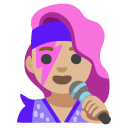


Appearance varies by platform and device. Google Noto, Twemoji, and OpenMoji are open-source.