🦹🏻♀️
The Emoji
Woman Supervillain: Light Skin Tone
U+1F9B9 U+1F3FB U+200D U+2640 U+FE0F · :woman_supervillain_light_skin_tone:
Trend 78
Meaning layers
- interpretation
- The chaotic, unbothered, morally ambiguous 'villain era' persona — owning your flaws, ruthlessness, or selfish phase without apology. Used to signal being in your villain arc.
- tiktok usage
- Captioned under 'villain era' content where someone embraces setting boundaries, cutting off people, or doing something purely for themselves. Common in 'POV: you're the villain' trends.
- irony level
- 6 / 10
Platform meanings
- meaning
- Emblem of the 'villain era' — used in videos where creators embrace cutting people off, thriving post-heartbreak, or doing something morally grey but satisfying.
- trend usage
- Appears in #villainera, #villainarc, #maincharacterenergy, #unbothered, and 'POV you finally became the villain' trending audio mashups.
- hashtags
- #villainera#villainarc#unbothered#poviamthevillain#darkera
- virality score
- 82 / 100
Cultural meanings
🇺🇸
Western / Gen-Z
The definitive 'villain era' emoji — widely used across the US, Canada, and Western Europe by Gen Z to own the antagonist identity without guilt. Deeply embedded in TikTok-driven self-empowerment culture.
🇵🇰
Pakistan & India
Used by urban, social-media-savvy youth to express a bold, dramatic personality shift — often captioned as 'villain mode on.' In Bollywood fandom contexts, associates with fierce female antagonist characters.
🌍
Middle East
Used primarily by younger, socially active users to express confidence and a no-nonsense attitude. Less common in conservative contexts but popular among Arab Gen Z on Instagram and Snapchat.
🌐
Global Neutral
Universally readable as a female villain or someone embracing a bold, powerful, and slightly dangerous persona. Skin tone modifier may shift relatability by region.
🇧🇩
Bangladesh
Emerging usage among urban youth and social media influencers as a symbol of confidence and stepping outside traditional expectations. Associated with Bangladeshi drama fandoms and strong female characters.
🇱🇰
Sri Lanka
Relatively niche; used mainly among younger social media users and K-drama/anime fans to reference villainous female characters. Growing in use as 'villain era' trends spread via TikTok.
🇨🇳
China
Less common due to emoji usage culture differences, but appears in younger communities on Weibo and Douyin. Aligns with '大女主' (strong female protagonist/antagonist) tropes popular in Chinese drama.
🇯🇵
Japan
Used in anime and manga fan communities to reference 'villain' female characters (悪役). Also appears in role-play communities and among users who follow Western social media trends.
🇰🇷
South Korea
Resonates strongly in K-drama fan culture where the 'villain female lead' is a beloved trope. Used on KakaoTalk and Twitter by fans celebrating morally complex female characters.
🇹🇼
Taiwan
Used among younger Taiwanese users who follow global social media trends. Associated with drama fandom and the growing 'dark feminine' aesthetic movement on Instagram and TikTok Taiwan.
🇭🇰
Hong Kong
Urban youth use this in a playful, self-aware way — often combined with Cantonese slang for someone who is sharp, cunning, or unapologetically bold.
🇵🇭
Philippines
Highly popular in Filipino social media — tied to teleserye villain appreciation and 'kontrabida' culture. Used to celebrate iconic female villains and own a 'savage' persona.
🇮🇩
Indonesia
Used by younger Indonesians on TikTok and Instagram to signal a bold personality or 'villain arc.' Often linked to sinetron (soap opera) villain character memes.
🇹🇭
Thailand
Popular in Thai fandom and lakorn (soap opera) culture where female villain characters are iconic. Used to express sass, cunning, or being in a powerful mood.
🇻🇳
Vietnam
Growing usage among Vietnamese Gen Z, especially in TikTok communities. Connected to Vietnamese drama villain archetypes and the broader 'villain era' trend from global social media.
🇲🇾
Malaysia
Used by younger Malaysians to signal a bold, boundary-setting mood. Also appears in Malay drama fan communities celebrating 'watak jahat' (villain characters).
🇸🇦
Saudi Arabia
Used primarily in private messaging among younger women to express a fierce, unapologetic attitude. Public usage is more restrained, but the emoji is recognized among social media-savvy users.
🇦🇪
UAE
Popular in Dubai/Abu Dhabi youth culture among influencers and expat communities. Used on Instagram to signal a powerful, luxury-villain aesthetic — often paired with high-fashion content.
🇪🇬
Egypt
Used by Egyptian youth on TikTok and Twitter to express a bold, unbothered persona. Connected to memes about dramatic Egyptian female characters in films and TV.
🇹🇷
Turkey
Used in Turkish social media, particularly among fans of dizi (Turkish drama) where powerful female antagonists are beloved. Signals someone is entering their confident, uncompromising phase.
🇮🇷
Iran
Used among Iranian youth on Instagram (despite restrictions) to express a defiant, powerful female identity. The villain-coded confidence resonates as a subtle form of self-expression.
🇳🇬
Nigeria
Used widely in Nigerian social media (Twitter/X, Instagram) — associated with 'slay queen' culture, Nollywood villain characters, and the unapologetically bold Naija woman archetype.
🇿🇦
South Africa
Used in South African youth culture to celebrate a fierce, no-nonsense attitude. Connected to local pop culture references and the broader African 'baddie' aesthetic movement.
🇬🇧
UK & Ireland
Used similarly to US Gen Z culture with British ironic wit layered on top. Often deployed in dry, self-deprecating captions like 'just a little villain 🦹🏻♀️' — understatement as humor.
🇫🇷
France
Occasional usage among French youth who engage with global social media trends. The 'femme fatale' archetype maps well culturally — associated with sophisticated, dangerous elegance.
🇩🇪
Germany
Relatively straightforward usage — appears in gaming communities, comic-book fandoms, and among younger users following international social media trends. Less ironic layering than Anglophone contexts.
🇪🇸
Spain & Italy
Used by younger Spanish and Italian users in a dramatic, expressive way — fitting the culturally theatrical communication style. Often appears in posts about passionate, boundary-setting moments.
🇧🇷
Brazil
Highly popular — tied to Brazilian novela villain culture and the beloved 'vilã' archetype. Used extensively on TikTok and Instagram to celebrate bold, powerful, and charismatic female personas.
🇲🇽
Mexico
Used by Mexican youth to express a fierce, unapologetic attitude. Connected to telenovela villain appreciation and the 'mujer cabrona' empowerment discourse on social media.
🌎
Latin America
Broadly popular across Latin America where the dramatic, powerful female villain is a beloved pop culture archetype. Used to celebrate boldness, passion, and controlled chaos.
🇦🇺
Australia & NZ
Used with dry humor and casual confidence — fits Australian directness culture. Often appears in ironic captions about making ruthless but practical life choices.
How its meaning shifted
- 2010
Did not exist — Unicode 11.0 was not released until 2018. The concept of gendered, skin-tone diverse role emoji was still years away from standardization.
- 2015
Still did not exist in this form. Precursor usage involved combining 💀, 😈, or 🎭 to convey villain energy. No dedicated supervillain emoji existed.
- 2020
Newly available and gaining traction in early 'villain era' discourse emerging on TikTok. Used mainly by comic-book fans, cosplayers, and early adopters of the villain archetype trend.
- 2026
Fully embedded in mainstream Gen Z vocabulary as the definitive 'villain era' emoji. Transcends comic-book origins — now a cultural shorthand for empowerment, boundary-setting, and unapologetic self-prioritization.
See it on every platform
Adjacent emojis
- Often confused with
- woman in tuxedomagewoman vampire
- Can replace
- smiling face with hornsskullfire
Share & embed
Frequently asked
01What does the 🦹🏻♀️ Woman Supervillain: Light Skin Tone emoji mean?
A woman with light skin tone dressed as a supervillain, typically depicted with a mask and dramatic costume. This is a ZWJ sequence combining Woman, Light Skin Tone modifier, and the Supervillain emoji components.
02What does 🦹🏻♀️ mean on TikTok?
Emblem of the 'villain era' — used in videos where creators embrace cutting people off, thriving post-heartbreak, or doing something morally grey but satisfying.
03What does 🦹🏻♀️ mean on WhatsApp?
Sent to friends to signal being done with someone's nonsense or entering a bold, no-apologies phase.
04What does 🦹🏻♀️ mean in Gen-Z slang?
The chaotic, unbothered, morally ambiguous 'villain era' persona — owning your flaws, ruthlessness, or selfish phase without apology. Used to signal being in your villain arc.
05Is the 🦹🏻♀️ emoji safe to use?
Playful self-expression of confidence, boldness, and the 'villain era' empowerment trend. Widely used for harmless humor, pop culture references, and persona play.
06What does 🦹🏻♀️ mean in texting?
Taps into the Jungian 'shadow self' — the socially repressed parts of identity that society labels 'bad.' Using this emoji is a healthy, symbolic reclamation of agency and boundary-setting through the villain archetype.
07What is the shortcode for 🦹🏻♀️?
The shortcode for Woman Supervillain: Light Skin Tone is :woman_supervillain_light_skin_tone:
08What does 🦹🏻♀️ mean in dating?
Sent to signal 'I'm the dangerous one you should be warned about' as a playful, confident flirt — implies mystery, intensity, and that the sender is not easily tamed.
Safety & usage
- Safe meaning
- Playful self-expression of confidence, boldness, and the 'villain era' empowerment trend. Widely used for harmless humor, pop culture references, and persona play.
- Caution
- Rarely weaponized, but could be used to glorify genuinely harmful or manipulative behavior by framing it as a 'villain arc' — normalizing toxic actions as aesthetically cool.
Generally safe for all ages in context. Minimal risk of misuse. Parental context: may appear in teen content about cutting off friends or setting dramatic boundaries — usually healthy but worth checking the surrounding context.
How it looks across platforms
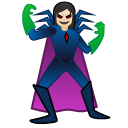
Appearance varies by platform and device. Google Noto, Twemoji, and OpenMoji are open-source.