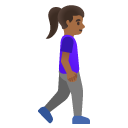
🚶🏾♀️➡️
The Emoji
Woman Walking Facing Right: Medium-dark Skin Tone
U+1F6B6 U+1F3FE U+200D U+2640 U+FE0F U+200D U+27A1 U+FE0F · :woman_walking_facing_right_mediumdark_skin_tone:
Trend 58
Meaning layers
- interpretation
- Used to convey walking away from drama, toxic situations, or bad vibes. Often symbolizes leaving something behind with purpose and confidence, especially while being a woman of color doing so unapologetically.
- tiktok usage
- Appears in 'walking away from...' trend videos, transition edits, and empowerment content where creators physically walk away from negativity or old versions of themselves.
- irony level
- 3 / 10
Platform meanings
- meaning
- Symbolizes walking away from something — bad relationships, drama, toxic workplaces, or a previous version of oneself. Used in transition videos and empowerment edits.
- trend usage
- Heavily used in 'that girl' aesthetic videos, walking montages, healing era content, and 'leaving my old life behind' narratives.
- hashtags
- #walkingaway#healingera#unbothered#glowup#maincharacter
- virality score
- 62 / 100
Cultural meanings
🇺🇸
Western / Gen-Z
Strongly associated with leaving toxic situations, unbothered energy, and female empowerment. Widely used in memes and social media storytelling.
🇵🇰
Pakistan & India
Used primarily in a literal sense for indicating movement or travel, but younger urban users adopt the 'walking away from drama' interpretation seen globally.
🌍
Middle East
Interpreted mostly literally as movement or going somewhere. Representation matters here; seeing a darker skin tone emoji may prompt discussions about diversity.
🌐
Global Neutral
Universally understood as a woman in motion, moving forward. Skin tone adds representation value across multilingual and multicultural digital spaces.
🇧🇩
Bangladesh
Primarily used in literal contexts — indicating walking, commuting, or heading somewhere. Empowerment connotations are emerging among younger social media users.
🇱🇰
Sri Lanka
Used to signal going somewhere or being on the move. The directional specificity is often appreciated in navigation-related casual messaging.
🇨🇳
China
Directional emojis are used pragmatically; this emoji signals movement or departure. The gender and skin tone aspects are noted but not always central to usage.
🇯🇵
Japan
Japanese users tend to use it literally for walking or exercise-related content. The skin tone modifier is appreciated for diversity representation.
🇰🇷
South Korea
Used casually in fitness and lifestyle content. K-beauty and wellness influencers may use it in morning walk or self-care routine posts.
🇹🇼
Taiwan
Used similarly to South Korea — mostly in lifestyle and wellness contexts, with the empowerment angle appearing among younger feminist communities online.
🇭🇰
Hong Kong
Used in casual movement contexts and increasingly in protest/activism-adjacent spaces to symbolize moving forward despite challenges.
🇵🇭
Philippines
Widely used in OFW (Overseas Filipino Worker) communities to symbolize moving abroad or leaving home for opportunity, carrying emotional weight.
🇮🇩
Indonesia
Used in everyday casual messaging to indicate being on the move. Empowerment messaging is growing among younger Indonesian women online.
🇹🇭
Thailand
Used primarily for movement and exercise contexts. The representation of darker skin tones resonates with skin-tone diversity conversations in Thai social media.
🇻🇳
Vietnam
Mostly used in practical movement contexts. Among younger Vietnamese users, it symbolizes ambition and heading toward goals.
🇲🇾
Malaysia
Used in multicultural Malaysian digital spaces to indicate movement or new beginnings. The darker skin tone is appreciated by South Asian and Malay communities.
🇸🇦
Saudi Arabia
Used carefully — mainly in literal movement or exercise contexts. Female representation in public movement can carry cultural nuance in conservative spaces.
🇦🇪
UAE
Embraced in the diverse UAE digital landscape for empowerment, movement, and new beginnings. Resonates strongly in expat and South Asian communities.
🇪🇬
Egypt
Used mostly in literal or travel-related contexts. Empowerment connotations are emerging among younger Egyptian women on platforms like TikTok.
🇹🇷
Turkey
Used casually for movement or leaving situations. Turkish Gen Z users align with global trends around the 'walking away from drama' interpretation.
🇮🇷
Iran
Used cautiously but gaining traction among young Iranian women online as a subtle symbol of independence and forward movement under social constraints.
🇳🇬
Nigeria
Strongly resonates — the medium-dark skin tone is embraced as representative. Used widely in empowerment, hustle culture, and independence content.
🇿🇦
South Africa
Celebrated for skin tone representation. Used in content about resilience, moving forward, and feminine power across South African social media communities.
🇬🇧
UK & Ireland
Used in both literal and metaphorical senses. British Gen Z uses it frequently in 'I'm out' and 'walking away from toxic things' content.
🇫🇷
France
Used in lifestyle and movement content. French social media users appreciate the diversity representation and use it in empowering narrative posts.
🇩🇪
Germany
Primarily used in practical movement contexts. Younger German users engage with the global 'walking away' meme culture around this emoji.
🇪🇸
Spain & Italy
Used in lively social contexts to signal leaving drama or heading out. Southern European users blend the literal and dramatic connotations freely.
🇧🇷
Brazil
Embraced enthusiastically — the skin tone representation resonates strongly. Used in empowerment, resilience, and 'seguindo em frente' (moving forward) content.
🇲🇽
Mexico
Used in relatable content about leaving bad situations or moving on. Resonates with themes of female independence and strength in Mexican digital culture.
🌎
Latin America
Broadly used across Latin America to signal moving forward, independence, and leaving negativity behind. The skin tone is celebrated for Afro-Latina representation.
🇦🇺
Australia & NZ
Used in casual movement contexts and empowerment narratives. Appreciated for skin tone diversity representation in increasingly multicultural digital spaces.
How its meaning shifted
- 2010
This specific emoji did not exist in 2010. Directional and skin-tone-specific emoji sequences were not yet part of Unicode, so basic walking figures were the closest equivalent.
- 2015
Skin tone modifiers were introduced in Unicode 8.0 (2015), but directional variants did not yet exist. The general woman walking emoji began appearing in limited platforms.
- 2020
By 2020, gendered and skin-tone walking emojis were widely supported. Used in fitness, travel, and lifestyle content. The 'walking away' meme usage began gaining traction.
- 2026
The directional variant (facing right) became fully mainstream. Widely used in empowerment content, Gen Z meme culture, representation discussions, and social media storytelling across all major platforms.
See it on every platform
Adjacent emojis
Share & embed
Frequently asked
01What does the 🚶🏾♀️➡️ Woman Walking Facing Right: Medium-dark Skin Tone emoji mean?
A woman walking and facing to the right, displayed with a medium-dark skin tone. This is a ZWJ sequence combining the woman walking emoji, a medium-dark skin tone modifier, and a right-facing arrow.
02What does 🚶🏾♀️➡️ mean on TikTok?
Symbolizes walking away from something — bad relationships, drama, toxic workplaces, or a previous version of oneself. Used in transition videos and empowerment edits.
03What does 🚶🏾♀️➡️ mean on WhatsApp?
Signals leaving a conversation, situation, or place. Often dropped after a disagreement to indicate the sender is done talking.
04What does 🚶🏾♀️➡️ mean in Gen-Z slang?
Used to convey walking away from drama, toxic situations, or bad vibes. Often symbolizes leaving something behind with purpose and confidence, especially while being a woman of color doing so unapologetically.
05Is the 🚶🏾♀️➡️ emoji safe to use?
A woman walking forward — used for movement, empowerment, fitness, travel, and leaving negative situations behind.
06What does 🚶🏾♀️➡️ mean in texting?
The forward-facing direction psychologically implies intentionality and progress. The female figure with a medium-dark skin tone adds layers of representation and empowerment, making it resonate strongly with communities seeking visible identity in digital spaces.
07What is the shortcode for 🚶🏾♀️➡️?
The shortcode for Woman Walking Facing Right: Medium-dark Skin Tone is :woman_walking_facing_right_mediumdark_skin_tone:
08What does 🚶🏾♀️➡️ mean in dating?
Rarely used as a direct flirt; more often used to signal 'I'm done with you' or 'I'm walking away' after a disappointing interaction or conversation.
Safety & usage
- Safe meaning
- A woman walking forward — used for movement, empowerment, fitness, travel, and leaving negative situations behind.
- Caution
- Rarely used in toxic ways; could theoretically be used to dismiss or mock someone by implying they should 'walk away' from a space.
Generally a very safe emoji. No documented patterns of harassment or harmful use. Skin tone representation makes it particularly positive in diversity and inclusion conversations.
How it looks across platforms
Appearance varies by platform and device. Google Noto, Twemoji, and OpenMoji are open-source.