👩🏾🦯➡️
The Emoji
Woman With White Cane Facing Right: Medium-dark Skin Tone
U+1F469 U+1F3FE U+200D U+1F9AF U+200D U+27A1 U+FE0F · :woman_with_white_cane_facing_right_mediumdark_skin_tone:
Trend 22
Meaning layers
- interpretation
- Used to represent navigating life blindly, moving forward despite uncertainty, or sometimes humorously for 'walking into situations without knowing what's coming.' Also used earnestly for disability pride and visibility.
- tiktok usage
- Appears in videos about blind confidence, disability awareness content, or metaphorically when someone admits they have no idea what they're doing but pressing forward anyway.
- irony level
- 3 / 10
Platform meanings
- meaning
- Used in disability awareness videos, blind confidence challenges, or sarcastically to represent cluelessness and walking into situations unknowingly.
- trend usage
- Appears in 'going in blind' challenge captions, disability pride content, and relatable humor about navigating life without a clear plan.
- hashtags
- #DisabilityPride#BlindConfidence#AccessibilityMatters#GoingInBlind#RepresentationMatters
- virality score
- 28 / 100
Cultural meanings
🇺🇸
Western / Gen-Z
Used both earnestly for disability pride representation and ironically to mean navigating life or situations without knowing what you're doing. Widely understood and respected in disability discourse.
🇵🇰
Pakistan & India
Primarily interpreted literally as representing a visually impaired woman; used in disability awareness campaigns, NGO social media, and accessibility advocacy. Metaphorical use is less common.
🌍
Middle East
Understood as a disability representation symbol; appears in accessibility awareness content and campaigns. Skin tone specificity may be noted positively for medium-dark representation.
🌐
Global Neutral
Universally recognized as representing a woman with visual impairment using a white cane, moving forward. Skin tone variant signals diversity in disability representation.
🇧🇩
Bangladesh
Used in disability awareness and social inclusion campaigns. Represents independence and mobility for visually impaired individuals. Appreciated in NGO and social welfare contexts.
🇱🇰
Sri Lanka
Appears in disability rights advocacy and social media campaigns. Recognized as a symbol of independence for visually impaired persons. Less common in casual conversation.
🇨🇳
China
Used in accessibility awareness content and discussions about disability inclusion policies. The directional facing adds a sense of purposeful movement which resonates culturally with 'moving forward' values.
🇯🇵
Japan
Interpreted respectfully as representing a person with visual impairment. Used in disability advocacy and accessibility design discussions. The white cane is a well-known symbol in Japanese public safety culture.
🇰🇷
South Korea
Used in disability awareness campaigns and K-accessibility discourse. Medium-dark skin tone may be noted in diversity and inclusion contexts. Used by disability advocates in social media.
🇹🇼
Taiwan
Appears in disability rights discussions and accessibility policy conversations. Recognized symbol for visual impairment community; used in inclusive design advocacy.
🇭🇰
Hong Kong
Used in disability advocacy posts and accessibility awareness. The directional emoji is noted for its unique forward-movement symbolism. Used in inclusive community discussions.
🇵🇭
Philippines
Used in PWD (Persons with Disabilities) advocacy content and social media campaigns. The medium-dark skin tone resonates with Filipino representation efforts in disability spaces.
🇮🇩
Indonesia
Appears in disability inclusivity campaigns and difabel (differently-abled) community content. Used by NGOs and advocates to represent independent navigation and rights.
🇹🇭
Thailand
Used in accessibility awareness and disability rights content. The white cane is recognized as a symbol of independence for visually impaired individuals in Thai public discourse.
🇻🇳
Vietnam
Used in disability awareness social media and inclusive education campaigns. Represents the growing conversation around rights and independence for visually impaired Vietnamese citizens.
🇲🇾
Malaysia
Used in OKU (Orang Kurang Upaya) community discussions and disability rights content. Recognized as a symbol of independence and mobility for visually impaired Malaysians.
🇸🇦
Saudi Arabia
Used in disability awareness campaigns, especially those aligned with Vision 2030 accessibility goals. Seen as a representation of independence and empowerment for visually impaired women.
🇦🇪
UAE
Appears in Dubai and UAE accessibility initiative posts, disability inclusion campaigns, and Expo-related diversity content. Aligns with UAE's growing focus on inclusive public spaces.
🇪🇬
Egypt
Used in disability rights and awareness content on Egyptian social media. Represents independence and dignity for visually impaired individuals. Less common in casual digital communication.
🇹🇷
Turkey
Used in engelli (disabled) rights discussions and accessibility campaigns. The directional facing is noted as symbolizing progress and forward movement, resonating with Turkish youth advocacy.
🇮🇷
Iran
Used in disability awareness content and advocacy for visually impaired rights. Recognized primarily in its literal meaning; metaphorical usage is minimal.
🇳🇬
Nigeria
Used in disability inclusion campaigns and PWD advocacy content. The medium-dark skin tone is particularly resonant for Nigerian audiences and seen as a positive representation.
🇿🇦
South Africa
Used in disability rights discussions and accessibility awareness. The medium-dark skin tone is positively noted for representation. Appears in NGO and advocacy social media content.
🇬🇧
UK & Ireland
Used in disability pride and accessibility advocacy, including Guide Dogs charity content. Also used humorously in British meme culture for 'going in completely blind' situations.
🇫🇷
France
Used in handicap awareness campaigns and accessibility rights discussions. Interpreted both as disability representation and occasionally as a metaphor for navigating without direction.
🇩🇪
Germany
Used in Behindertenrechte (disability rights) and accessibility policy discussions. Recognized as a clear symbol of visual impairment independence; used seriously in advocacy contexts.
🇪🇸
Spain & Italy
Used in disability awareness campaigns and inclusive society discussions. The directional element is appreciated for its symbolism of moving forward despite challenges.
🇧🇷
Brazil
Used in deficiência visual (visual impairment) advocacy and PCDs (Pessoas com Deficiência) rights content. The medium-dark skin tone resonates positively with Brazilian diversity discourse.
🇲🇽
Mexico
Used in discapacidad visual awareness campaigns and disability inclusion discussions. Appears in NGO content and social media advocacy for blind community rights.
🌎
Latin America
Broadly used across Latin America in disability inclusion and accessibility awareness campaigns. The medium-dark skin tone is noted positively as representative of Latin American diversity.
🇦🇺
Australia & NZ
Used in disability inclusion and NDIS-related content, as well as Guide Dogs Australia campaigns. Also used casually and humorously for 'going in blind' situations in Aussie meme culture.
How its meaning shifted
- 2010
This emoji did not exist in 2010. Disability and accessibility emojis had not yet been developed; basic smileys and objects dominated emoji vocabulary.
- 2015
Still non-existent; the push for disability representation in emoji sets was just beginning to gain traction through advocacy campaigns. Basic accessibility symbols were being discussed but not yet standardized.
- 2020
The white cane emoji variants were being introduced and adopted; directional variants and skin tone modifiers were part of the Unicode diversity expansion. Used mainly by disability advocates and representation-focused communities.
- 2026
Established in disability pride, accessibility advocacy, and inclusive representation content. Also widely used metaphorically in Gen Z humor for obliviousness and 'going in blind' scenarios across TikTok and meme culture.
See it on every platform
Adjacent emojis
Share & embed
Frequently asked
01What does the 👩🏾🦯➡️ Woman With White Cane Facing Right: Medium-dark Skin Tone emoji mean?
A woman with medium-dark skin tone using a white cane, facing right, representing a visually impaired or blind woman navigating forward.
02What does 👩🏾🦯➡️ mean on TikTok?
Used in disability awareness videos, blind confidence challenges, or sarcastically to represent cluelessness and walking into situations unknowingly.
03What does 👩🏾🦯➡️ mean on WhatsApp?
Sent when someone is navigating a situation without enough information, or in disability-related conversations about independence and mobility.
04What does 👩🏾🦯➡️ mean in Gen-Z slang?
Used to represent navigating life blindly, moving forward despite uncertainty, or sometimes humorously for 'walking into situations without knowing what's coming.' Also used earnestly for disability pride and visibility.
05Is the 👩🏾🦯➡️ emoji safe to use?
Disability representation and advocacy; independence and mobility for visually impaired individuals; forward movement and resilience.
06What does 👩🏾🦯➡️ mean in texting?
Evokes feelings of strength and determination in navigating challenges. For disabled communities it signals pride and self-sufficiency; for broader audiences it can metaphorically represent pressing forward despite lack of clarity or guidance.
07What is the shortcode for 👩🏾🦯➡️?
The shortcode for Woman With White Cane Facing Right: Medium-dark Skin Tone is :woman_with_white_cane_facing_right_mediumdark_skin_tone:
08What does 👩🏾🦯➡️ mean in dating?
Rarely used in flirting contexts. Occasionally used self-deprecatingly like 'navigating dating apps like 👩🏾🦯➡️' to mean going in completely blind.
Safety & usage
- Safe meaning
- Disability representation and advocacy; independence and mobility for visually impaired individuals; forward movement and resilience.
- Caution
- Rarely used in toxic ways; could potentially be misused to mock someone's obliviousness, but this is uncommon and generally considered insensitive.
Using this emoji mockingly or to make ableist jokes about blind people is offensive. Metaphorical use is generally acceptable when not demeaning to the visually impaired community. Context sensitivity is important.
How it looks across platforms
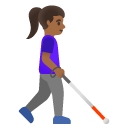
Appearance varies by platform and device. Google Noto, Twemoji, and OpenMoji are open-source.